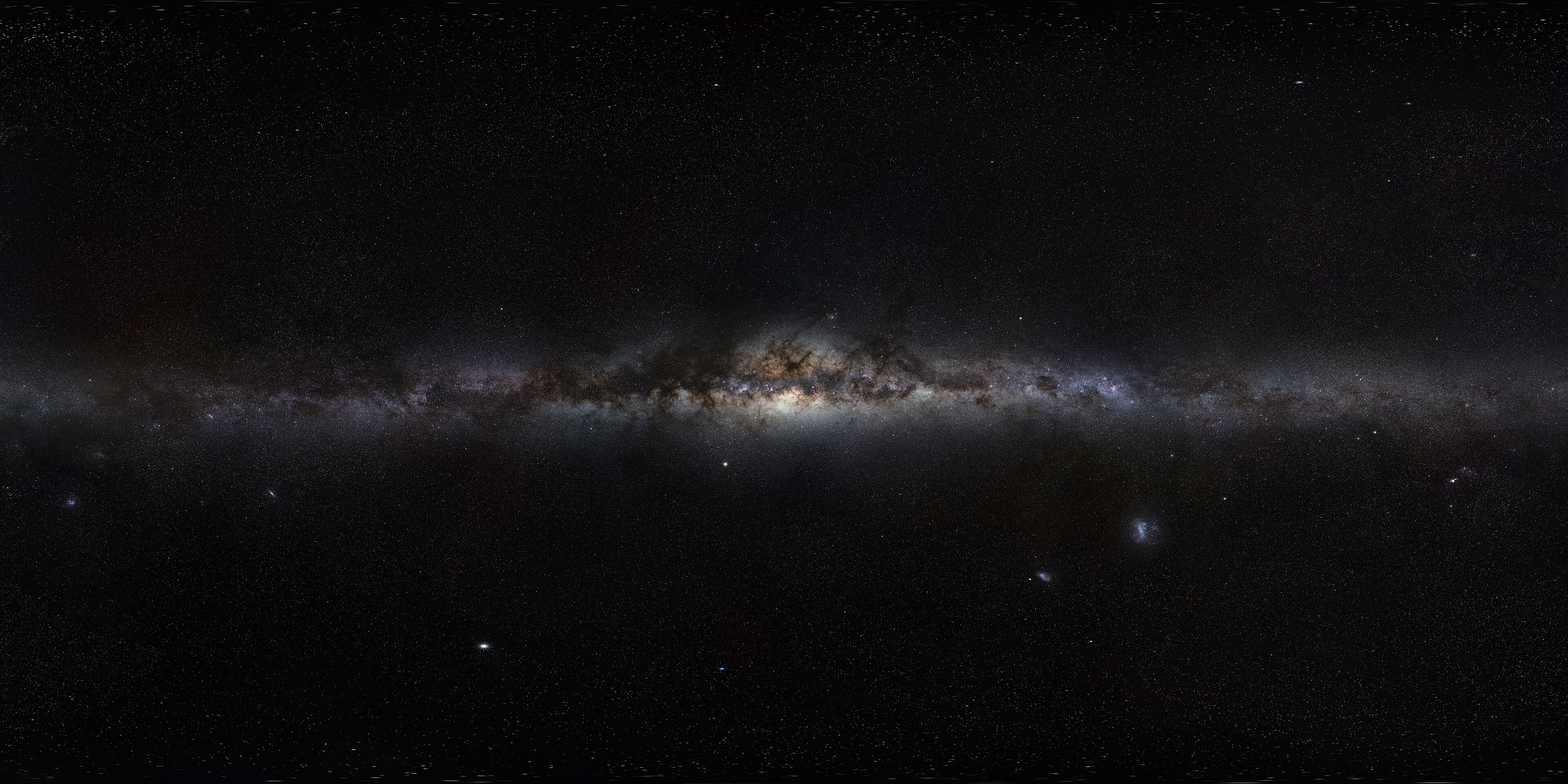

What a constellation is
For most of history a constellation was a figure: a hunter, a scorpion, a queen on her throne, traced out by joining bright stars. Astronomers now use the word in a stricter sense. Since 1922 the International Astronomical Union has recognised exactly 88 constellations, and in 1930 the Belgian astronomer Eugène Delporte drew official boundaries between them along lines of right ascension and declination. Together they tile the whole sky like the counties of a state, with no gaps and no overlaps. Every star, galaxy and nebula lies in exactly one constellation, which is why the Andromeda Galaxy is "in Andromeda" even though it is millions of times farther away than any of that constellation's stars.
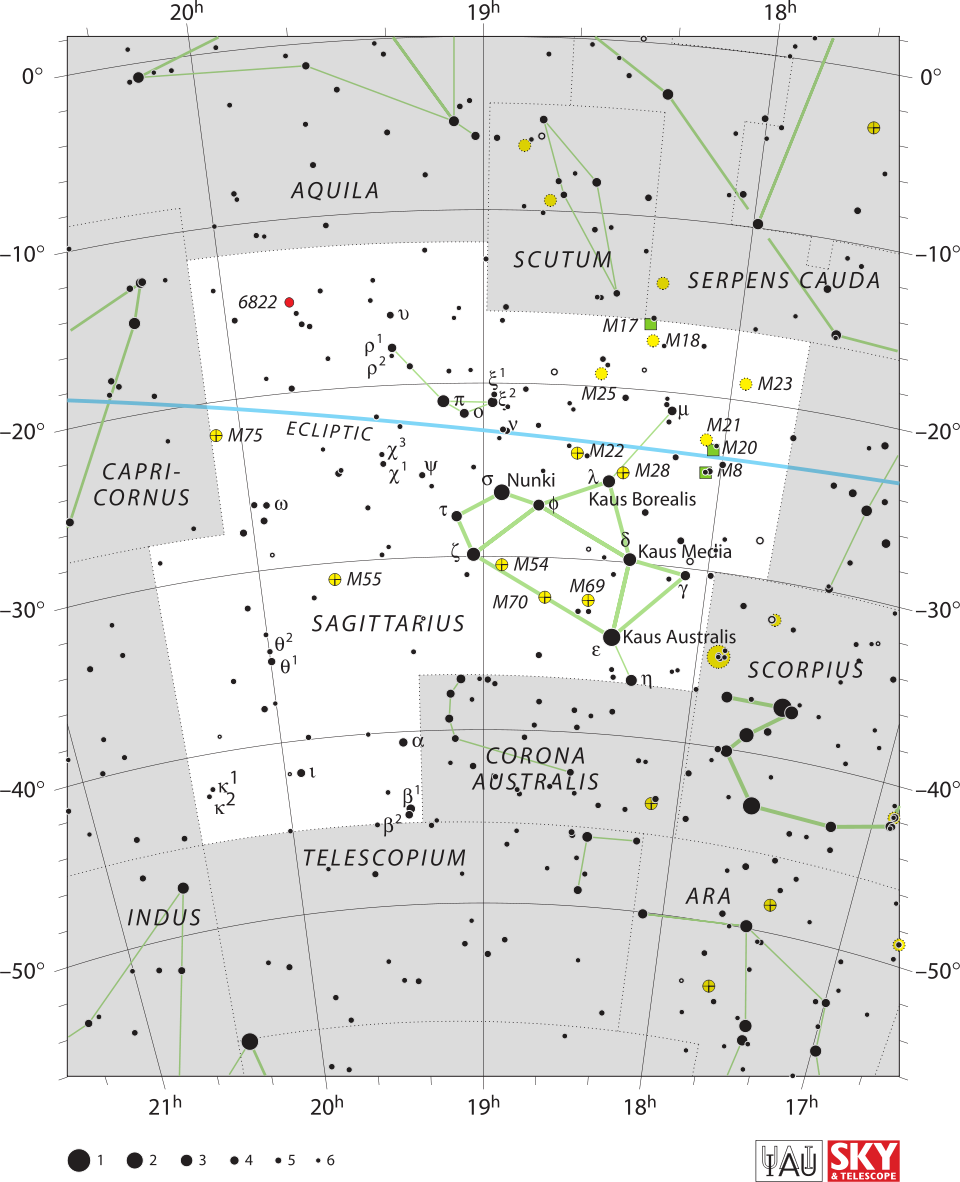
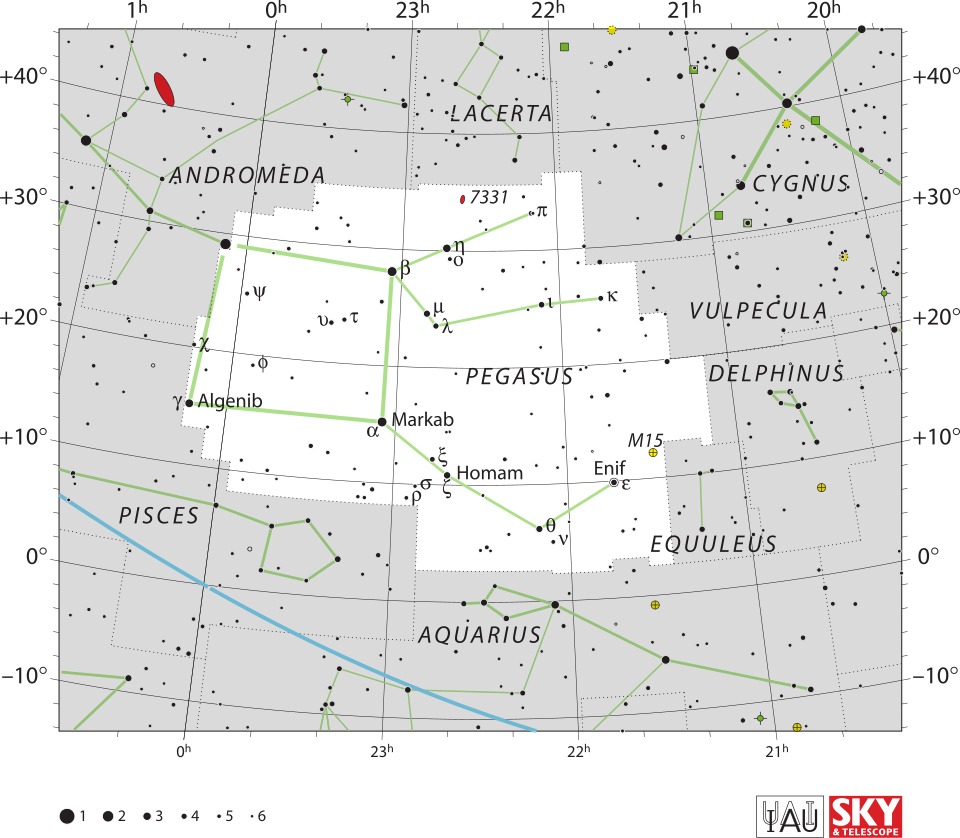
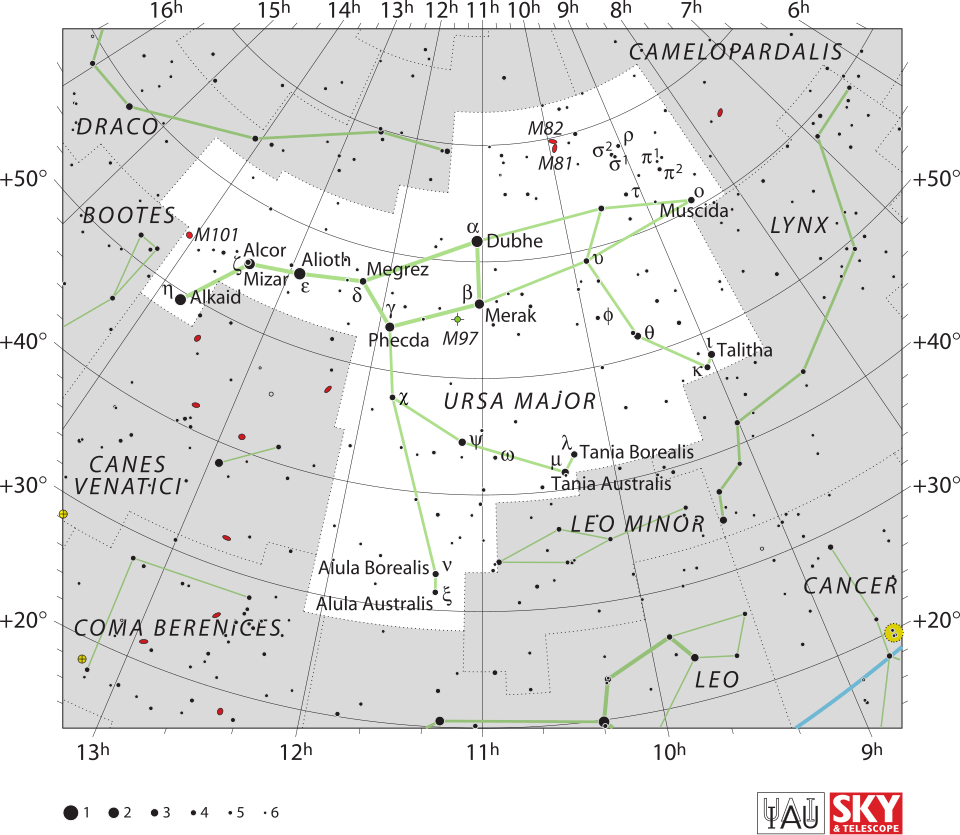
A familiar star pattern that is not one of the 88 is an asterism. The Big Dipper is the best-known example; it is part of Ursa Major, the Great Bear. The Summer Triangle, the Great Square of Pegasus, the Sickle of Leo and the Teapot of Sagittarius are others.
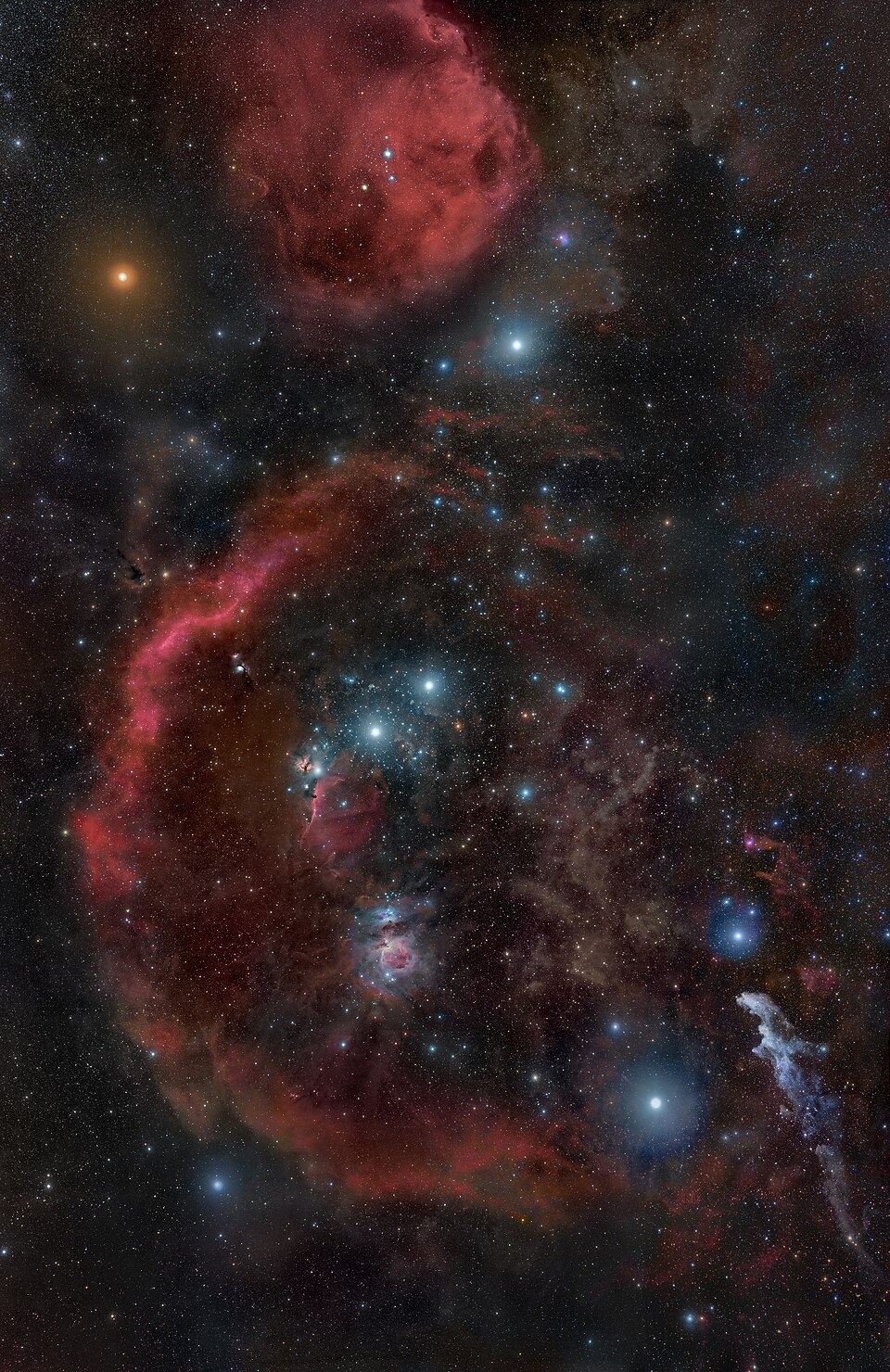
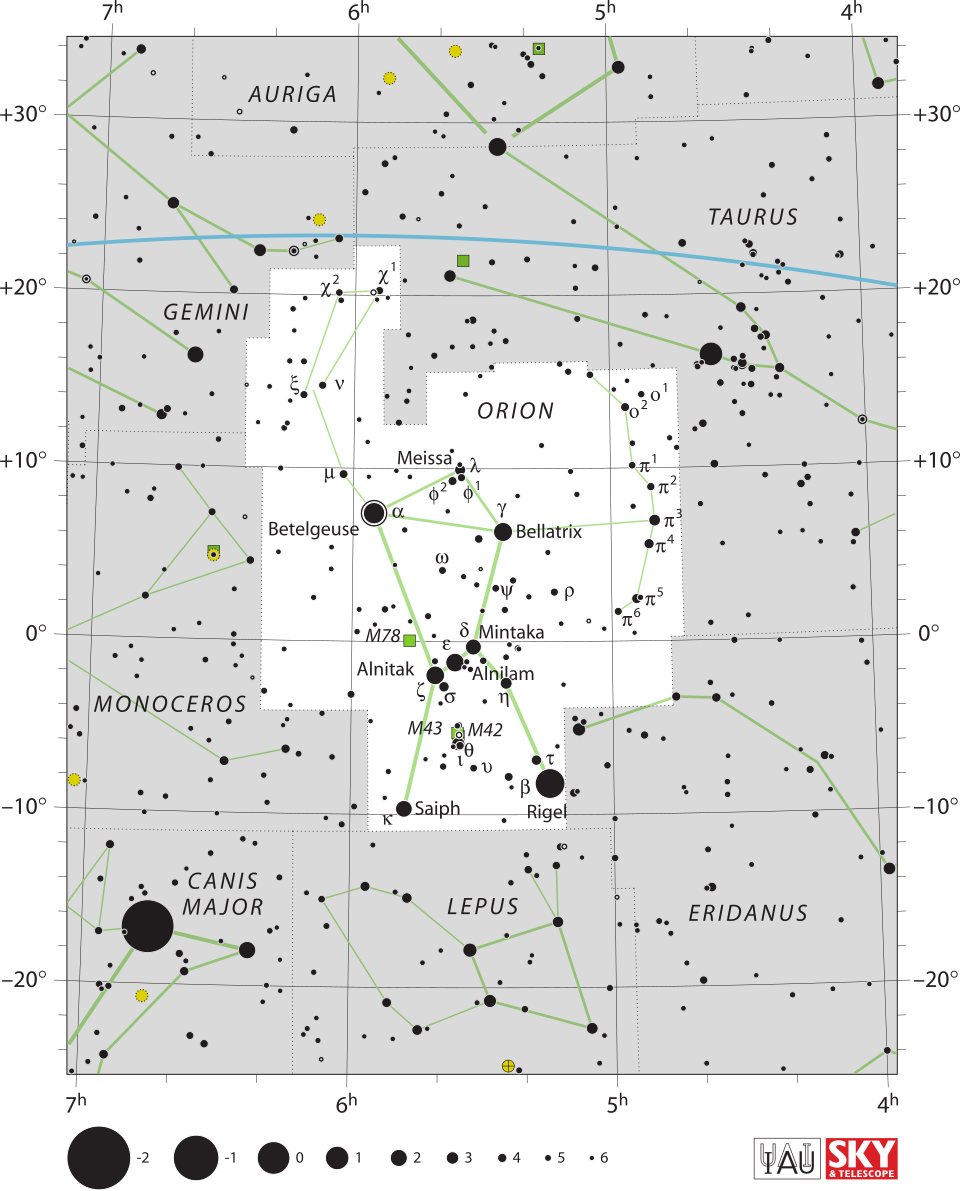
The stars of a constellation are usually not related to one another at all. They line up only from our point of view. In Orion, Bellatrix (the western shoulder) is about 250 light-years away, Betelgeuse about 550, Rigel about 860, and the belt stars well over a thousand. Seen from a planet around another star, Orion would be scrambled beyond recognition. The constellations are a map of directions, not of neighbourhoods.
Constellations vary enormously in size. The largest, Hydra the Water Snake, covers 1,303 square degrees and stretches more than a quarter of the way around the sky; the smallest, Crux, the Southern Cross, covers just 68.

Where the constellations came from
Many of the northern constellations go back to Mesopotamia. Babylonian star lists compiled around 1000 BC, known from the clay tablets called MUL.APIN, already name a bull, a lion, a scorpion and twins, and single out the constellations "in the path of the Moon". The Greeks inherited and reworked these figures, attaching their own myths: Perseus rescuing Andromeda from the sea monster Cetus while her parents Cepheus and Cassiopeia look on is one story spread across five neighbouring constellations.
Around AD 150 the astronomer Ptolemy catalogued 48 constellations in his Almagest. Those 48 formed the core of Western star maps for 1,400 years, and nearly all survive today. The largest, the ship Argo Navis, was later split into Carina (the keel), Puppis (the stern) and Vela (the sails).
Ptolemy's list covered only the sky visible from the Mediterranean. The far southern sky was charted by Europeans from the 1590s, when Dutch navigators Pieter Keyser and Frederick de Houtman recorded southern stars and the cartographer Petrus Plancius turned them into twelve new figures, including the Toucan, the Peacock and the Bird of Paradise. In the 1750s the French astronomer Nicolas-Louis de Lacaille, observing from the Cape of Good Hope, filled the remaining gaps with fourteen constellations named after the instruments of science and art: the Telescope, the Microscope, the Air Pump, the Pendulum Clock, the Painter's Easel.
Other cultures saw entirely different pictures in the same stars. In China the sky was divided into 283 smaller asterisms organised around an imperial court; many Aboriginal Australian traditions read the dark dust lanes of the Milky Way as figures, such as the Emu in the Sky. The 88 IAU constellations are the Greek-and-European tradition, adopted as an international standard.
The zodiac: the constellations behind the Sun
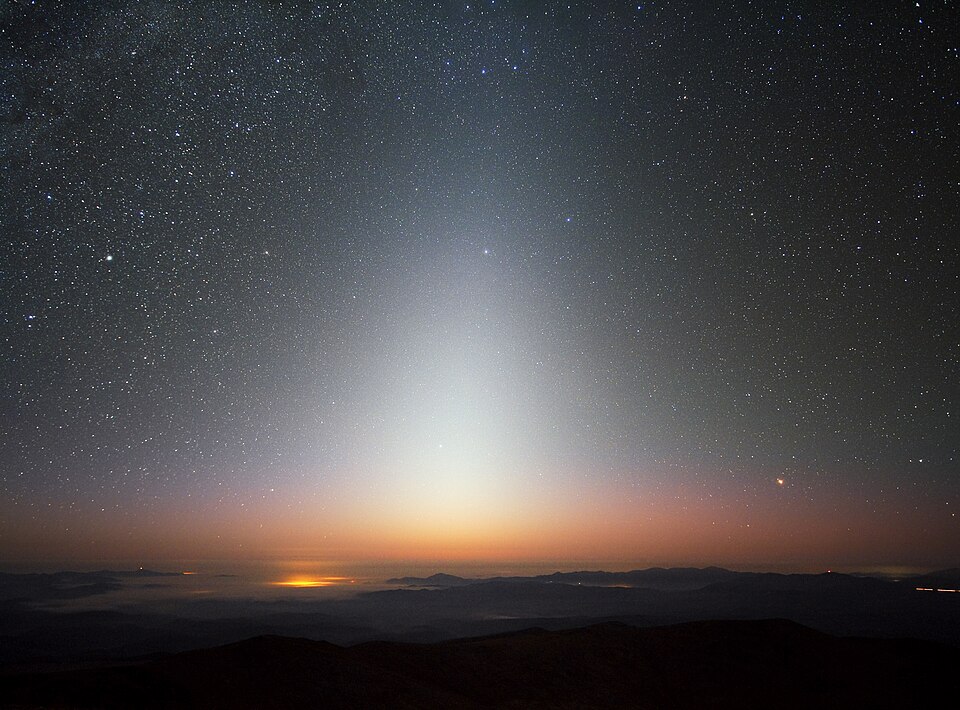
As the Earth orbits, the Sun appears to move against the background stars, completing one circuit of the sky each year along the ecliptic. We cannot see the stars behind the Sun in daylight, but ancient astronomers could work out where it stood by watching which stars vanished into the evening twilight and which reappeared before dawn.
Because the Moon and planets orbit in nearly the same plane as the Earth, they too stay close to the ecliptic. The band of sky they travel through — about 8° either side of it — is the zodiac, from the Greek for "circle of little animals". By about the 5th century BC Babylonian astronomers had divided it into twelve equal 30° sections named after the constellations they contained, to make calculating the positions of the Sun, Moon and planets easier.
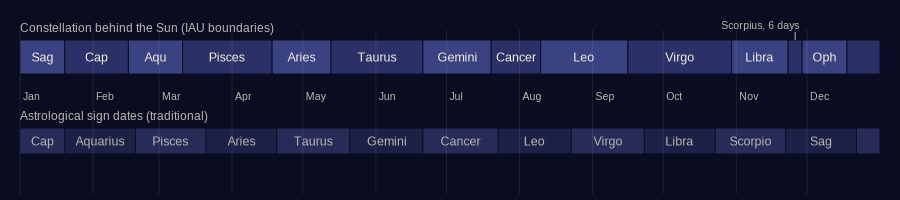
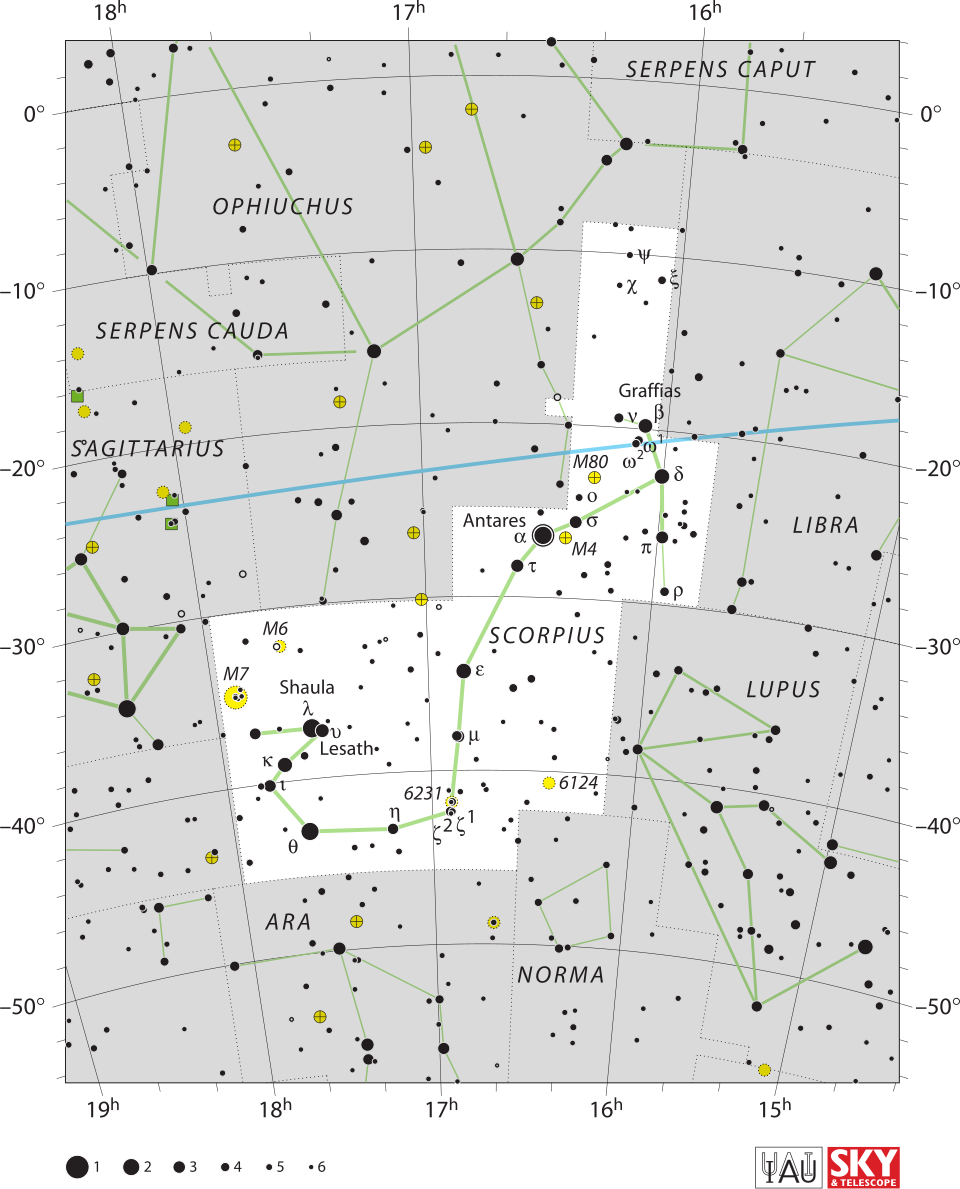
The real constellations are not equal. Along the ecliptic, Virgo spans about 44°, while Scorpius spans only about 6°. And when Delporte drew the official boundaries in 1930, the ecliptic passed through a thirteenth constellation: Ophiuchus, the Serpent Bearer, whose feet lie between Scorpius and Sagittarius. The Sun now spends only about six days in Scorpius, and about nineteen in Ophiuchus.
Precession, described on the Sky coordinates page, has shifted the whole system. The twelve signs used in astrology are measured from the March equinox, which has slid westward by almost a full constellation since the zodiac was laid out. So on your birthday the Sun is usually in the constellation before the one your traditional sign is named after. Astronomy and astrology parted ways long ago: the constellations are simply regions of the sky, and their positions have no measurable influence on events on Earth.

| Constellation | Figure | Sun is there | Days | Brightest star | Best evening sky |
|---|---|---|---|---|---|
| Aries | Ram | 18 Apr – 13 May | 25 | Hamal | Autumn |
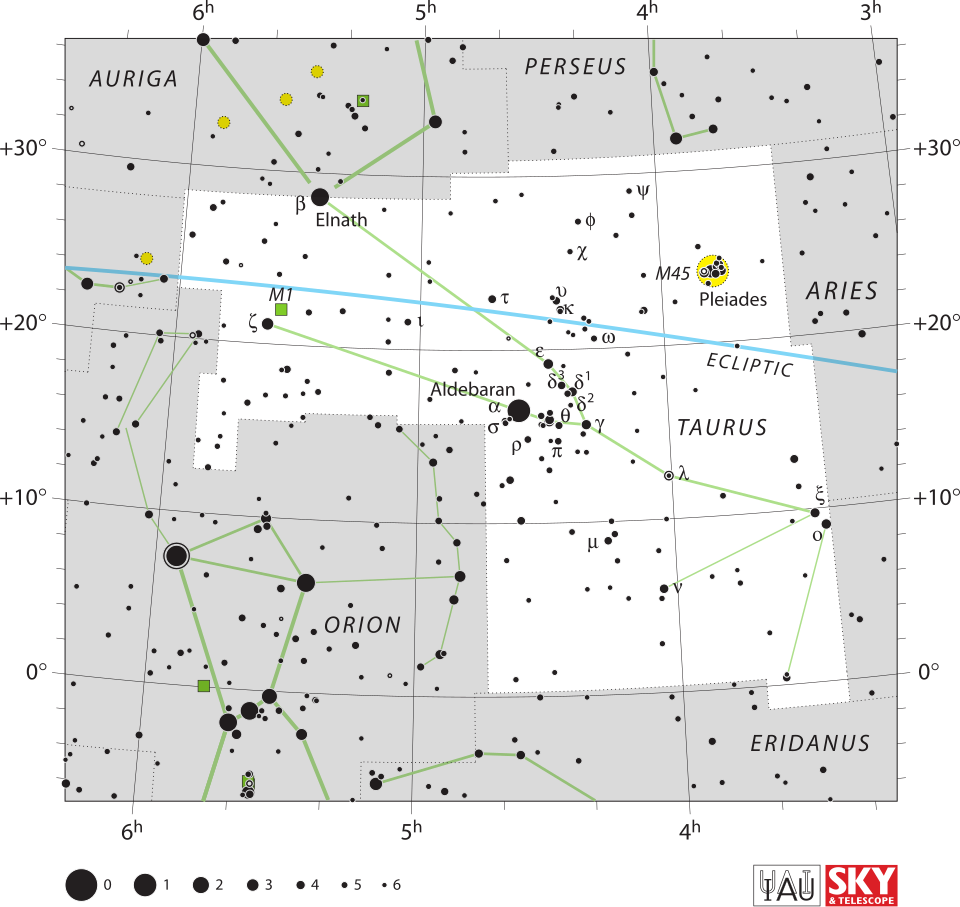
| Taurus | Bull | 13 May – 21 Jun | 39 | Aldebaran | Winter |
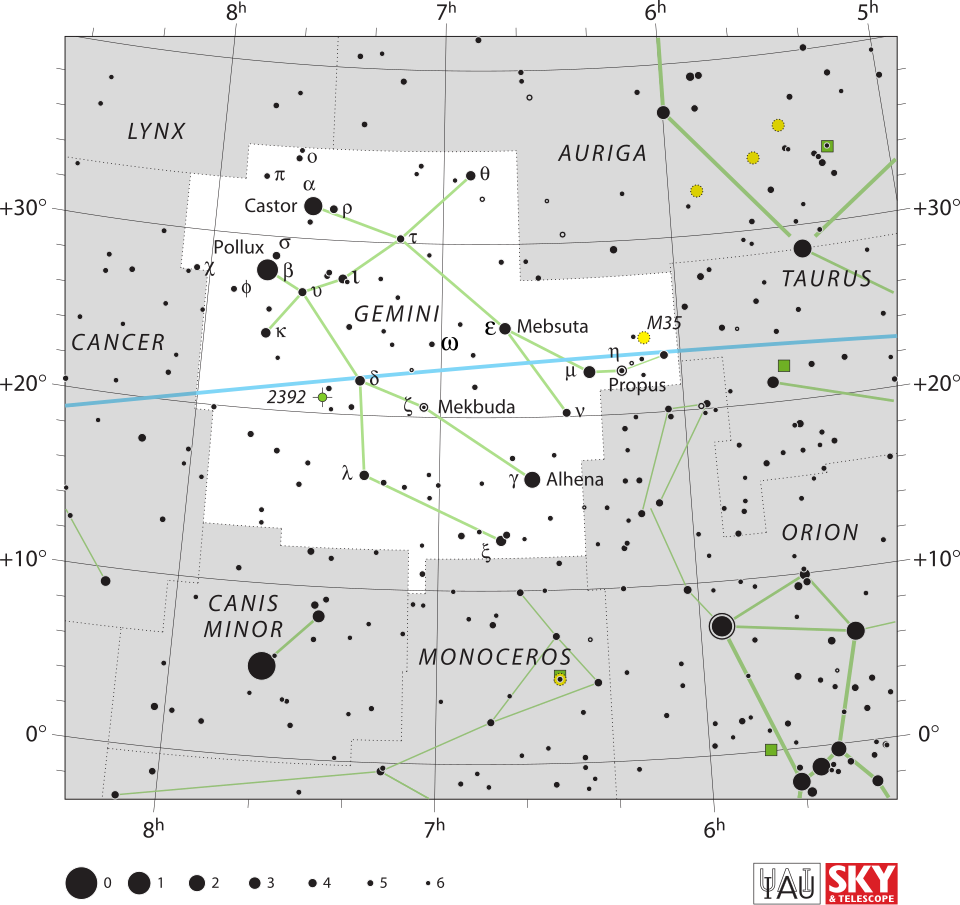
| Gemini | Twins | 21 Jun – 20 Jul | 29 | Pollux | Winter |
| Cancer | Crab | 20 Jul – 10 Aug | 21 | Al Tarf | Late winter |
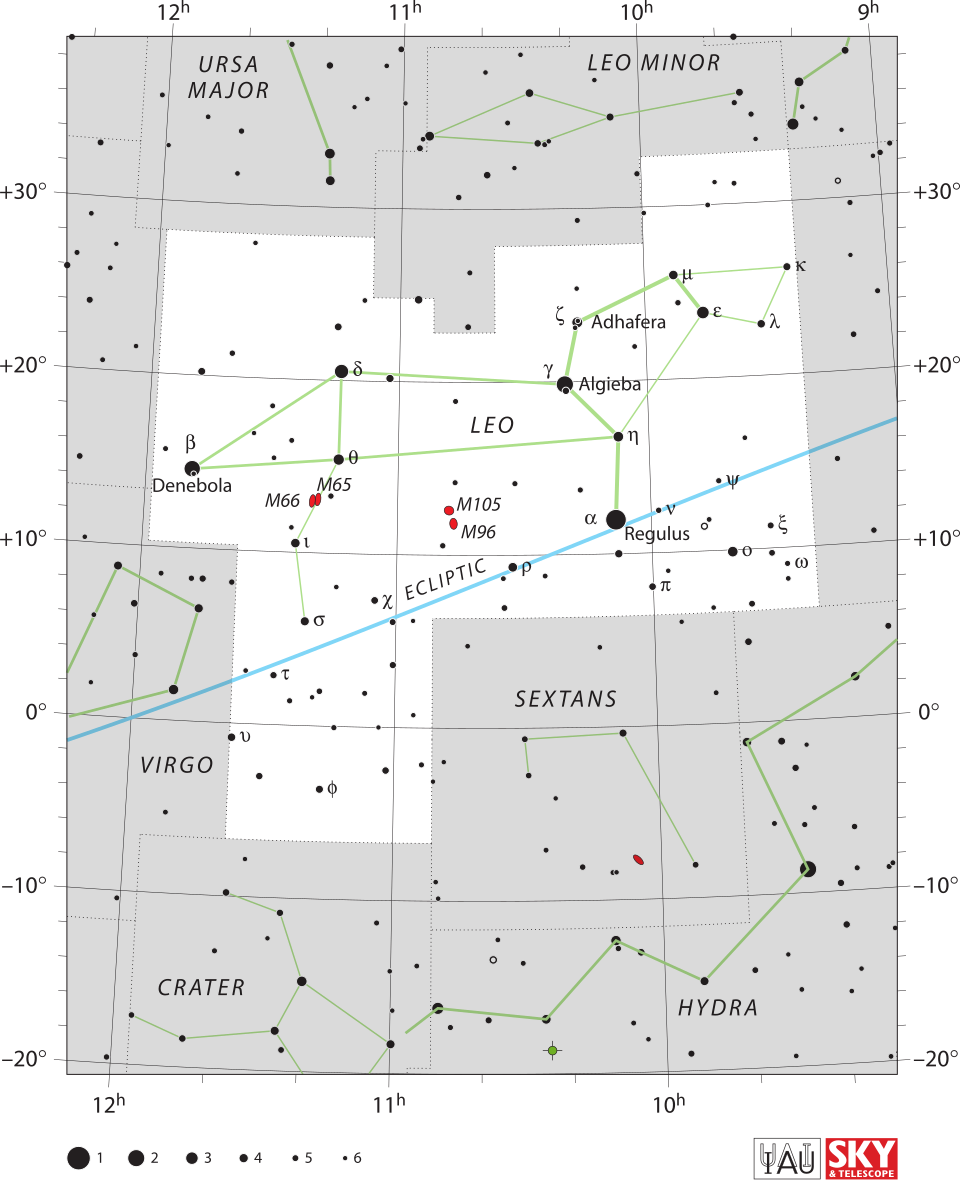
| Leo | Lion | 10 Aug – 16 Sep | 37 | Regulus | Spring |
| Virgo | Maiden | 16 Sep – 30 Oct | 44 | Spica | Spring |
| Libra | Scales | 30 Oct – 23 Nov | 24 | Zubeneschamali | Early summer |
| Scorpius | Scorpion | 23 Nov – 29 Nov | 6 | Antares | Summer |
| Ophiuchus | Serpent Bearer | 29 Nov – 18 Dec | 19 | Rasalhague | Summer |
| Sagittarius | Archer | 18 Dec – 20 Jan | 33 | Kaus Australis | Summer |
| Capricornus | Sea-goat | 20 Jan – 16 Feb | 27 | Deneb Algedi | Late summer |
| Aquarius | Water Bearer | 16 Feb – 11 Mar | 23 | Sadalsuud | Autumn |
| Pisces | Fishes | 11 Mar – 18 Apr | 38 | Alpherg | Autumn |
Why the night sky changes through the year
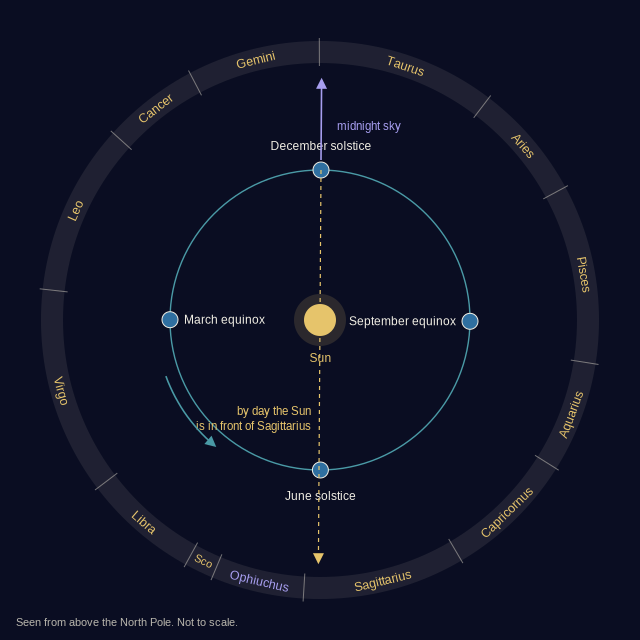
The constellations are always there, day and night, all year. What changes is which half of the sky is hidden by the Sun's glare. Whatever constellation the Sun stands in is overhead at noon and invisible. The constellation on the opposite side of the sky is highest around midnight, and it is the one that dominates that season's nights.
Follow the diagram around. In December the Earth is on the side of its orbit where the Sun appears in front of Sagittarius; looking away from the Sun at midnight, we face Taurus and Gemini, with Orion just to the south of them — the classic winter sky. Six months later the Earth is on the far side of the Sun. Now the Sun is in Taurus, hiding Orion in daylight, and at midnight we look out toward Sagittarius and Scorpius, low in the south on summer nights.
Because the stars rise about four minutes earlier each night (see sidereal time), the change is gradual: each constellation creeps westward night by night, until it disappears into the evening twilight and spends a few weeks behind the Sun before re-emerging in the dawn sky on the eastern side.
A useful rule of thumb follows: a constellation you see high in the south at about 10 pm will be in the same spot around 8 pm a month later, and around 2 am a few months earlier. So early risers can preview the next season's constellations before dawn — Orion is already up in the east before sunrise in late August.
A sky for each season
What follows is the evening sky (around 9–10 pm local time) from mid-northern latitudes such as New Jersey. Each season's sky is anchored by a few bright constellations or asterisms that make it easy to find the rest. Many of the deep-sky objects in the Gallery sit inside them.
| Season | Key constellations | Signposts | Deep-sky highlights |
|---|---|---|---|
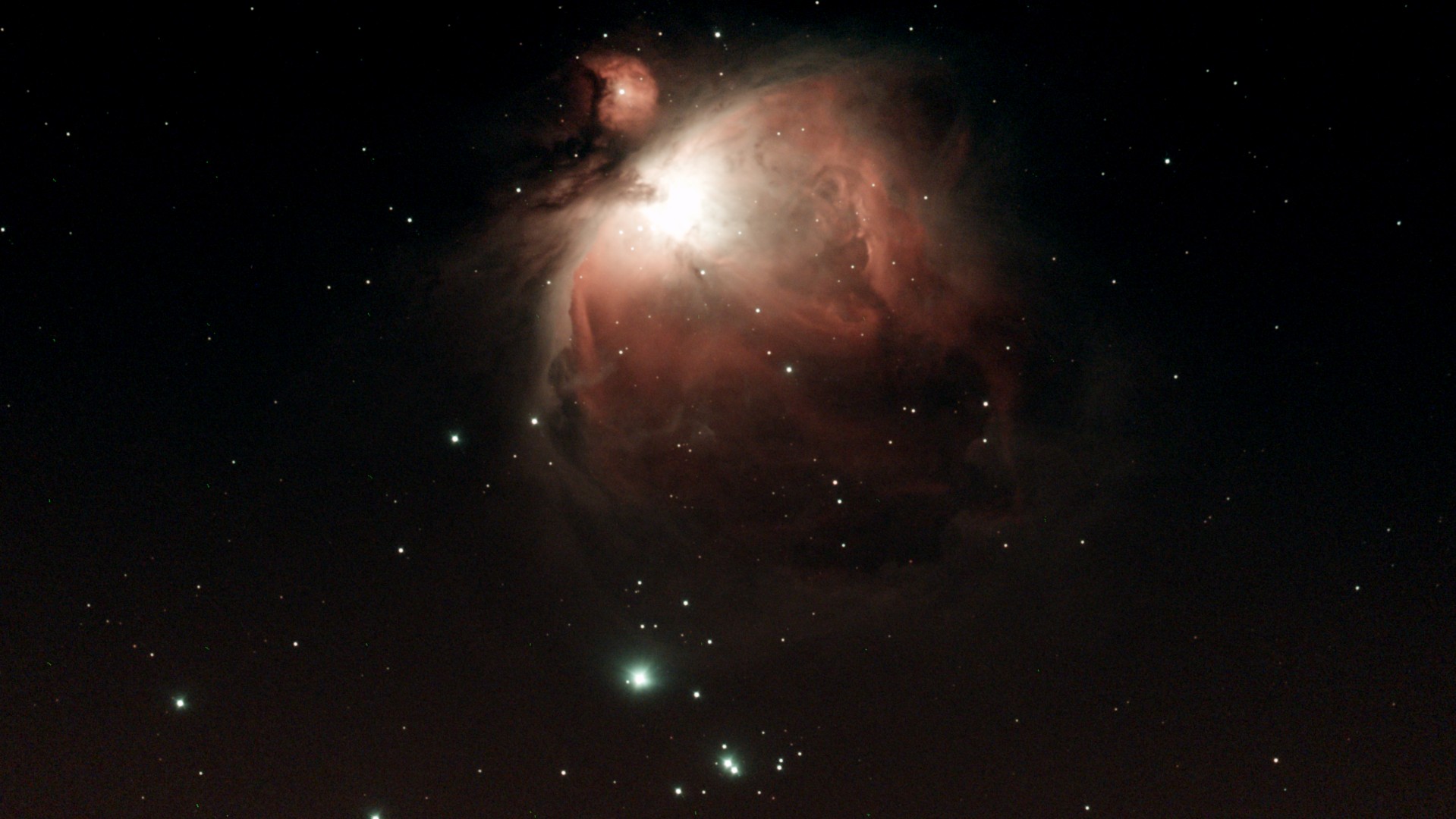
| Winter | Orion, Taurus, Gemini, Auriga, Canis Major, Canis Minor | Orion's Belt points down to Sirius, the brightest star in the night sky, and up to Aldebaran and the Pleiades. The Winter Hexagon of Sirius, Procyon, Pollux, Capella, Aldebaran and Rigel rings the sky. | Orion Nebula (M42), Pleiades (M45), Crab Nebula (M1), clusters M35–M38 |
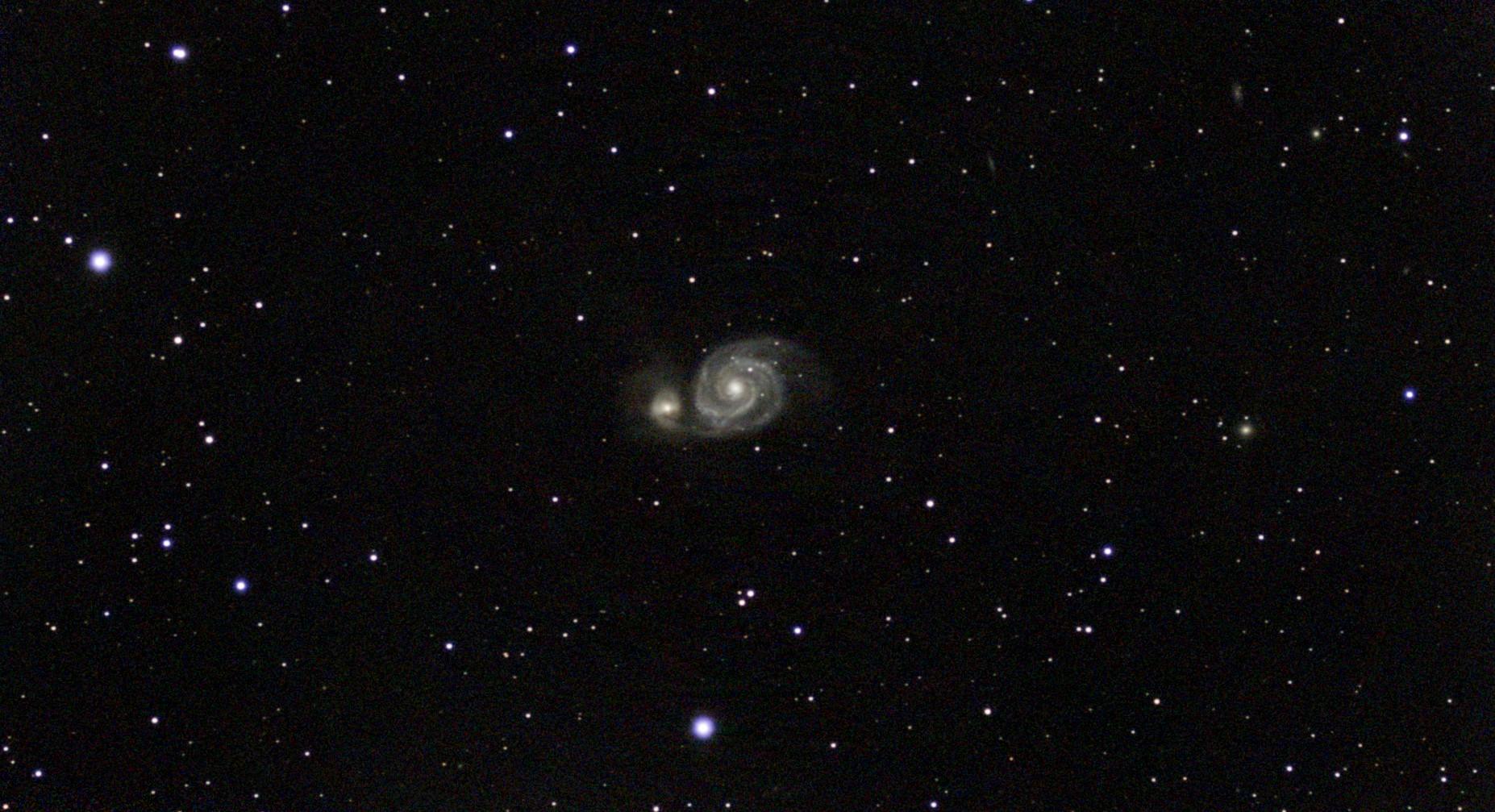
| Spring | Leo, Virgo, Boötes, Cancer, Ursa Major (high overhead) | "Arc to Arcturus, speed on to Spica": follow the curve of the Big Dipper's handle to orange Arcturus, then on to Spica in Virgo. The backward question mark of the Sickle marks Leo's head. | The Virgo galaxy cluster, Leo Triplet, Beehive Cluster (M44), Whirlpool Galaxy (M51) |
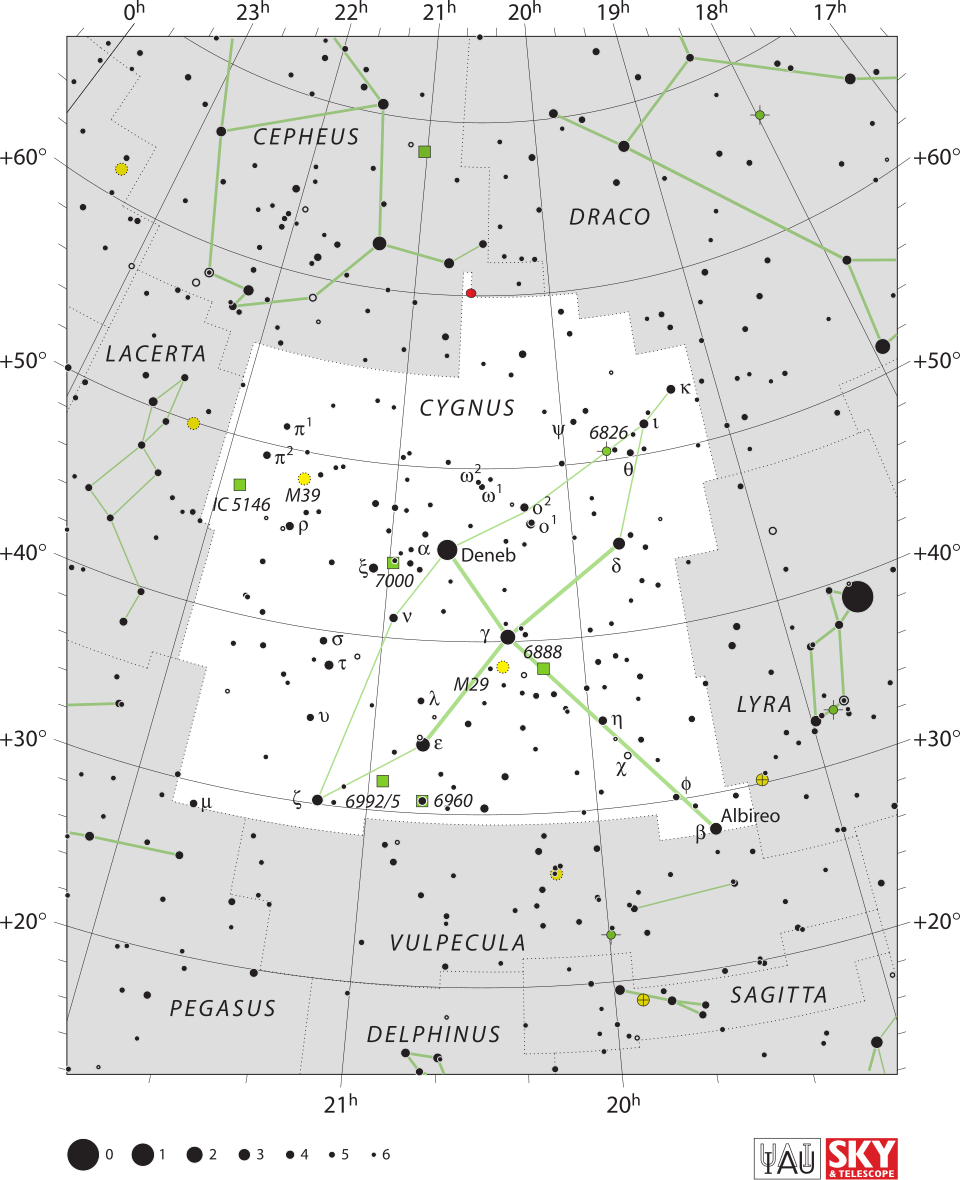
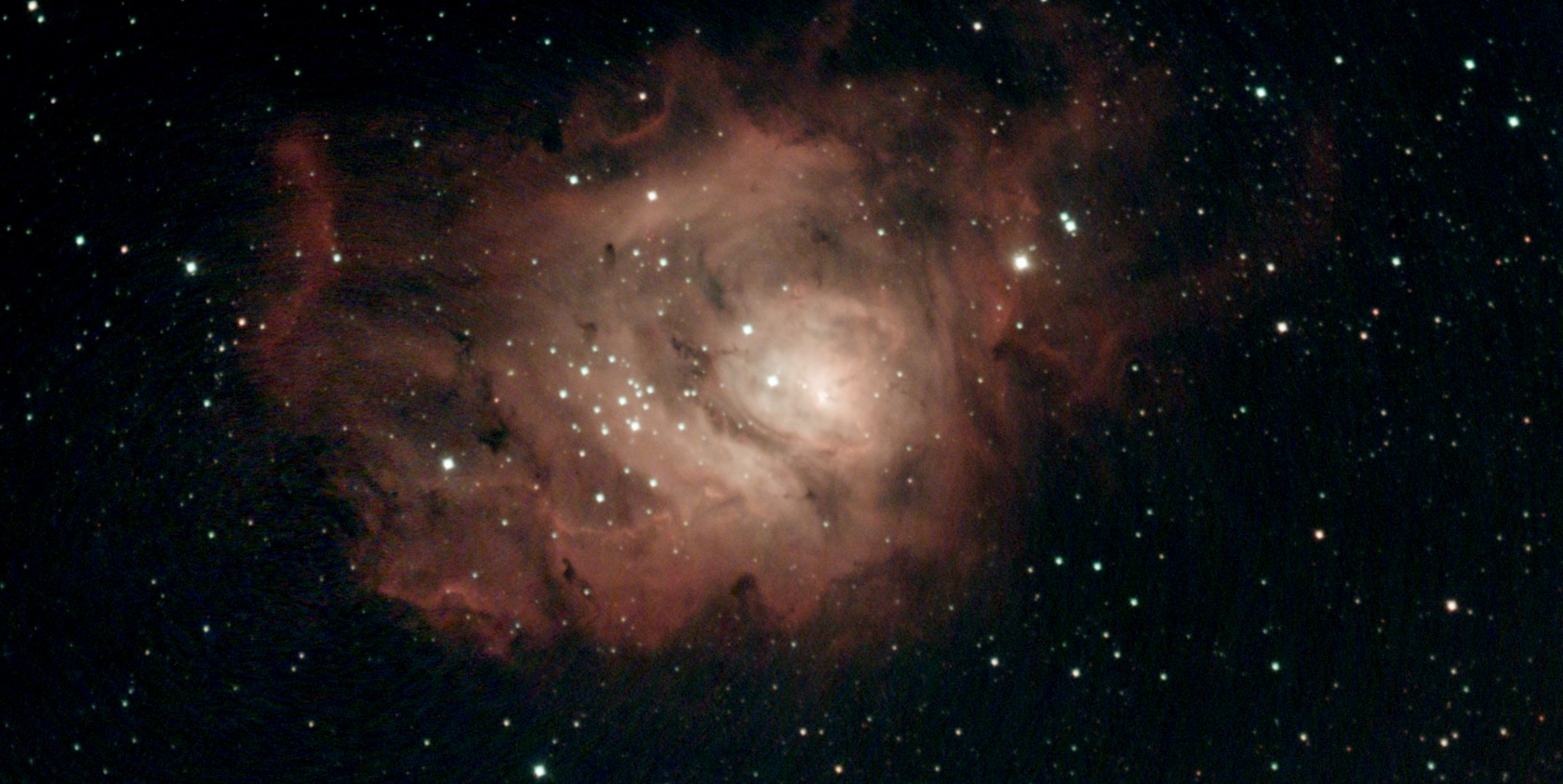
| Summer | Scorpius, Sagittarius, Lyra, Cygnus, Aquila, Hercules, Ophiuchus | The Summer Triangle of Vega, Deneb and Altair high overhead. Red Antares marks the Scorpion's heart low in the south; the Teapot of Sagittarius sits on the brightest part of the Milky Way. | Lagoon (M8), Omega (M17) and Eagle (M16) nebulae, Ring Nebula (M57), Hercules Cluster (M13) |
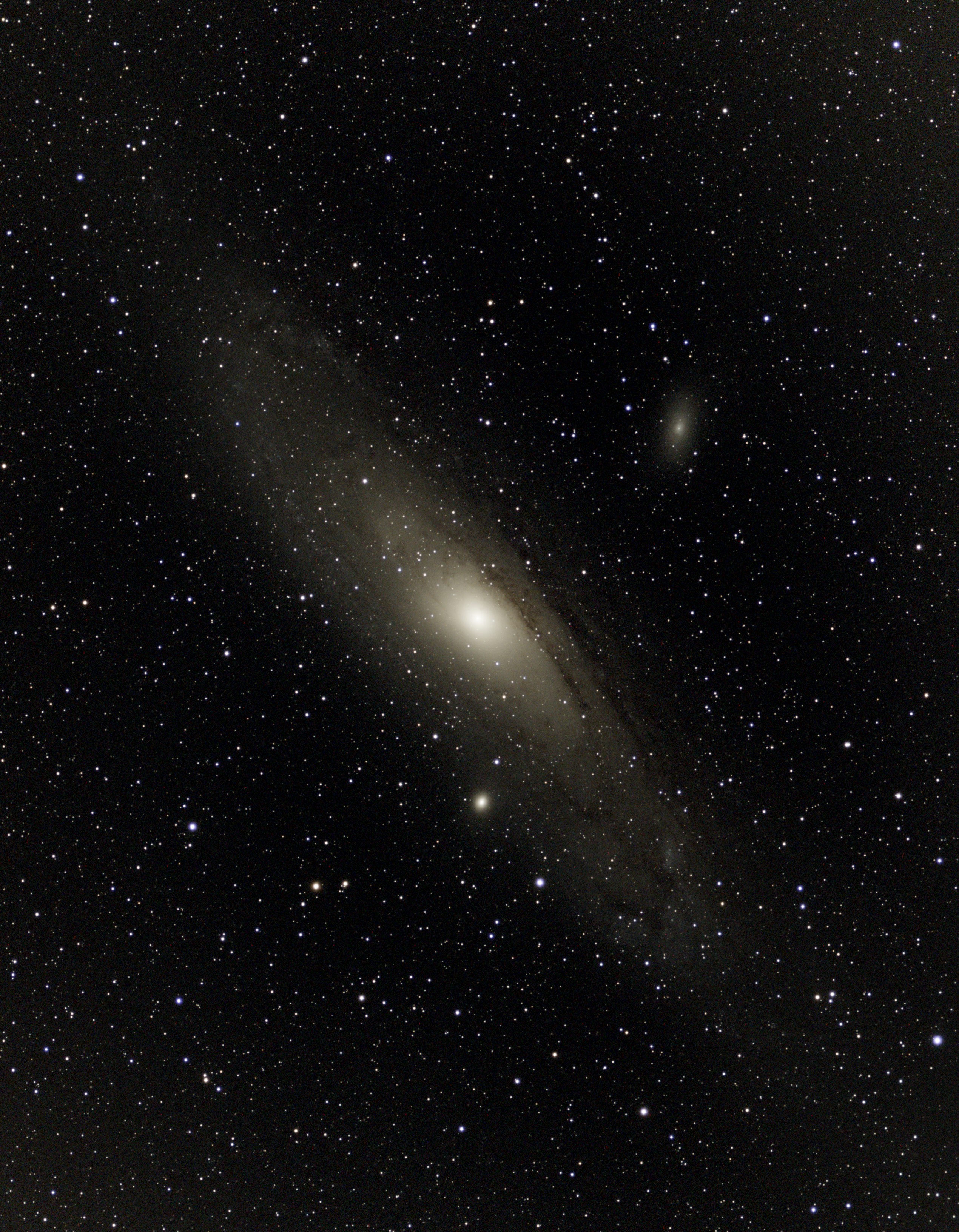
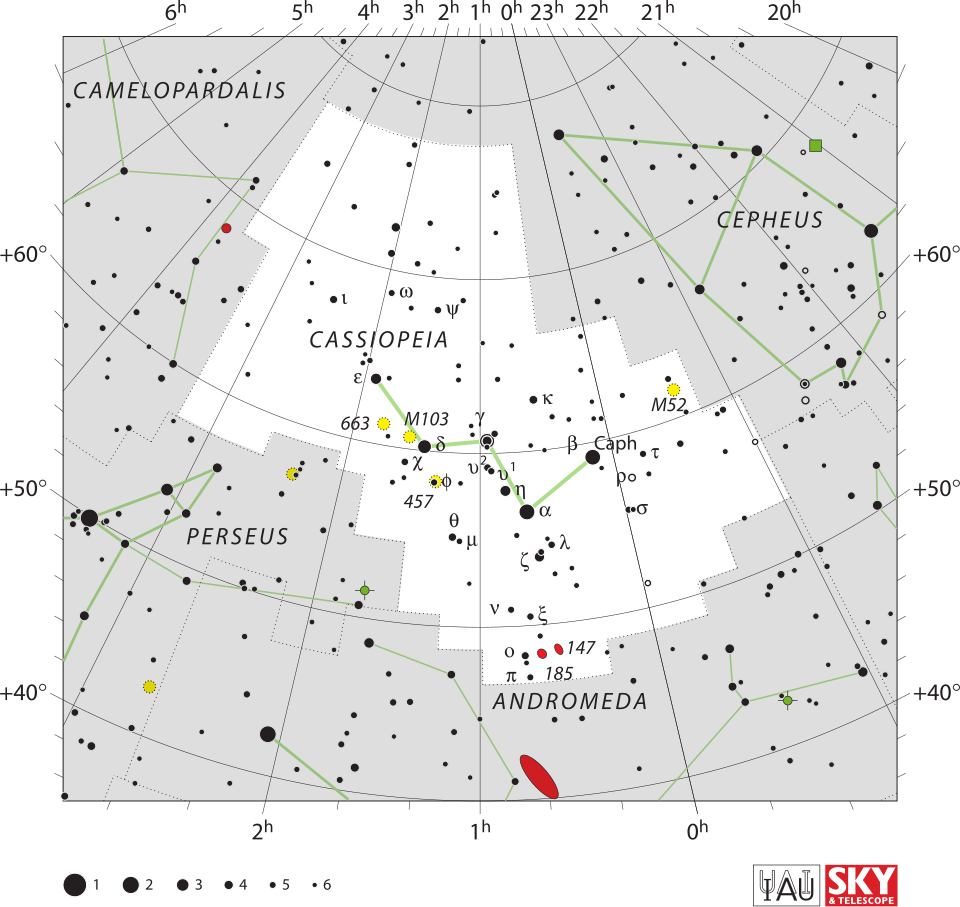
| Autumn | Pegasus, Andromeda, Cassiopeia, Perseus, Aquarius, Pisces | The Great Square of Pegasus. From its north-east corner, a chain of stars leads through Andromeda toward Perseus; the W of Cassiopeia rides high to the north. | Andromeda Galaxy (M31), Triangulum Galaxy (M33), Double Cluster in Perseus |








From the gallery: one object in each season's sky
Circumpolar constellations, and the ones we never see
From New Jersey, at about 40° north, the north celestial pole stands 40° above the northern horizon. Anything within 40° of the pole circles it without ever setting. These circumpolar constellations are visible on every clear night of the year, though their orientation changes with the hour and the season: the Big Dipper skims low over the northern horizon on autumn evenings and swings high overhead in spring.
- Ursa Minor, the Little Bear, with Polaris at the end of its tail
- Ursa Major, the Great Bear: its Big Dipper never quite sets, though the tip of the handle grazes the horizon
- Cassiopeia, the W-shaped queen, opposite the Dipper across the pole
- Cepheus, the king, shaped like a child's drawing of a house
- Draco, the dragon, winding between the two bears
- Camelopardalis, the giraffe, large and faint
The same geometry works in reverse. Stars within 40° of the south celestial pole never rise above a New Jersey horizon. The Southern Cross, the bright pointer stars Alpha and Beta Centauri, the Large and Small Magellanic Clouds and constellations such as Musca, Chamaeleon, Apus and Octans can be seen only from farther south. Florida's southern tip, at 25° north, brings the Southern Cross briefly above the horizon on spring nights.


What causes the seasons
A common belief is that summer happens when the Earth is closest to the Sun. In fact the Earth is closest to the Sun, at perihelion, in early January, at about 147 million km, and farthest, at aphelion, in early July, at about 152 million km. That 3% difference in distance changes the sunlight reaching us by only about 7%, and it works against northern summer, not for it.
The real cause is the 23.4° tilt of the Earth's axis. The axis keeps pointing the same way in space — toward Polaris — all the way around the orbit. In June the Northern Hemisphere leans toward the Sun: the Sun climbs high at noon, its light strikes the ground steeply and is concentrated on a smaller area, and days are long. In December the north leans away: the Sun stays low, its light arrives at a slant and is spread thin, and nights are long. The Southern Hemisphere has the opposite seasons at the same time.
The four turning points of the year are fixed by the tilt and are marked in the sky by where the Sun stands on the ecliptic:
- March equinox (about 20 March): the Sun crosses the celestial equator heading north. Day and night are roughly equal everywhere. The Sun is in Pisces.
- June solstice (about 21 June): the Sun reaches its northernmost point, Dec +23.4°, and stands overhead at noon along the Tropic of Cancer. It is at the border of Taurus and Gemini.
- September equinox (about 22 September): the Sun crosses the equator heading south. It is in Virgo.
- December solstice (about 21 December): the Sun reaches Dec −23.4°, overhead along the Tropic of Capricorn. It is in Sagittarius.
The tropics are named for the constellations the Sun stood in at the solstices about 2,000 years ago — Cancer and Capricornus. Precession has since moved the solstice points nearly 30° west, into neighbouring constellations, but the names have stuck: one more reminder that the sky we see is a snapshot of a slowly turning machine.
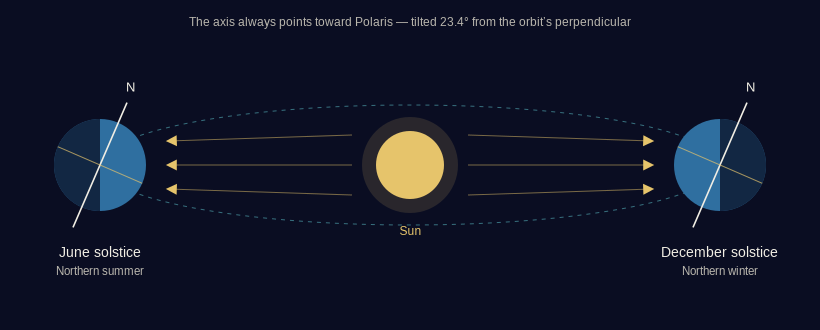
Image credits
- Milky Way panorama (page header) — ESO/S. Brunier. CC BY 4.0. Source
- Orion, head to toe — Rogelio Bernal Andreo. CC BY-SA 3.0. Source
- Zodiacal light over La Silla — ESO/Y. Beletsky. CC BY 4.0. Source
- IAU chart of Orion — IAU and Sky & Telescope (R. Sinnott & R. Fienberg). CC BY 3.0. Source
- IAU chart of Taurus — IAU and Sky & Telescope (R. Sinnott & R. Fienberg). CC BY 3.0. Source
- IAU chart of Leo — IAU and Sky & Telescope (R. Sinnott & R. Fienberg). CC BY 3.0. Source
- IAU chart of Scorpius — IAU and Sky & Telescope (R. Sinnott & R. Fienberg). CC BY 3.0. Source
- IAU chart of Sagittarius — IAU and Sky & Telescope (R. Sinnott & R. Fienberg). CC BY 3.0. Source
- IAU chart of Cygnus — IAU and Sky & Telescope (R. Sinnott & R. Fienberg). CC BY 4.0. Source
- IAU chart of Pegasus — IAU and Sky & Telescope (R. Sinnott & R. Fienberg). CC BY 3.0. Source
- IAU chart of Gemini — IAU and Sky & Telescope (R. Sinnott & R. Fienberg). CC BY 3.0. Source
- IAU chart of Ursa Major — IAU and Sky & Telescope (R. Sinnott & R. Fienberg). CC BY 3.0. Source
- IAU chart of Cassiopeia — IAU and Sky & Telescope (R. Sinnott & R. Fienberg). CC BY 3.0. Source
- Diagrams — drawn for this site; Sun dates are computed from the official IAU constellation boundaries.
- Seasonal deep-sky photographs — taken by the site author with a Vaonis Vespera Classic smart telescope.