One ordinary star, eight planets, a scattering of dwarf planets, and two vast reservoirs of ice that reach a good fraction of the way to the next star.
About 4.6 billion years ago a cold fragment of a molecular cloud, a few light-years across, began to collapse under its own weight. Almost everything fell to the centre and became the Sun. The small fraction of material with too much sideways motion to fall in flattened into a spinning disc, and that disc is where the rest of the solar system was built.
Close to the young Sun the disc was hot, and only rock and metal could condense. Farther out, past what astronomers call the frost line (roughly where the asteroid belt is now), water, ammonia and methane froze too, so there was far more solid material to gather. That single temperature gradient explains the basic layout: small rocky worlds inside, giants outside, ice everywhere beyond them.
Dust grains stuck together into pebbles, pebbles into planetesimals kilometres across, and planetesimals collided and merged into planets. The giant planets grew fast enough to pull in the surrounding gas before the Sun's early wind blew the disc away, a window of only a few million years. Whatever was left over — never swept up, never flung out — is what we see today as asteroids, comets and the Kuiper belt.
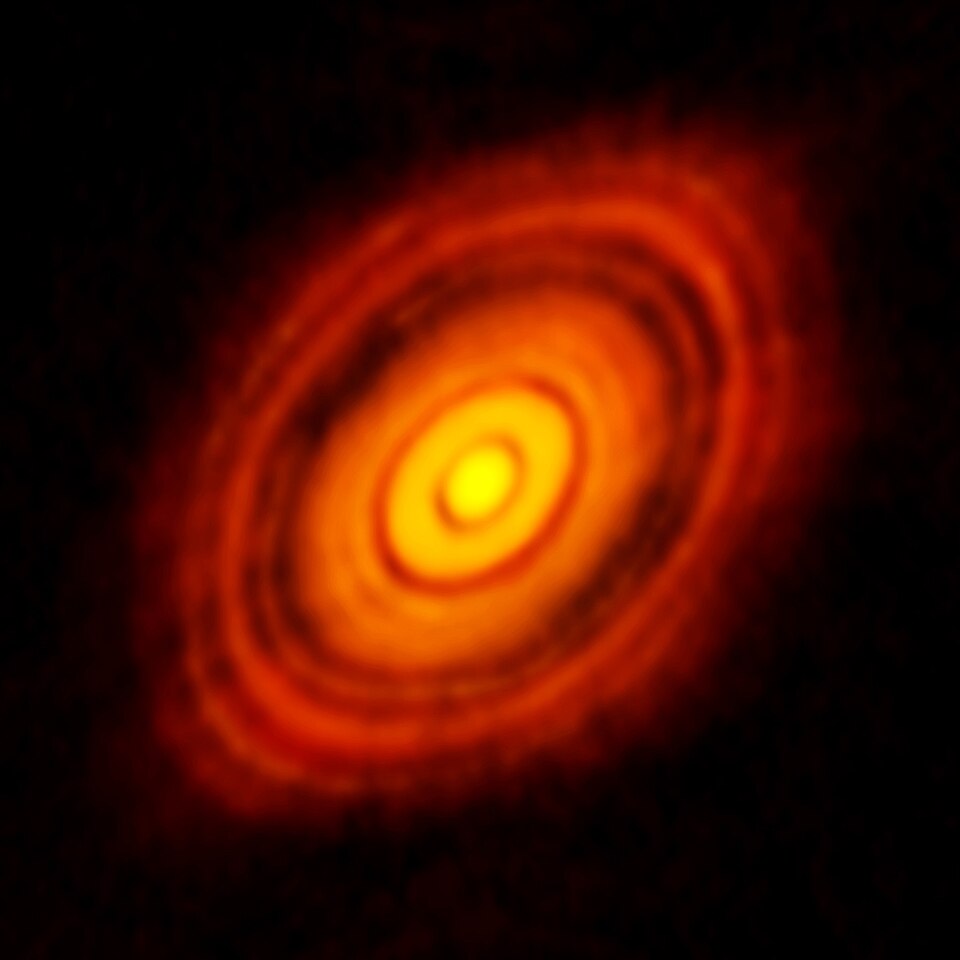
Another solar system in the making. ALMA's image of the young star HL Tauri shows a dusty disc with dark gaps where planets are probably sweeping up material — a snapshot of what our own system looked like in its first million years.
ALMA (ESO/NAOJ/NRAO), CC BY 4.0
The Sun
The Sun holds 99.8% of the mass of the solar system. It is a G-type main-sequence star, middle-aged and thoroughly average, which is exactly what makes it useful: everything we learn about it applies to hundreds of billions of stars like it.
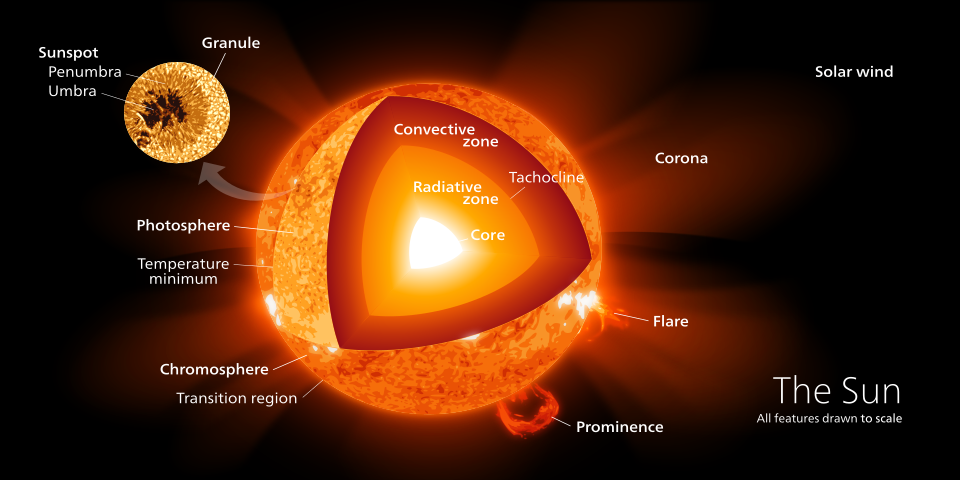
At the centre, 15 million kelvin and a density thirteen times that of lead let hydrogen nuclei fuse into helium through the proton–proton chain. About 600 million tonnes of hydrogen become helium every second, and 4 million tonnes of that mass disappears as energy, in accordance with E = mc². The energy leaks outward as radiation through the deep interior, then is carried by boiling convection cells through the outer third, arriving at the visible surface — the photosphere — roughly 100,000 years after it was made.
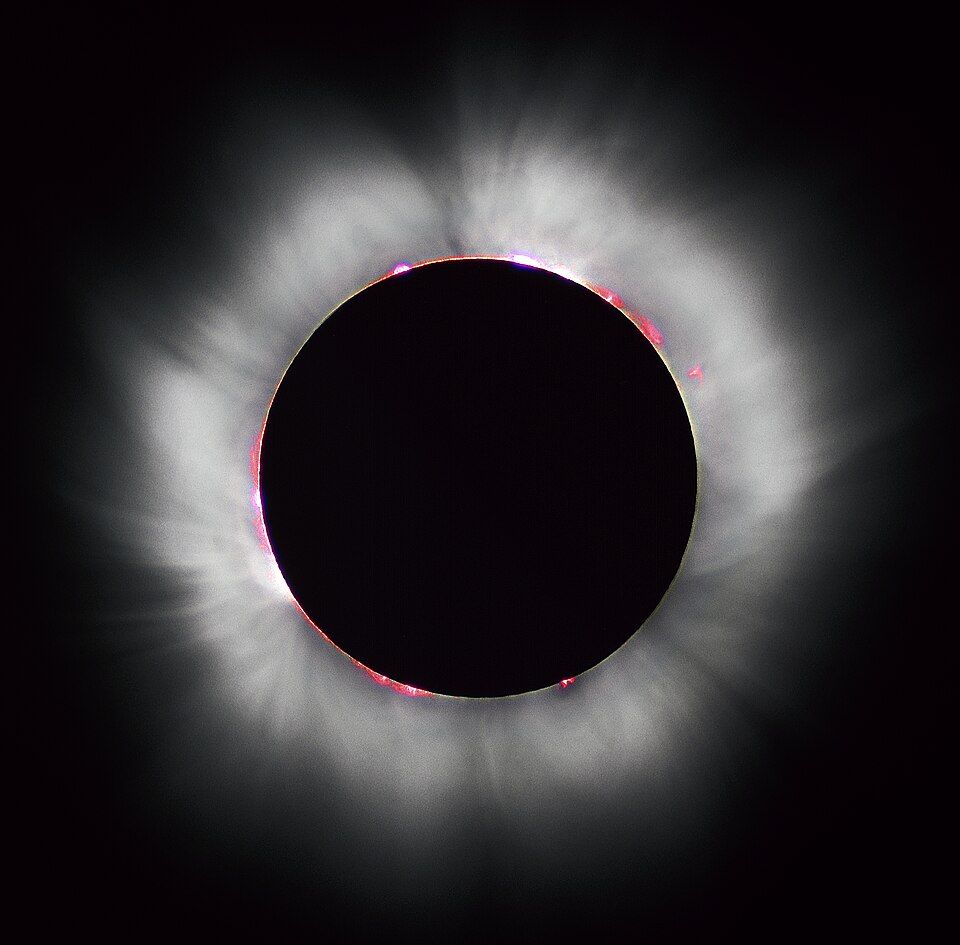
The photosphere is only about 5,800 K, but the tenuous corona above it is over a million degrees, a puzzle that has driven decades of solar physics and is now attributed largely to magnetic waves and small-scale reconnection events. The corona streams away as the solar wind, a flow of charged particles that inflates a bubble around the whole solar system called the heliosphere. Sunspots, flares and coronal mass ejections all follow an approximately eleven-year magnetic cycle.
Mass
333,000 Earths
Diameter
1.39 million km
Core temperature
15 million K
Surface temperature
5,800 K
Age
4.6 billion yr
Main-sequence life
~10 billion yr
The Sun's surface is constantly changing. Sunspots, plage, filaments, prominences, flares and coronal mass ejections are all driven by its magnetic field; see Features of the Sun for a guide to each, with Earth shown to scale.
Its future is covered on the Stars page: in about five billion years the Sun will swell into a red giant, shed its envelope as a planetary nebula, and settle down as a white dwarf.
The layered Sun. Fusion happens only in the core, roughly the inner quarter by radius.
Kelvinsong, CC BY-SA 3.0The corona, visible only when the Moon blocks the photosphere. The 1999 total eclipse from France.
Luc Viatour, CC BY-SA 3.0
The rocky planets
Four small, dense worlds formed inside the frost line from rock and metal, each with an iron core and a silicate mantle. Their differences come down to size and distance from the Sun.
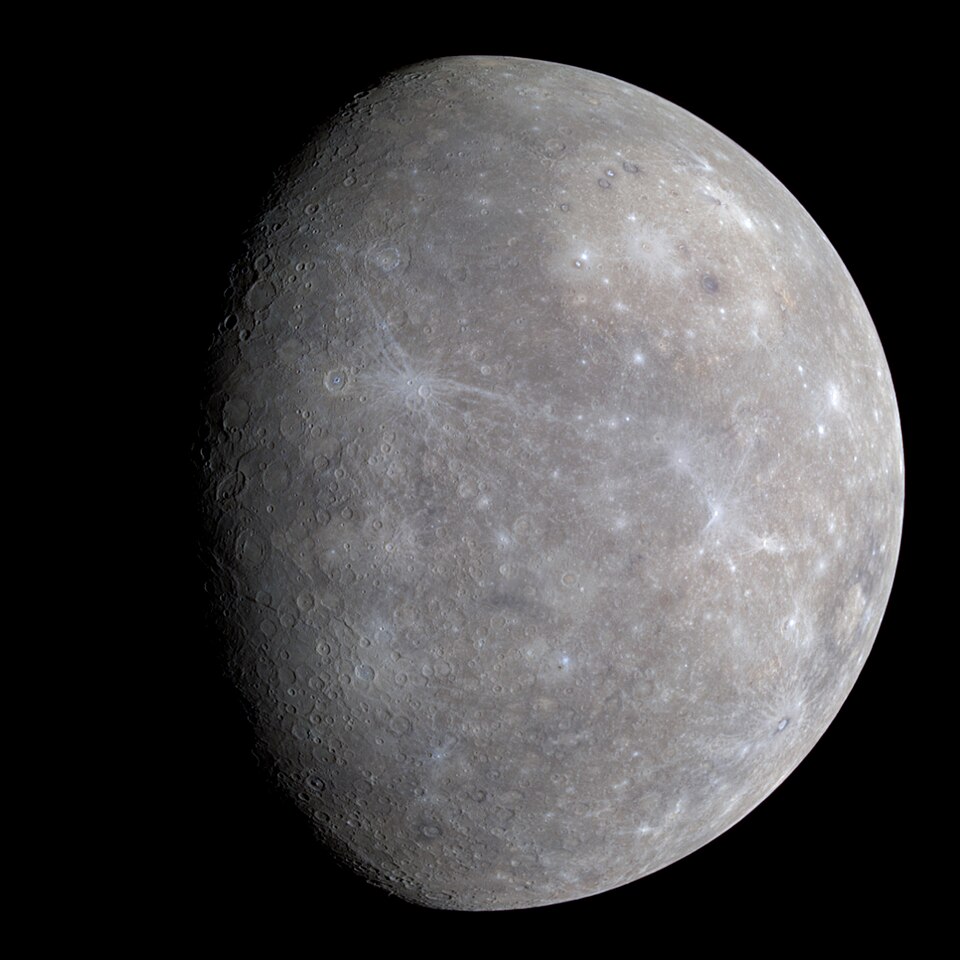
The smallest planet and the fastest, completing an orbit in 88 days. It is oddly dense: its iron core makes up more than 60% of its mass, perhaps because a giant impact stripped away much of its original mantle. With almost no atmosphere, the surface swings from 430 °C at noon to −180 °C at night. Mercury's day is peculiar too: it rotates exactly three times for every two orbits, so a single day–night cycle lasts 176 Earth days. The MESSENGER and BepiColombo missions found water ice in permanently shadowed polar craters and a surprisingly active magnetic field.
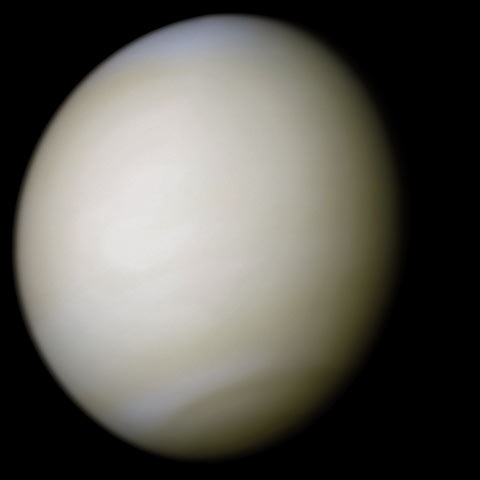
Almost Earth's twin in size and mass, and a lesson in how differently a planet can turn out. A carbon-dioxide atmosphere 90 times denser than ours traps heat so effectively that the surface sits at 465 °C everywhere, hotter than Mercury. Sulphuric-acid clouds hide the ground completely; radar mapping reveals volcanic plains, a few thousand volcanoes and evidence of recent eruptions. Venus rotates backwards and very slowly — a Venusian day is longer than its year. It is the brightest object in our sky after the Sun and Moon.
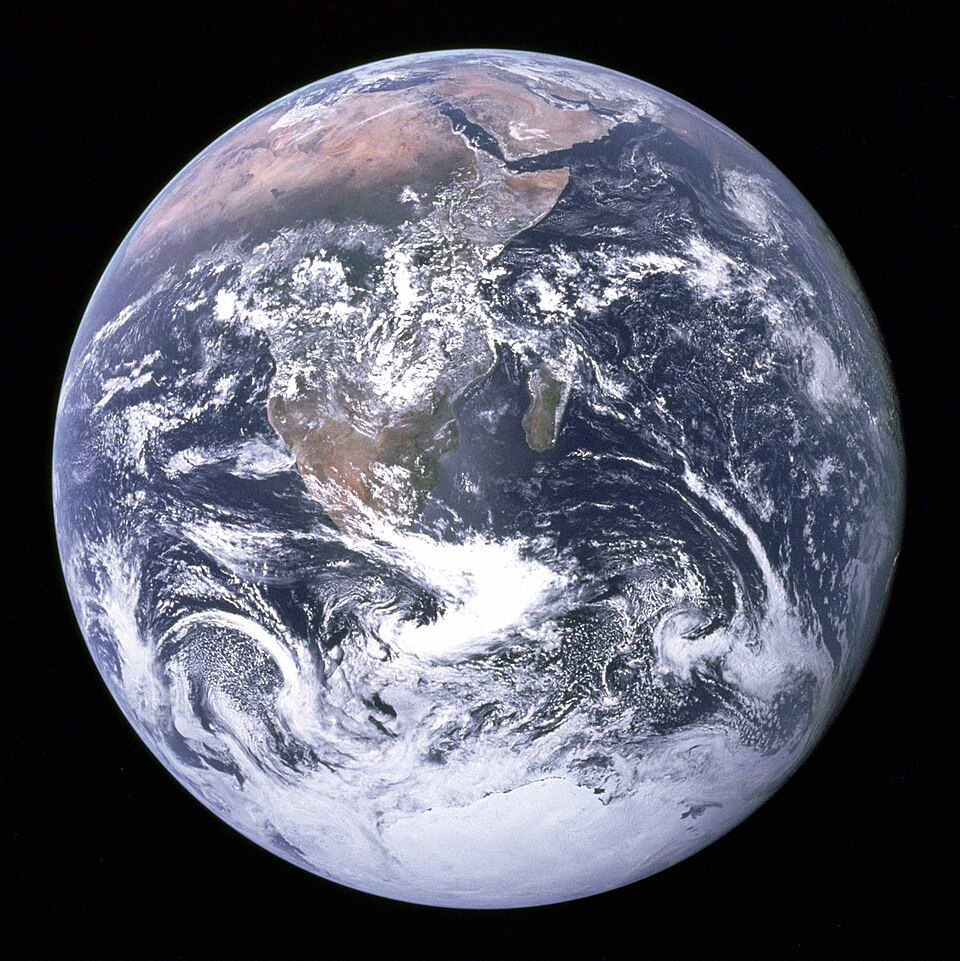
The only world known to have liquid water on its surface, plate tectonics, and life. Its distance from the Sun is part of that, but so is its nitrogen–oxygen atmosphere, its magnetic field (generated by convection in a liquid iron outer core), and its unusually large Moon, which stabilises the tilt of the axis and drives the tides. The Moon is thought to have formed from debris after a Mars-sized body struck the young Earth about 4.5 billion years ago. Earth's 23.4° axial tilt gives us the seasons; its 24-hour rotation and 365.25-day orbit are the base units of every calendar.
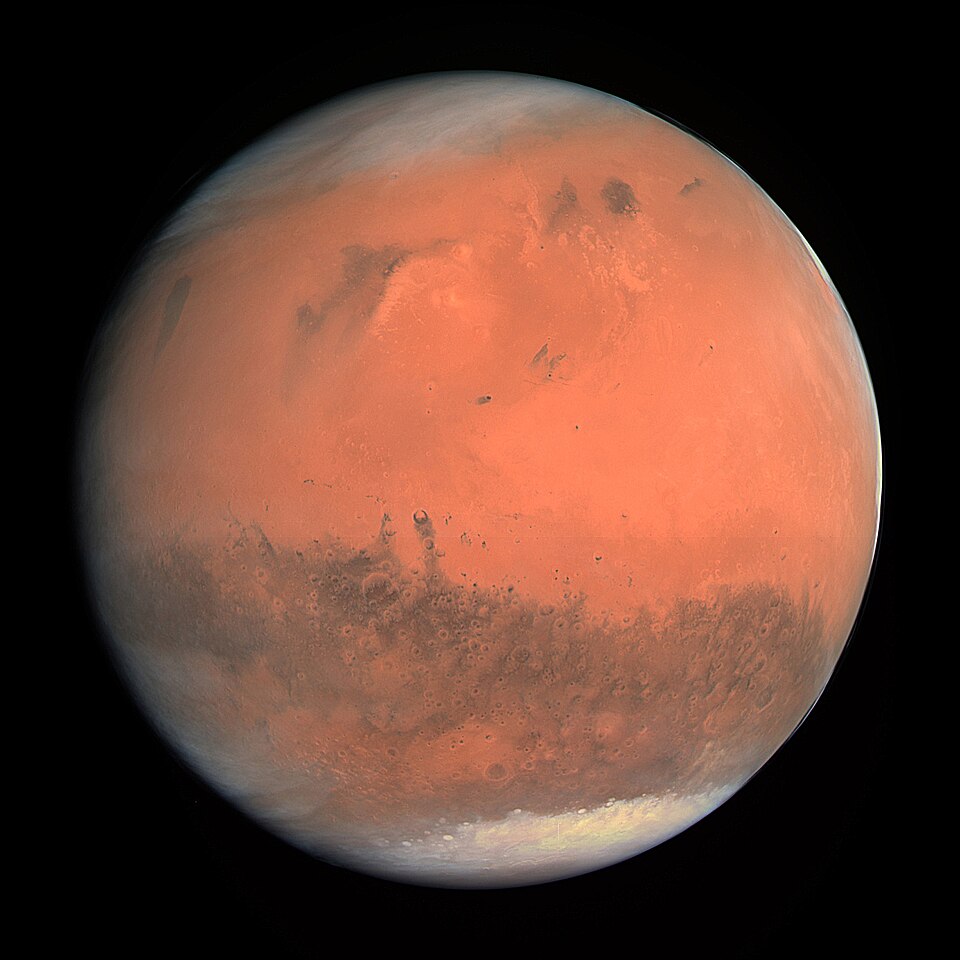
Half Earth's diameter, a tenth its mass, with a thin CO₂ atmosphere and an average temperature of −60 °C. Its colour is iron oxide — rust. Mars has the tallest volcano in the solar system (Olympus Mons, 22 km high) and a canyon system, Valles Marineris, that would stretch across the United States. Rovers and orbiters have found dry river valleys, lake beds, clay minerals and buried ice: three to four billion years ago Mars was wetter and warmer, before it lost most of its atmosphere to space once its magnetic field died. Two small captured asteroids, Phobos and Deimos, serve as moons.
The asteroid belt
Between Mars and Jupiter lies a zone where Jupiter's gravity stirred the planetesimals too violently for them ever to assemble into a planet. What remains is the asteroid belt: more than a million rocky and metallic bodies larger than a kilometre, with a total mass of only about 3% of the Moon. Despite film depictions, it is mostly empty space; spacecraft cross it without special manoeuvres.
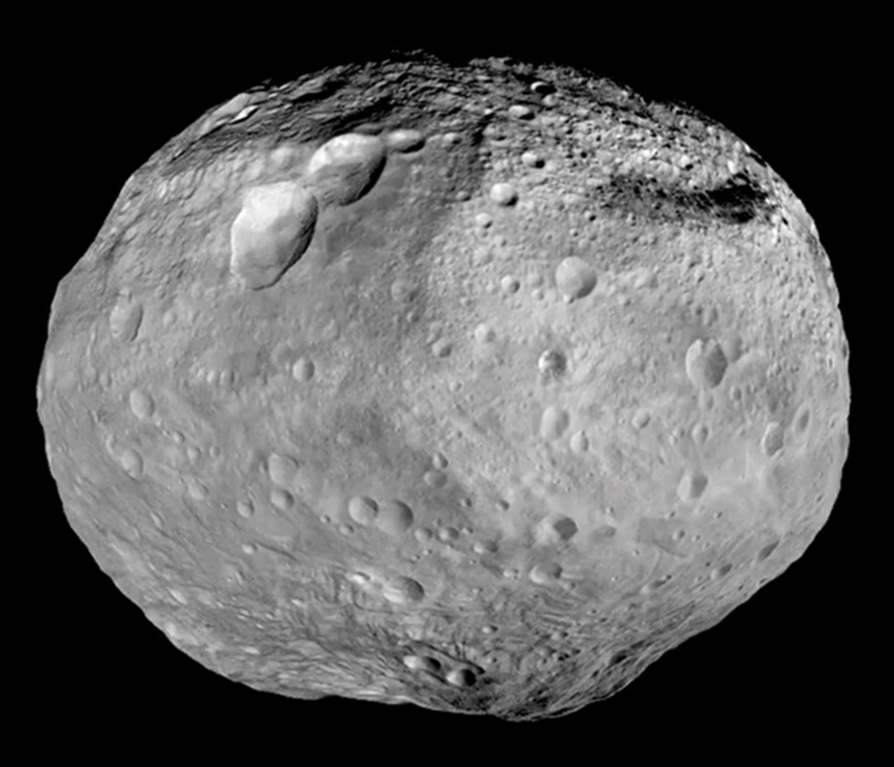
The largest member, Ceres, is nearly 1,000 km across and round enough to count as a dwarf planet (see below). Vesta, the second-largest, has a basaltic crust and a huge impact basin at its south pole; fragments of it fall to Earth as a recognised class of meteorite. Asteroids are the nearest thing we have to leftover building blocks from the original disc, which is why sample-return missions such as Hayabusa2 and OSIRIS-REx went to fetch pieces.
Beyond the frost line, ice was plentiful and the planets grew large enough to capture hydrogen and helium directly from the disc. Jupiter and Saturn are gas giants, mostly hydrogen and helium down to their cores. Uranus and Neptune, farther out and slower to form, are ice giants, richer in water, ammonia and methane. All four have rings and large families of moons.
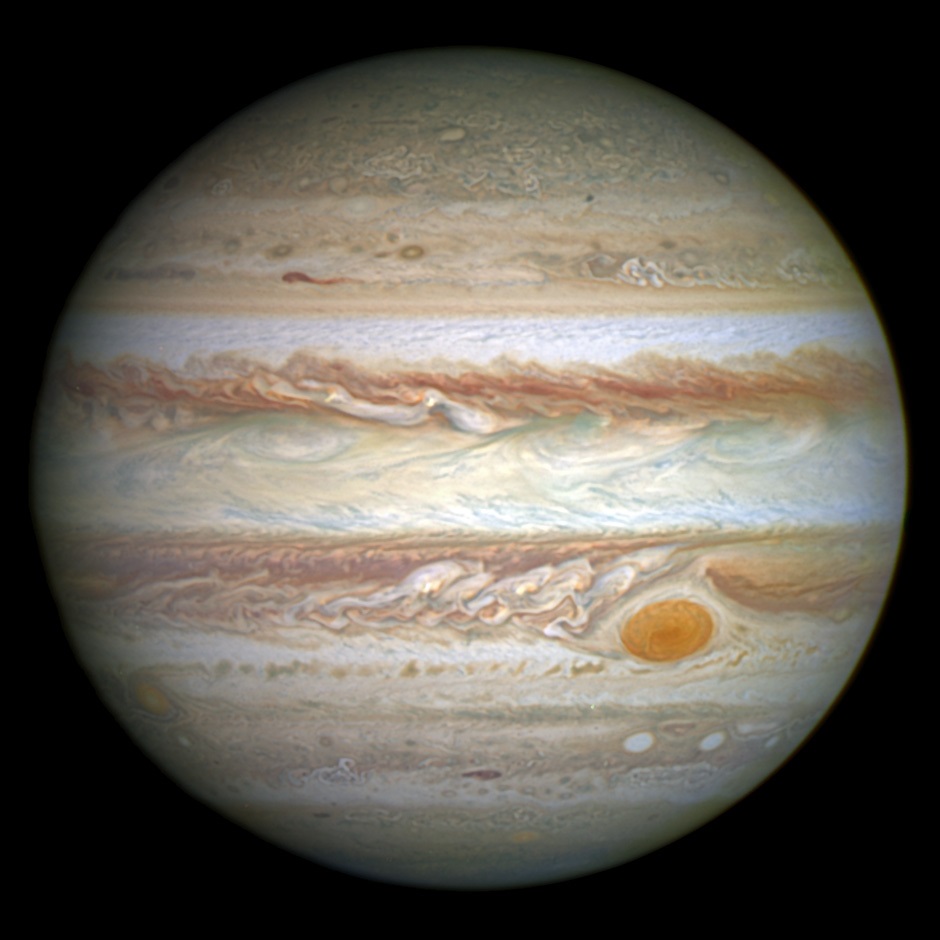
More than twice as massive as all the other planets combined. Its banded clouds of ammonia crystals race around the planet in under ten hours, driven by heat still escaping from Jupiter's formation. The Great Red Spot is an anticyclone larger than Earth that has persisted for at least 190 years. Deep inside, hydrogen is squeezed into a liquid metallic state, generating the strongest magnetic field of any planet. Jupiter has 95 confirmed moons; the four Galilean moons — Io, Europa, Ganymede and Callisto — are worlds in their own right, and Europa's subsurface ocean is a leading candidate for life elsewhere in the solar system.
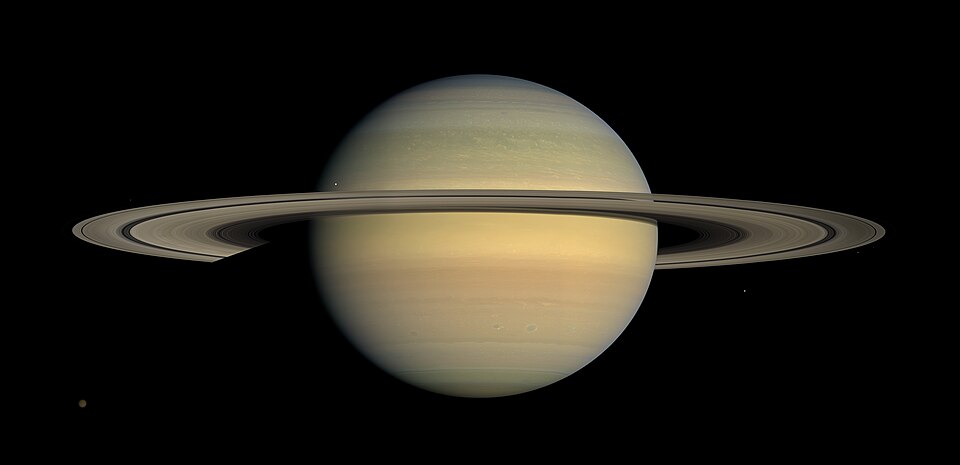
The least dense planet — it would float in water — and the owner of the solar system's great rings. The rings are almost pure water ice, spanning 280,000 km but in places only ten metres thick, and they may be surprisingly young, perhaps only a few hundred million years old. Saturn has 146 known moons, more than any other planet. Titan, the largest, has a thick nitrogen atmosphere and lakes of liquid methane; tiny Enceladus sprays water vapour from geysers over a subsurface ocean. A hexagonal jet stream circles the north pole.
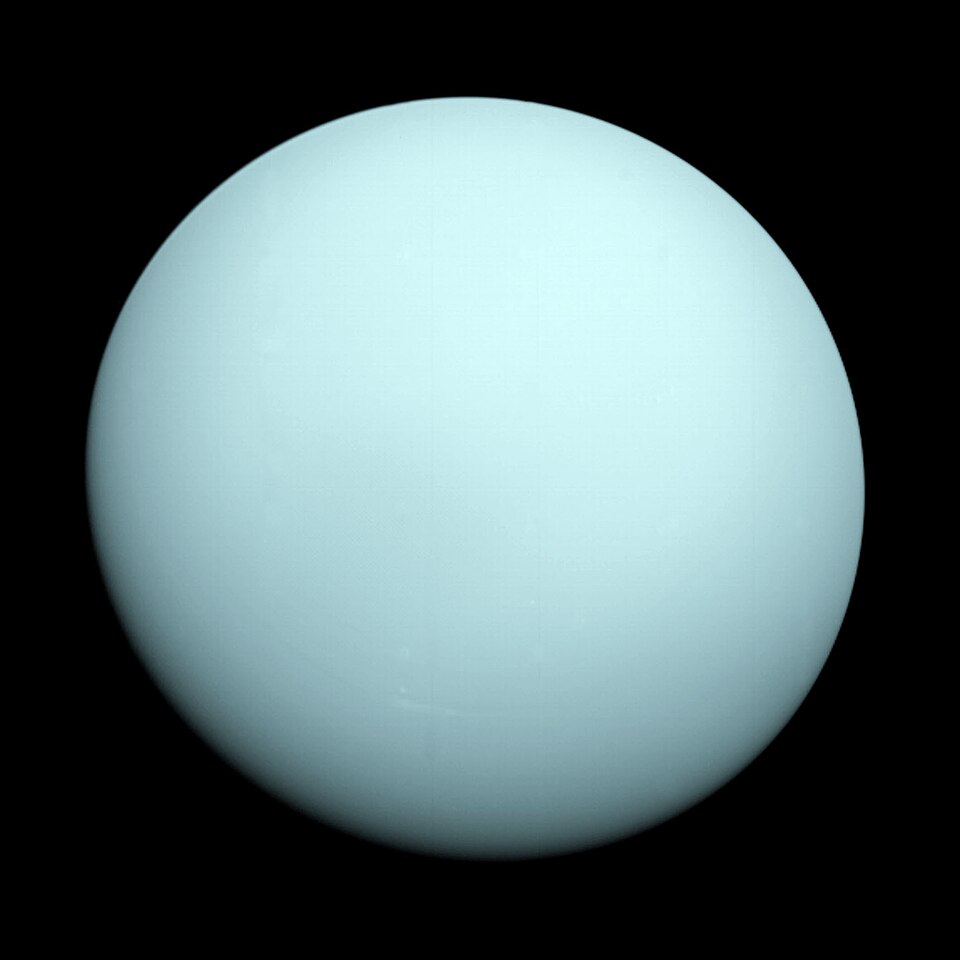
The first planet discovered with a telescope (William Herschel, 1781). Uranus is tipped on its side, its axis tilted 98°, so each pole gets 42 years of continuous daylight followed by 42 of darkness — probably the result of a giant collision early in its history. Methane in the upper atmosphere absorbs red light and gives the planet its aquamarine colour. It is the coldest planet, with cloud-top temperatures near −224 °C, and radiates almost no internal heat. Voyager 2 in 1986 remains the only spacecraft to visit. It has 13 faint rings and 28 known moons named after characters from Shakespeare and Pope.
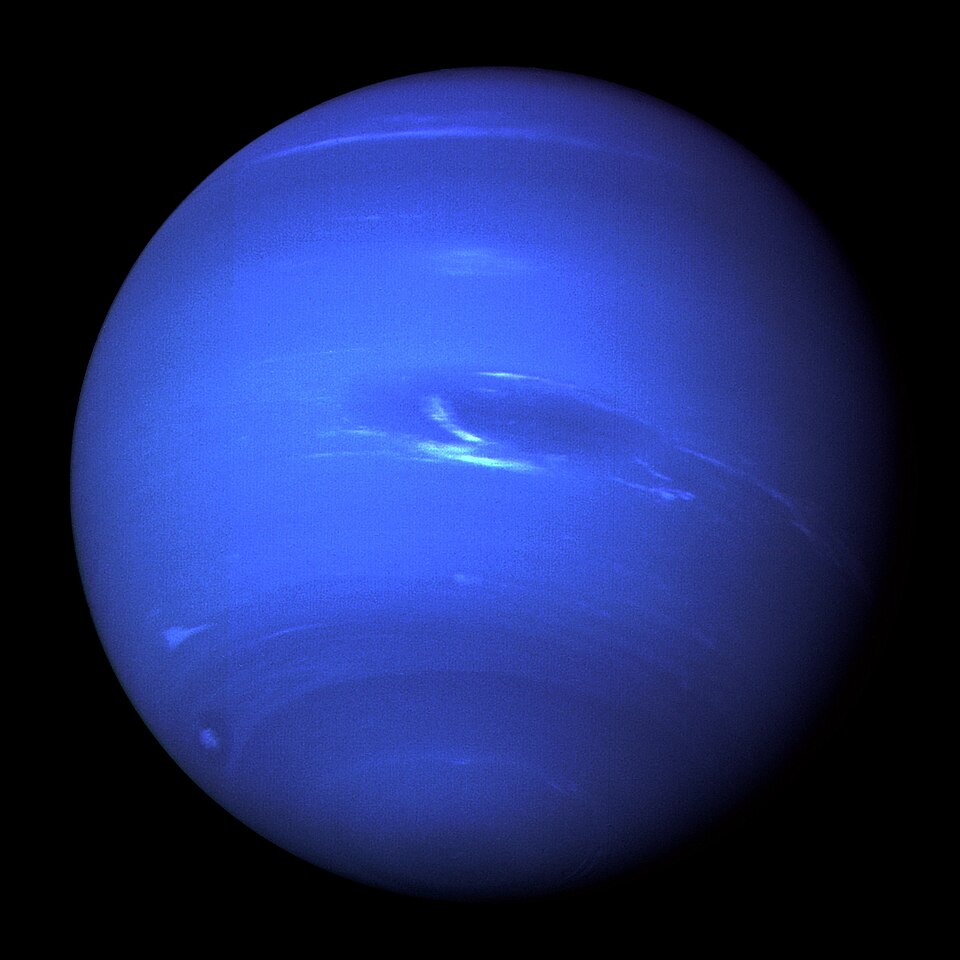
Found in 1846 not by searching but by calculation: irregularities in the orbit of Uranus pointed to an unseen planet, and Neptune was where the mathematics said it should be. It has the fastest winds in the solar system, over 2,000 km/h, and radiates 2.6 times the energy it receives from the Sun. Its large moon Triton orbits backwards and is almost certainly a captured Kuiper belt object; it has nitrogen geysers and a surface of frozen nitrogen at −235 °C. Neptune's gravity shapes the entire Kuiper belt beyond it, herding Pluto and thousands of other bodies into resonant orbits.
The planets at a glance
Planet
Distance (AU)
Diameter (Earth = 1)
Mass (Earth = 1)
Year
Day
Known moons
Mercury
0.39
0.38
0.055
88 d
59 d
0
Venus
0.72
0.95
0.82
225 d
243 d (retrograde)
0
Earth
1.00
1.00
1.00
365 d
24 h
1
Mars
1.52
0.53
0.11
687 d
24.6 h
2
Jupiter
5.20
11.2
318
11.9 yr
9.9 h
95
Saturn
9.58
9.45
95
29.5 yr
10.6 h
146
Uranus
19.2
4.0
14.5
84 yr
17.2 h (retrograde)
28
Neptune
30.1
3.9
17.1
165 yr
16.1 h
16
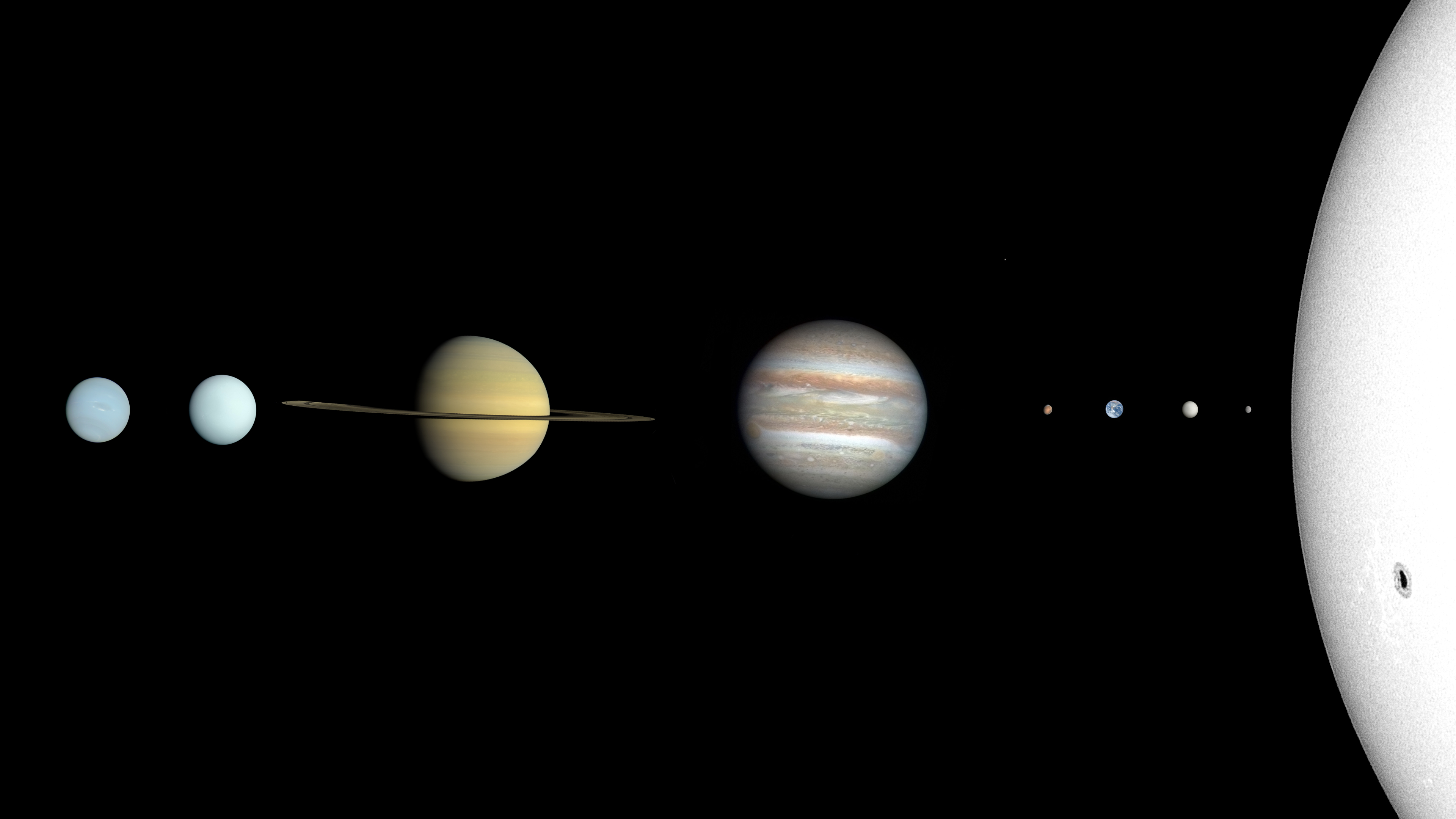
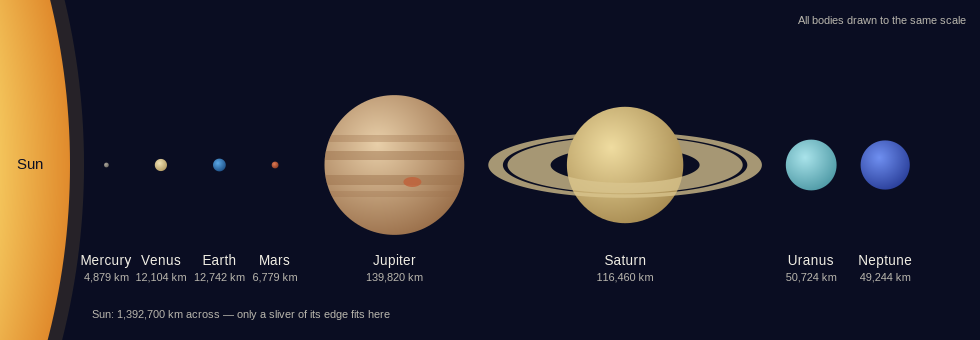
The planets in order from the Sun, all drawn to the same scale. Jupiter is about 11 times wider than Earth, and the Sun is about 10 times wider than Jupiter — only a sliver of its edge fits at the left. Distances between the planets are not to scale; see how far apart everything is.
The planets in their orbits
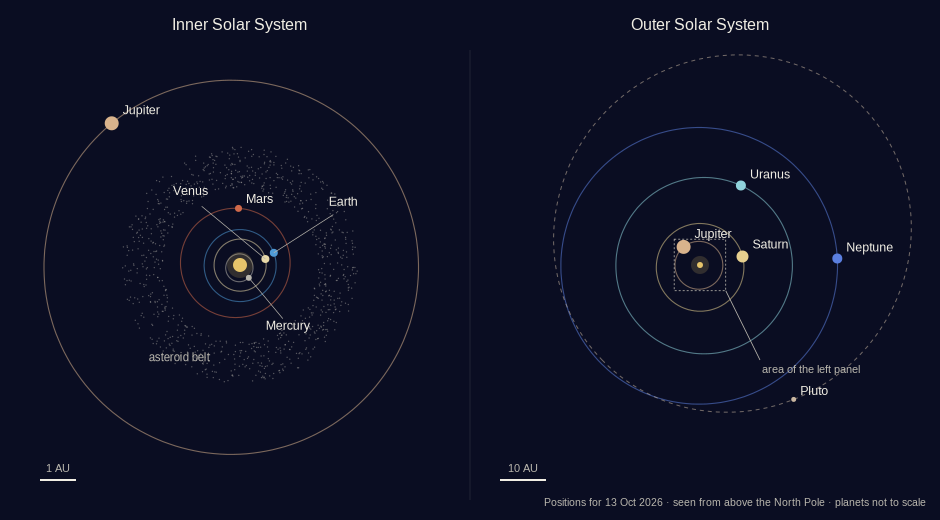
Seen from above, the orbits are nearly circular and almost all in one plane, and the planets all travel the same way around the Sun — counter-clockwise when viewed from above the North Pole. Here the orbits are drawn to scale in two panels, because the outer system is so much larger than the inner one: the whole left panel fits inside the small dotted square at the centre of the right one. Each planet is shown where it is in October 2026. Notice that Pluto's tilted, stretched orbit brings it closer to the Sun than Neptune for 20 years of its 248-year circuit; the two never collide because Pluto is locked in step with Neptune (see the Kuiper belt).
The orbits of the planets to scale, with each planet at its approximate position on 13 October 2026. The planets themselves are drawn hugely enlarged; at this scale even Jupiter would be far smaller than a pixel. 1 AU is the Earth–Sun distance.
Spin, tilt, days and years
Every planet does two things at once: it revolves around the Sun, and it rotates on its own axis. The time to go once around the Sun is the planet's year; the time to turn once on its axis is its rotation period. The angle between that axis and a line perpendicular to the orbit is its axial tilt, and the tilt is what gives a planet seasons.
The cloud of gas and dust the planets formed from was itself turning, so the planets all orbit in the same direction and most also spin that way. Two do not. Venus turns backwards, and so slowly that one rotation (243 Earth days) takes longer than its year (225 days); from its surface the Sun would rise in the west and set in the east, about 117 days later. Uranus is tipped 98°, so it rolls around the Sun on its side. Each pole gets about 42 years of continuous sunlight followed by 42 years of darkness. A collision with an Earth-sized body early in its history is the likely cause.
Mercury stands almost perfectly upright and is locked into an unusual rhythm by the Sun's gravity: it turns exactly three times for every two orbits. The result is that a full day, from one sunrise to the next, lasts 176 Earth days — two Mercury years.
Earth and Mars are near-twins in this respect: tilts of 23.4° and 25.2°, and days of 24 hours and 24 hours 40 minutes. Mars therefore has seasons like ours, each roughly twice as long. Our large Moon steadies Earth's tilt; Mars, with no such moon, has swung between roughly 10° and 60° over tens of millions of years, rearranging its ice caps and climate.
The giant planets spin fastest of all. Jupiter turns in under ten hours, so quickly that it bulges about 7% wider at its equator than through its poles; Saturn, in about 10 hours 34 minutes, is flattened by 10% — easily visible in a small telescope. Neither has a solid surface, so their rotation periods are measured from their magnetic fields and radio emissions, and for Saturn from waves in its rings recorded by the Cassini spacecraft. Jupiter's tilt is only 3°, so it has almost no seasons; Saturn and Neptune are tilted much like Earth, and their seasons each last decades.
The length of the year follows a simple rule that Johannes Kepler found in 1619: the square of a planet's orbital period is proportional to the cube of its distance from the Sun. Double the distance and the year lengthens almost threefold. Farther planets also move more slowly — Mercury races along at 47 km/s, Earth at 30 km/s and Neptune at just 5.4 km/s — so Neptune, 30 times farther out than Earth, takes 165 years to complete one orbit. It has gone around the Sun only once since its discovery in 1846.
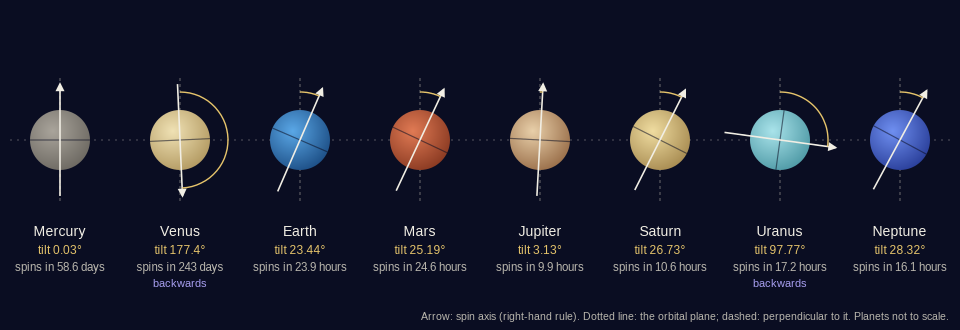
Each planet's axial tilt drawn to the true angle, with its rotation period. A tilt above 90° means the planet spins backwards (retrograde) compared with its orbit. Venus, at 177°, is effectively upside down; Uranus, at 98°, lies on its side.
Rotation and revolution of the planets
Planet
Axial tilt
Rotation period
Sunrise to sunrise
Orbital period (year)
Orbital speed
Mercury
0.03°
58.6 days
176 days
88 days
47.4 km/s
Venus
177.4°
243 days (backwards)
117 days
225 days
35.0 km/s
Earth
23.44°
23 h 56 m
24 h
365.26 days
29.8 km/s
Mars
25.19°
24 h 37 m
24 h 40 m
687 days (1.88 yr)
24.1 km/s
Jupiter
3.13°
9 h 56 m
9 h 56 m
11.9 years
13.1 km/s
Saturn
26.73°
10 h 34 m
10 h 34 m
29.5 years
9.7 km/s
Uranus
97.77°
17 h 14 m (backwards)
17 h 14 m
84.0 years
6.8 km/s
Neptune
28.32°
16 h 6 m
16 h 6 m
164.8 years
5.4 km/s
The rotation period is measured against the distant stars. "Sunrise to sunrise" is the solar day, which differs from it because the planet moves along its orbit while it turns; for the fast-spinning giants the two are practically the same.
Dwarf planets and the lesser worlds
In 2006 the International Astronomical Union settled a long argument by defining a planet as a body that orbits the Sun, is massive enough for gravity to pull it round, and has cleared its orbital neighbourhood of other objects. A body that meets the first two tests but not the third is a dwarf planet. Five are officially recognised — Ceres, Pluto, Haumea, Makemake and Eris — and several dozen more Kuiper belt objects are probably large enough to qualify.
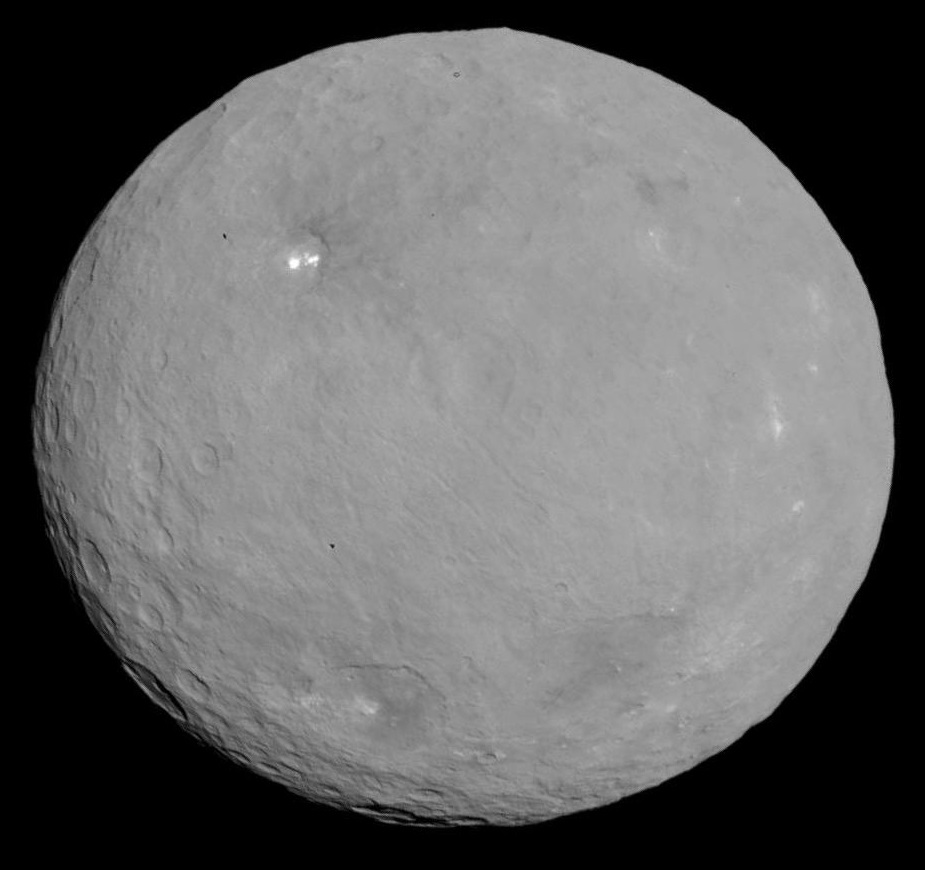
Ceres (2.8 AU, 940 km). The only dwarf planet in the asteroid belt. Its bright spots are salt deposits left by briny water that seeped up from a subsurface reservoir.
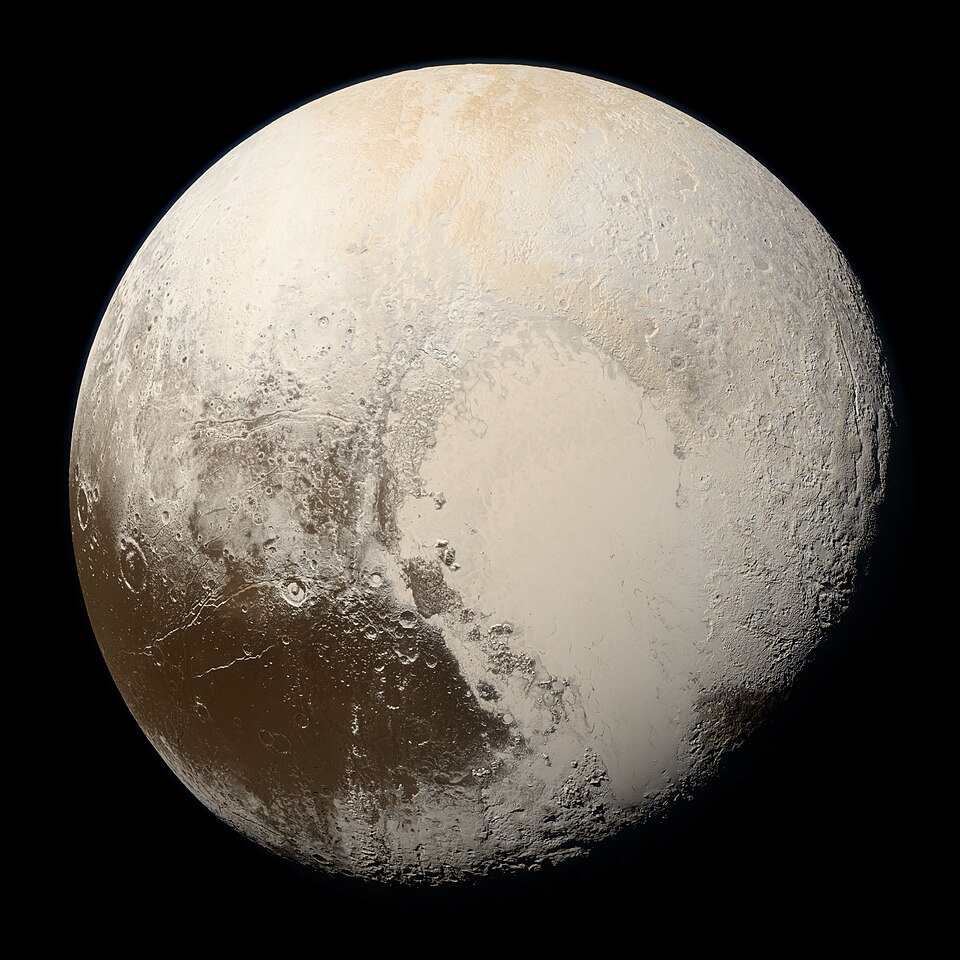
NASA/JPL-Caltech/UCLA/MPS/DLR/IDA (public domain)Pluto (39.5 AU, 2,377 km). Discovered in 1930, visited by New Horizons in 2015. Nitrogen-ice glaciers flow across Sputnik Planitia, mountains of water ice rise 3 km, and a thin blue haze surrounds the planet. Its moon Charon is half its size.
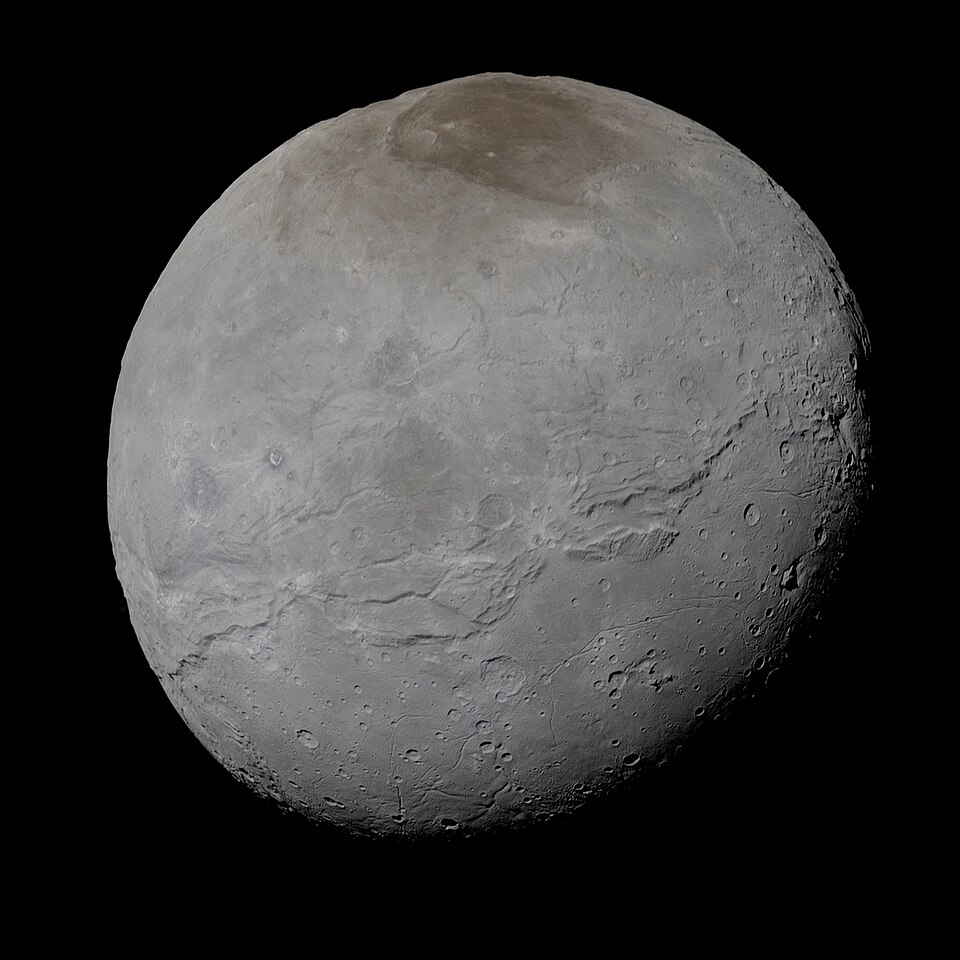
NASA/JHUAPL/SwRI (public domain)Charon, Pluto's largest moon, 1,212 km across. Pluto and Charon orbit a point between them; some astronomers regard them as a double dwarf planet.
NASA/JHUAPL/SwRI (public domain)
Dwarf planet
Region
Mean distance
Diameter
Notes
Ceres
Asteroid belt
2.8 AU
940 km
Water-rich; possible remnant subsurface brine
Pluto
Kuiper belt
39.5 AU
2,377 km
Five moons; 3:2 resonance with Neptune
Haumea
Kuiper belt
43 AU
~1,600 km (long axis ~2,100)
Spins every 4 hours, stretched into an ellipsoid; has a ring
Makemake
Kuiper belt
45.8 AU
~1,430 km
Methane-frost surface; one known moon
Eris
Scattered disc
68 AU
2,326 km
Slightly more massive than Pluto; its discovery in 2005 forced the planet definition
Beyond the planets: the Kuiper belt and the Oort cloud
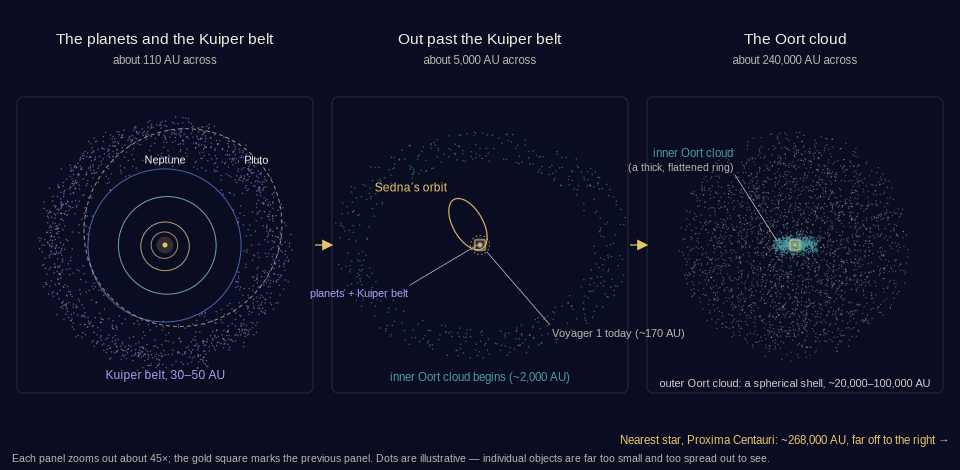
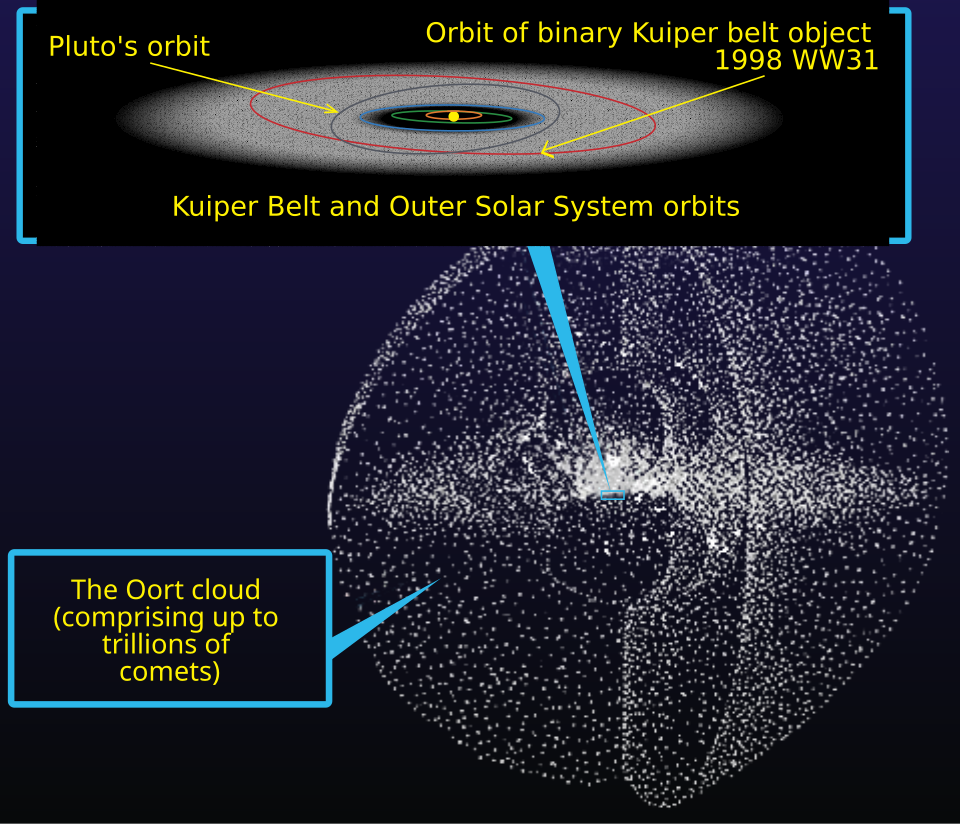
The planets are only the inner core of the Sun's domain. Just past Neptune lies the Kuiper belt, a flat, doughnut-shaped disc of icy bodies in the same plane as the planets, from about 30 to 50 AU. Beyond it is a sparse scattered region where a few objects such as Sedna follow long, stretched orbits reaching hundreds of AU out. Then comes the Oort cloud: first a thick, flattened inner cloud starting around 2,000 AU, then an enormous, roughly spherical outer shell of comets reaching perhaps 100,000 AU — more than a third of the way to the nearest star. The three panels below zoom out step by step, and the next two sections look at each region in turn; in each, the gold square marks the whole of the panel before it.
Three views, each about 45 times wider than the last. The Kuiper belt is a flat disc in the plane of the planets; the outer Oort cloud is a sphere surrounding the Sun on all sides, which is why long-period comets arrive from every direction. The dots only show the shape of each region — the real objects are tiny and millions of kilometres apart.
The Kuiper belt
Beyond Neptune, from about 30 to 50 AU, the solar system flattens out into a second, far larger belt of debris. The Kuiper belt is to comets what the asteroid belt is to asteroids: a disc of icy bodies left over from formation, never gathered into a planet because there was too little material spread over too great a volume, and because Neptune's gravity kept it stirred. It was predicted in the 1940s and 1950s, notably by Gerard Kuiper, but the first object other than Pluto was not found until 1992.
Several thousand Kuiper belt objects (KBOs) are now catalogued, and the belt probably holds more than 100,000 larger than 100 km. They fall into families. Classical objects follow nearly circular orbits in the main belt. Resonant objects, including Pluto, are locked into rhythms with Neptune — Pluto orbits twice for every three Neptune orbits, which is why the two can never collide despite Pluto's crossing orbit. Scattered-disc objects like Eris were flung onto stretched, tilted orbits by Neptune and reach hundreds of AU.
The belt is the source of the short-period comets, and studying it tells us how the giant planets migrated. The leading model, called the Nice model, proposes that Neptune formed closer to the Sun and moved outward, ploughing through the primordial disc and scattering it — which explains the belt's sharp outer edge, its excited orbits and the resonant families.
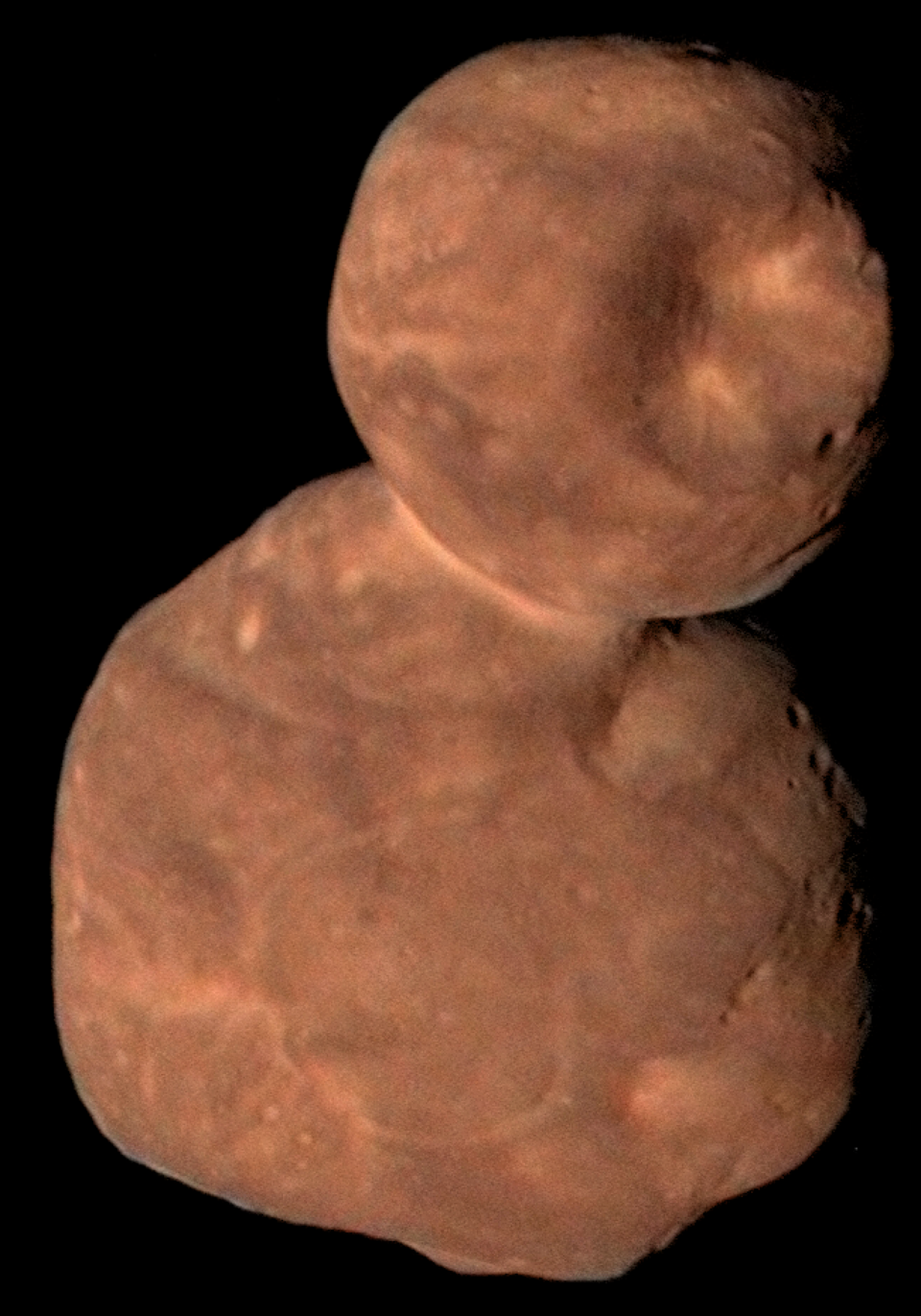
In 2019 New Horizons flew past Arrokoth, a 36-km classical KBO, and found two smooth lobes gently joined together — direct evidence that planetesimals formed by soft accumulation of pebbles rather than by violent collisions.
Arrokoth (2014 MU69), the most distant object ever visited by a spacecraft, 6.6 billion km from the Sun. The red colour comes from complex organic molecules produced by radiation acting on ices.
NASA/JHUAPL/SwRI (public domain)
Extent
30–50 AU
Total mass
~2% of Earth
Largest member
Pluto
Temperature
~40 K
The Oort cloud
The Oort cloud has never been seen. It is inferred from the comets that fall out of it. In 1950 Jan Oort noticed that long-period comets arrive from every direction in the sky, not just from the plane of the planets, and that their orbits trace back to distances of tens of thousands of AU. He concluded the Sun must be surrounded by a vast spherical shell of icy bodies, only occasionally nudged inward.
The picture today: an inner, doughnut-shaped region (sometimes called the Hills cloud) from about 2,000 to 20,000 AU, and an outer spherical shell from 20,000 to perhaps 100,000 AU or more — a substantial fraction of the 4.2-light-year distance to the nearest star. It may contain trillions of objects larger than a kilometre, with a combined mass of a few Earths. These are the most distant things that still belong to the Sun.
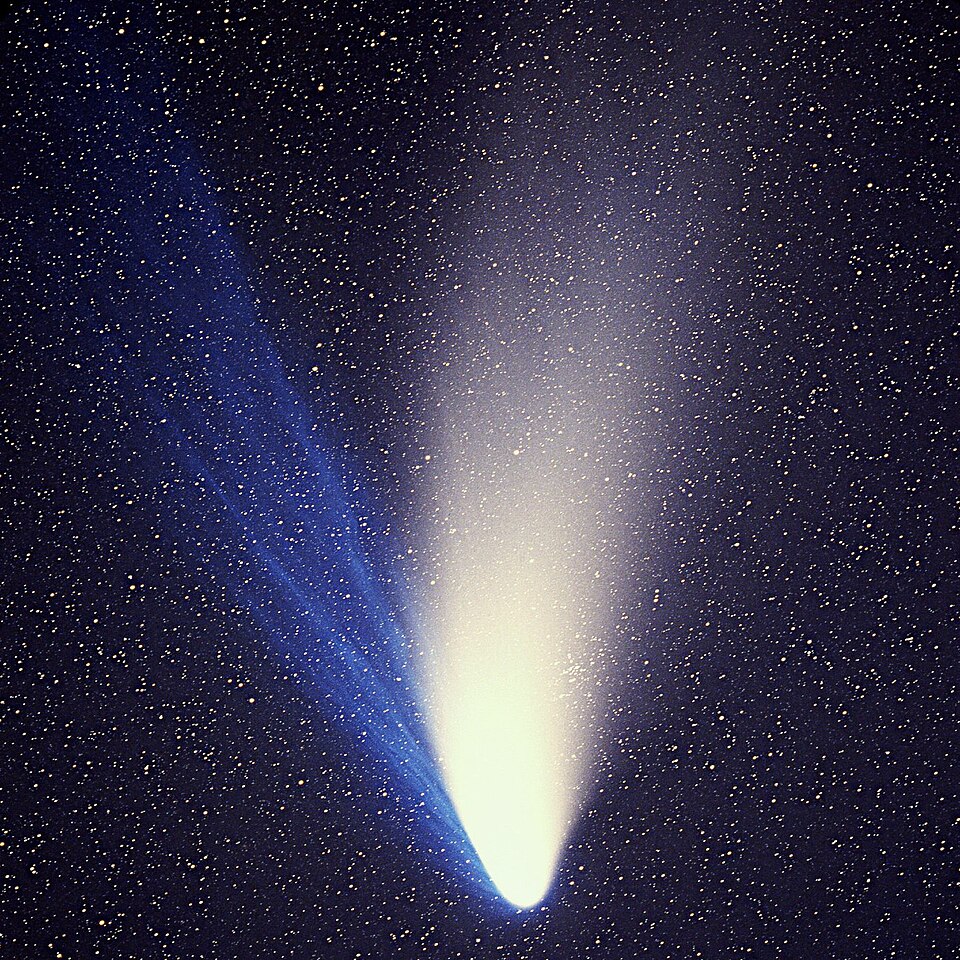
The cloud's members did not form out there. They were planetesimals from the giant-planet region that were slung outward by close encounters with Jupiter and Saturn, then had their orbits circularised and randomised by the gravity of the whole Milky Way and by passing stars. That same galactic tide, plus occasional stellar flybys, is what dislodges a few of them each year and sends them falling toward the Sun to appear as long-period comets — Hale–Bopp, Hyakutake, and the "new" comets that appear with no warning.
Why it matters. The Oort cloud preserves the most pristine material from the solar system's birth, and it is the natural boundary of the Sun's domain: the point where the Sun's gravity gives way to the pull of the rest of the galaxy. Beyond it, the next stop is another star.
Sunlight takes 8 minutes to reach Earth, more than 4 hours to reach Neptune, and over a year to reach the outer edge of the Oort cloud. Distances like that are hard to picture, so this section lays them out along lines running from the Sun. For the orbits seen from above, see the planets in their orbits; for a zoom out past the planets to the edge of the Sun’s reach, see beyond the planets.
The inner Solar System, drawn to scale
Distances here are linear: one astronomical unit is the same width everywhere on the line. Notice how much of it is empty.
To fit the Oort cloud on the same line the scale has to change: each step to the right now multiplies the distance by ten. The rocky planets, which filled the strip above, are crowded into the first fifth of this one.
1 AU (astronomical unit) is the average Earth–Sun distance, about 150 million km. Light covers it in 8 minutes 20 seconds. Voyager 1, launched in 1977 and the most distant human-made object, is only now approaching 170 AU — well short of the inner Oort cloud.
All of it is held together, lit and warmed by one ordinary star. Take a closer look at it next: continue to the Sun.
Image credits
The planets of the Solar System in true colour, to scale (page header) — CactiStaccingCrane, using NASA, ESA and other mission imagery. CC BY-SA 4.0.
Source
Protoplanetary disc around HL Tauri (ALMA) — ALMA (ESO/NAOJ/NRAO). CC BY 4.0.
Source