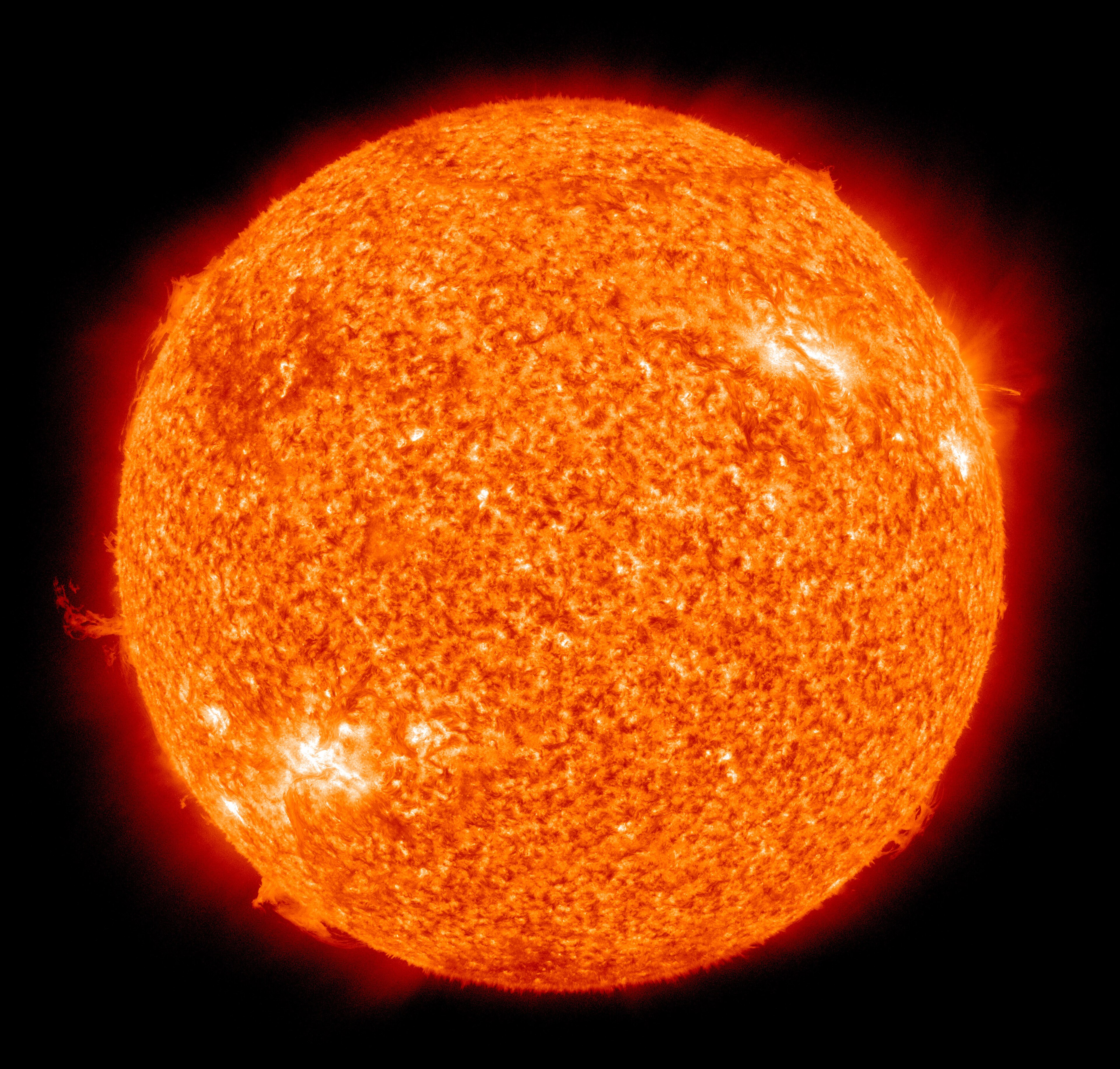

A magnetic star
All of these features share a single cause: the Sun's magnetic field. The Sun is a ball of electrically charged gas (plasma) that rotates faster at its equator than near its poles. That uneven spin twists and concentrates the magnetic field until bundles of it break through the visible surface. Where they emerge, astronomers find an active region — and that is where sunspots, plage, filaments, flares and coronal mass ejections tend to cluster. Activity rises and falls over an average 11-year solar cycle.
To give a sense of scale, most photos on this page carry a small Earth to scale inset. Earth is about 12,700 km (7,900 miles) across; the Sun is about 1.39 million km, so roughly 109 Earths would fit side by side across its face. The insets compare Earth with the true physical size of each feature.
Earth to scale
The layers of the Sun
From the core to the corona
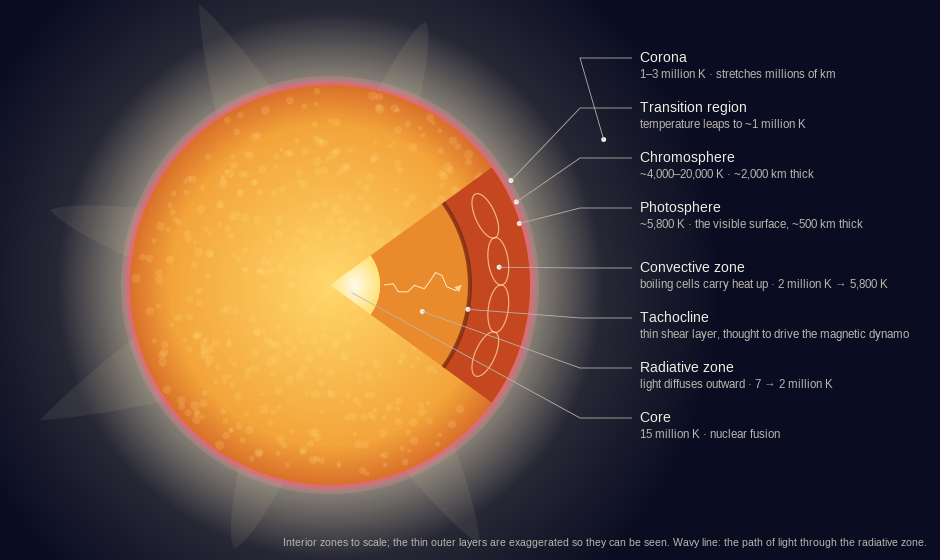
The Sun has no solid surface. It is a ball of hot plasma, about 73% hydrogen and 25% helium by mass, that gets steadily hotter and denser toward the centre. Even so, it has distinct layers, each defined by how energy moves through it. The features described on this page all live in the outer layers, but their energy and their magnetism come from deep inside.
The core. The inner quarter of the Sun's radius is its power plant. At about 15 million K, and squeezed to roughly 150 times the density of water, hydrogen nuclei fuse into helium, converting about 4 million tonnes of matter into energy every second. Almost all of the Sun's energy is made here.
The radiative zone. From the edge of the core out to about 70% of the radius, the gas is too dense and hot to boil, so energy moves outward as light. Each photon travels only a tiny distance before it is absorbed and re-emitted in a random direction, so the energy staggers outward in an aimless walk. Estimates of how long it takes to cross this zone range from tens of thousands to a few hundred thousand years.
The tachocline. At the outer edge of the radiative zone is a thin boundary layer. Below it the Sun turns like a solid ball; above it the equator spins faster than the poles. The shearing between the two is thought to wind up the Sun's magnetic field and drive the solar dynamo behind the 11-year cycle.
The convective zone. In the outer 30% of the Sun, about 200,000 km deep, the gas is cool enough that it can no longer pass the energy along as light. Instead it boils, like a pot on a stove: hot plasma rises, cools at the top, and sinks again, carrying energy to the surface in a matter of weeks. The tops of these cells show on the surface as granulation, a pattern of bright grains each about the size of Texas that form and fade within ten or twenty minutes.
The photosphere. This is the visible "surface" — the layer, only about 500 km thick, where the gas finally becomes transparent and light escapes into space. Its temperature is about 5,800 K. Sunspots, granulation and the bright faculae near the Sun's edge are all photospheric features. The disc looks darker toward its edge (limb darkening) because there we see only the cooler upper part of the photosphere.
The chromosphere. Above the photosphere lies a thin, irregular layer about 2,000 km thick. Strangely, the temperature rises again here, from about 4,000 K to around 20,000 K. Its light is swamped by the photosphere except in special filters such as hydrogen-alpha, or for a few seconds at a total eclipse, when it flashes into view as a pinkish-red rim — the colour that gives it its name, from the Greek for "colour sphere". Plage, filaments and the bases of prominences are chromospheric features, and its surface bristles with jets of gas called spicules.
The transition region. In a layer only a few hundred kilometres thick the temperature leaps from tens of thousands of degrees to about a million. It is seen only in ultraviolet light from spacecraft.
The corona. The Sun's outer atmosphere is a million times fainter than the photosphere and extremely thin, yet it is heated to 1–3 million K, hotter still above active regions. Why the corona is hundreds of times hotter than the surface beneath it is one of the great puzzles of solar physics; the leading explanations involve magnetic waves and countless small magnetic explosions. The corona is normally hidden by the glare of the photosphere, but during a total solar eclipse it appears as a pearly white halo with long streamers shaped by the magnetic field. It has no outer edge: it flows continuously away from the Sun as the solar wind, at 400–800 km/s, out past all the planets. In 2021 NASA's Parker Solar Probe became the first spacecraft to fly through the corona.
| Layer | Where | Temperature | How energy moves |
|---|---|---|---|
| Core | Centre to 25% of the radius | ~15 million K | Made by nuclear fusion |
| Radiative zone | 25–70% of the radius | ~7 to 2 million K | Carried by light, absorbed and re-emitted countless times |
| Convective zone | Outer 30%, ~200,000 km deep | ~2 million K to 5,800 K | Carried by rising and sinking plasma |
| Photosphere | The visible surface, ~500 km thick | ~5,800 K | Escapes into space as sunlight |
| Chromosphere | ~2,000 km above the surface | ~4,000 to 20,000 K | Heated by magnetic waves and shocks |
| Transition region | A few hundred km thick | ~20,000 K to 1 million K | Sharp jump in temperature |
| Corona | Outward for millions of km | 1–3 million K | Flows away as the solar wind |
Sunspots
Layer: photosphere (the visible surface) · Seen in: white light
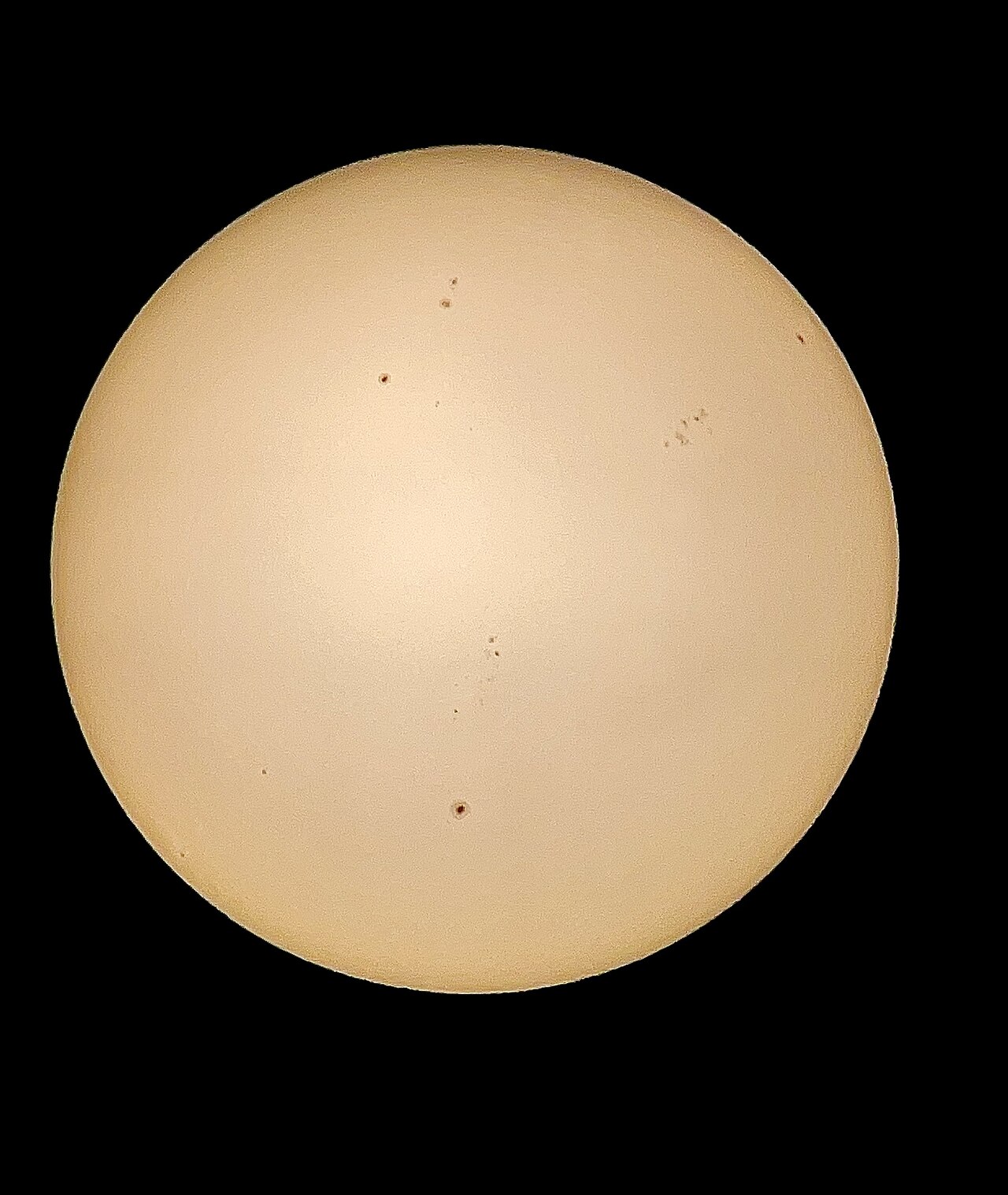
Sunspots are the easiest solar feature to see — with a proper solar filter, even a small telescope shows them. They look black, but only by contrast: a sunspot is roughly 1,500–2,000 degrees cooler than the surrounding surface, which glows at about 5,800 K. Seen on its own, a sunspot would still shine brighter than an arc welder.
The cause is magnetism. Inside a sunspot the magnetic field is thousands of times stronger than Earth's, strong enough to choke off the churning convection that normally carries heat up from below. Less heat arriving means a cooler, darker patch.
Earth to scale

Quick facts
- Sunspots usually come in pairs or groups of opposite magnetic polarity, like the two ends of a bar magnet.
- Large spots can be several times the diameter of Earth and last for weeks.
- Their number rises and falls with the 11-year solar cycle; counting them is one of the longest-running records in science.
- The Sun's rotation carries spots across the disk in about two weeks.
Plage
Layer: chromosphere · Seen in: hydrogen-alpha and calcium-K light
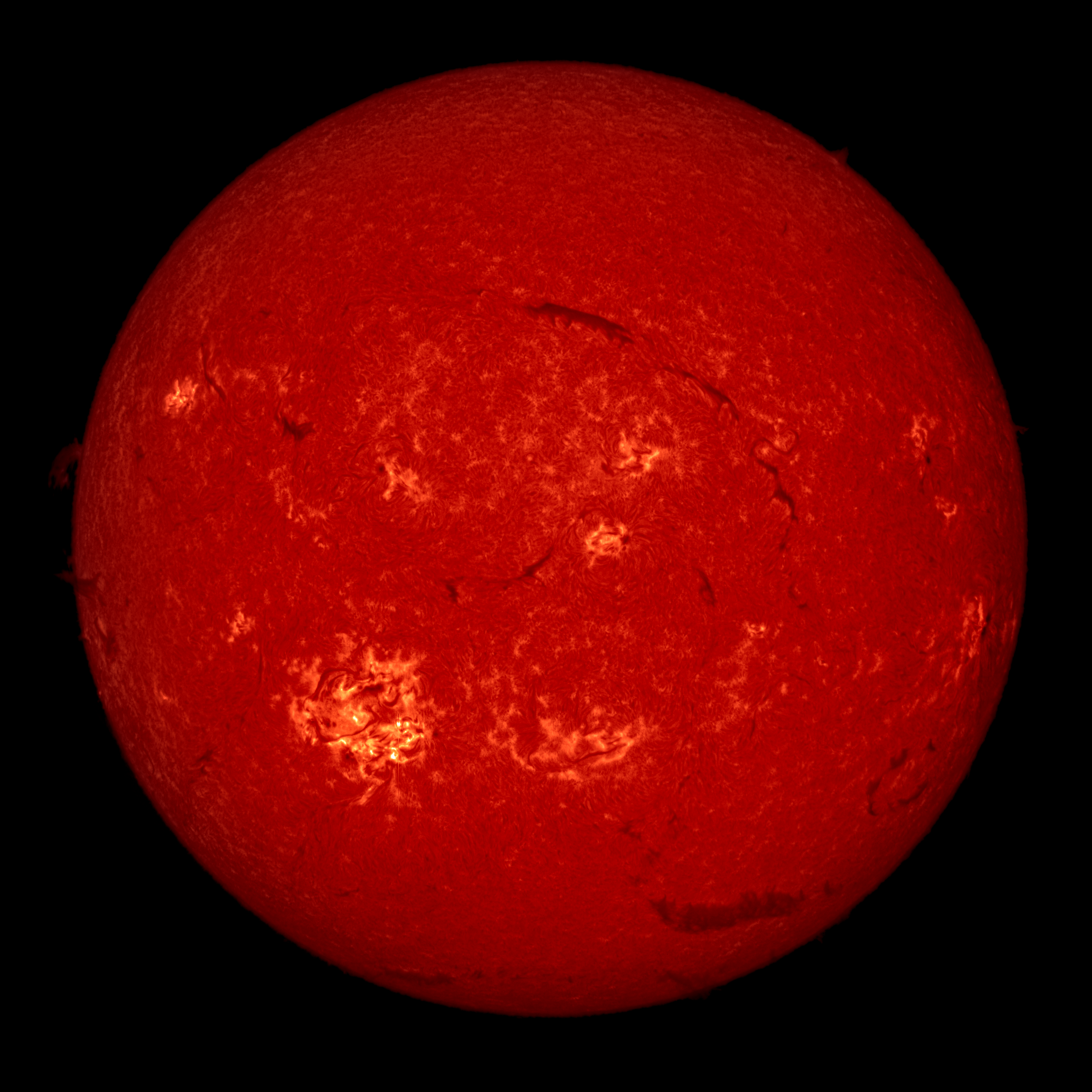
Plage (pronounced "plahzh") are bright, cloud-like patches that surround sunspot groups. They are nearly invisible in ordinary white light but stand out clearly through narrow-band filters tuned to hydrogen-alpha (deep red) or ionized calcium's "K line" (violet).
Plage mark places where the magnetic field is concentrated, but not concentrated enough to form a spot. Instead of blocking heat, these smaller magnetic bundles let extra energy leak upward, so the chromosphere above them glows brighter than its surroundings. Their counterparts lower down, in the photosphere, are called faculae — bright specks seen most easily near the Sun's edge.
The name comes from the French plages brillantes, "bright regions," a phrase used by the astronomer Henri Deslandres in the 1890s. (It is often said to mean "beach," but that's a later misreading.)
Quick facts
- Plage often appear before sunspots form and linger after the spots fade.
- They are a reliable map of the Sun's magnetic activity, even on days with no spots at all.
- Plage and faculae slightly raise the Sun's total brightness at solar maximum, more than offsetting the dimming from sunspots.
- In the hydrogen-alpha image under “A magnetic star,” the bright blotches are plage.
- A single plage region can sprawl across 100,000 km or more, wide enough to line up about eight Earths side by side.
Filaments
Layer: chromosphere and corona · Seen in: hydrogen-alpha and extreme ultraviolet
Filaments are long, dark ribbons stretched across the face of the Sun. Each one is a vast cloud of relatively cool, dense plasma — around 10,000 K — floating in the corona, where the surrounding gas is more than a million degrees. Magnetic field lines cradle the material like a hammock, holding it aloft against the Sun's gravity.
Because the filament is cooler than what lies behind it, it absorbs light and looks dark against the bright disk. When the same kind of structure sits at the Sun's edge, seen against black space, it glows instead and is called a prominence. Filaments and prominences are the same phenomenon viewed from different angles.
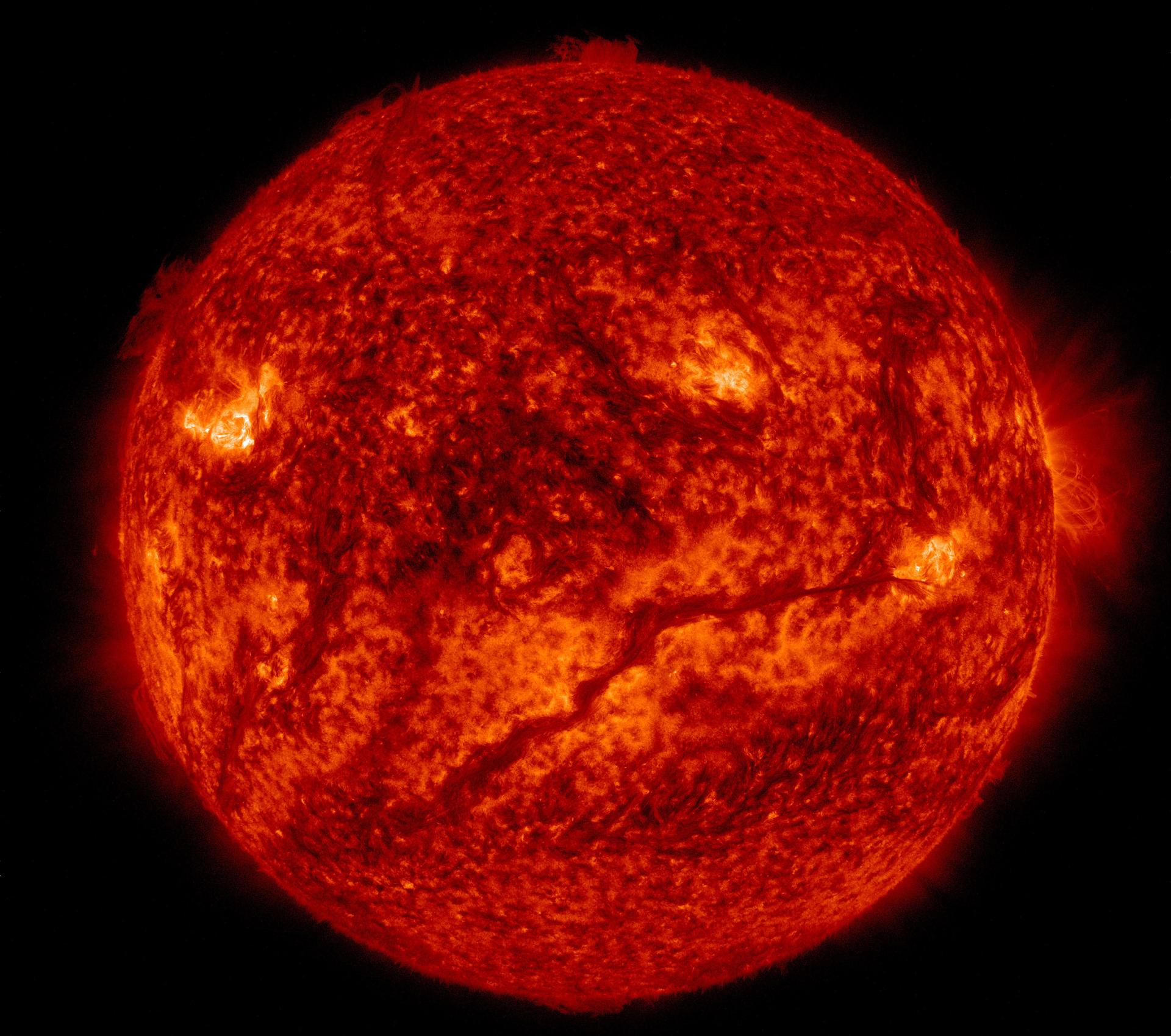
Earth to scale
Quick facts
- Filaments form above the boundary line between regions of opposite magnetic polarity.
- Quiet filaments far from active regions can survive for weeks or even months.
- When a filament becomes unstable it can collapse back down or erupt outward, often launching a coronal mass ejection.
Prominences
Layer: chromosphere into the corona · Seen in: hydrogen-alpha, extreme ultraviolet, and at total solar eclipses
A prominence is a filament seen side-on. When the Sun's rotation carries one of those dark ribbons to the edge of the disk, it is no longer silhouetted against the bright surface. Instead it glows against the blackness of space as a luminous arch, plume or hedgerow of plasma standing high above the surface.
Like filaments, prominences are made of gas at roughly 10,000 K, about a hundred times cooler than the corona around them, held up by magnetic fields that act as both support and insulation. During a total solar eclipse, when the Moon blocks the bright disk, prominences can be seen with the naked eye as vivid pink-red flames around the black edge of the Moon. Their color comes from hydrogen's red H-alpha light.
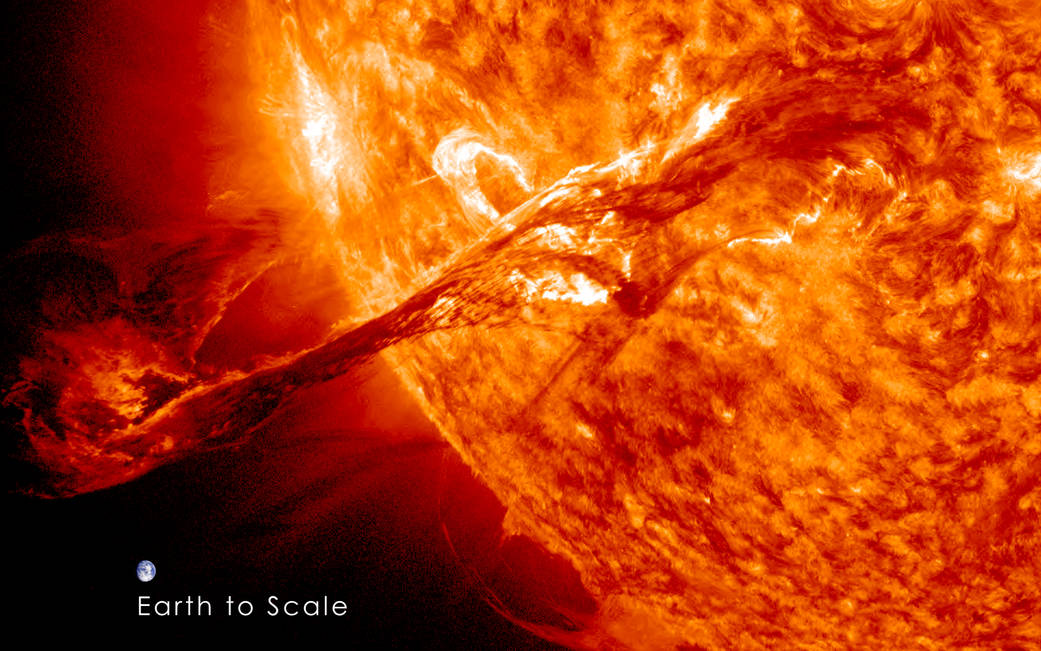
Astronomers sort prominences by how they behave:
- Quiescent prominences form far from active regions, often at high latitudes. They are calm and long-lived, sometimes lasting for months, and can reach great heights.
- Active-region prominences sit in the strong magnetic fields near sunspots. They live for hours to days and are far more likely to erupt.
- Eruptive prominences are those that break loose, rising at hundreds to more than 1,000 km per second and lifting off into space.
Quick facts
- Prominence and filament are two names for the same structure: "filament" on the disk, "prominence" at the edge.
- The largest on record stretched more than 800,000 km, well over half the Sun's diameter.
- At least 70% of prominence eruptions are accompanied by a coronal mass ejection.
- The first detailed written description of a prominence dates to the total solar eclipse of May 1, 1185, recorded in a Russian chronicle.
Flares
Layer: all layers, from photosphere to corona · Seen in: X-rays, ultraviolet, hydrogen-alpha, radio
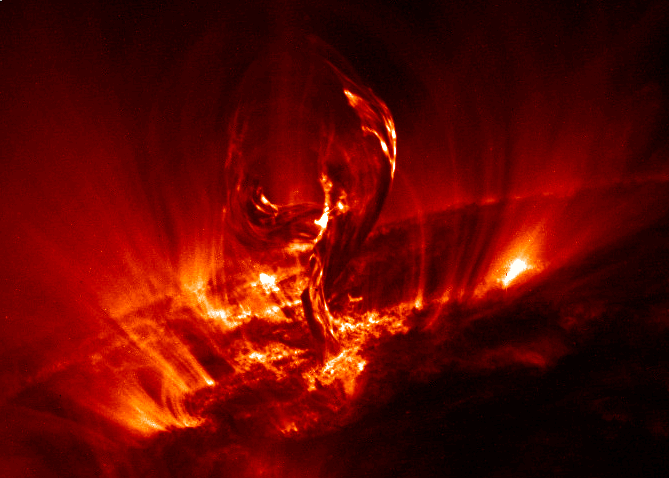
A solar flare is a sudden, intense burst of light from an active region — the most powerful explosions in the solar system. Over minutes, tangled magnetic field lines above a sunspot group snap and reconnect into a simpler shape, releasing stored energy all at once. A large flare can release as much energy as millions of hydrogen bombs, heating gas to tens of millions of degrees and flinging particles to nearly the speed of light.
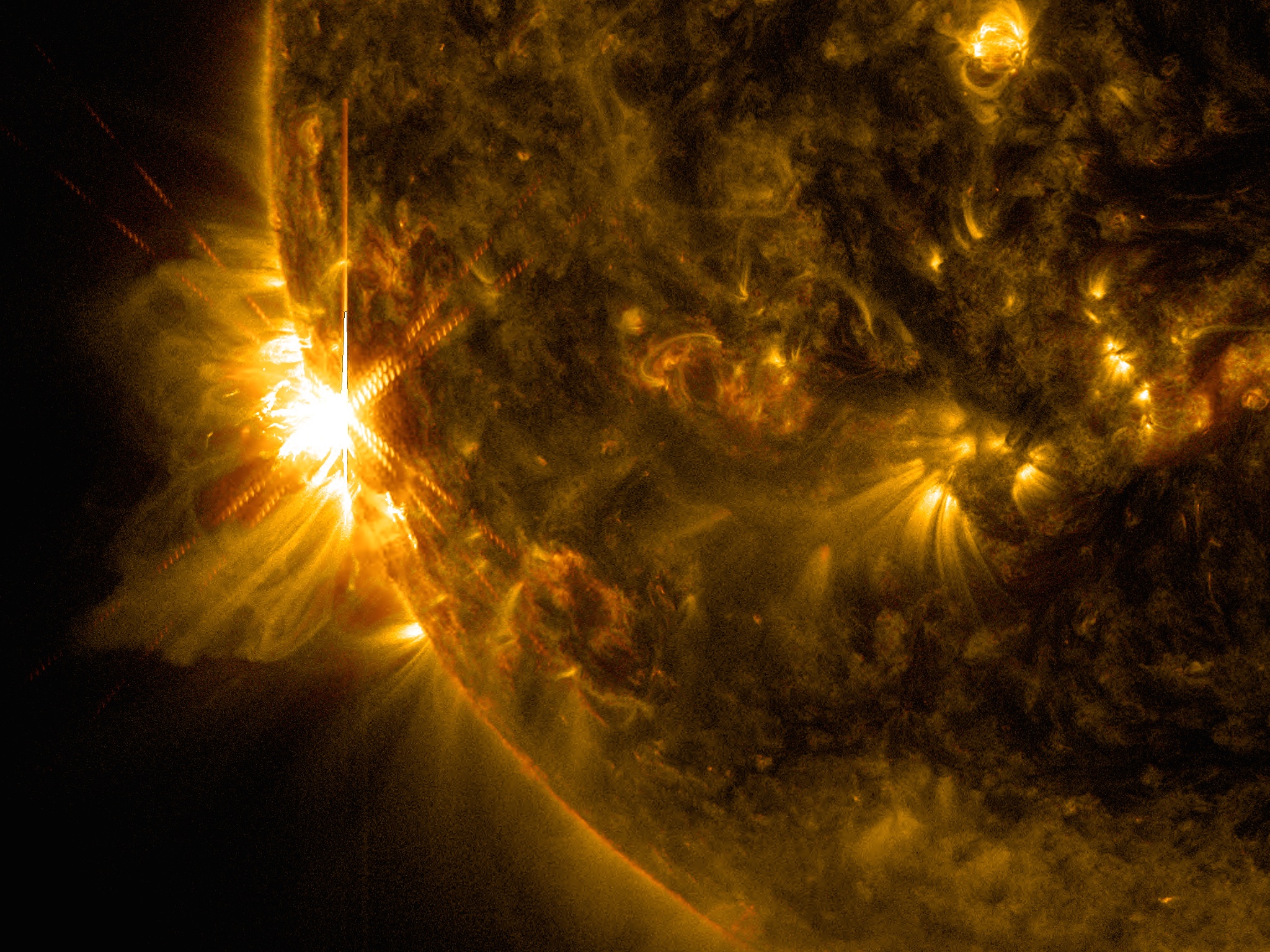
Earth to scale
Flares are ranked by how much X-ray energy reaches Earth. Each letter class is ten times stronger than the one before it, and a number refines the strength within a class (an X2 is twice an X1).
| Class | Strength | Typical effect on Earth |
|---|---|---|
| A, B | Background | None |
| C | Small | Little or none |
| M | Medium | Brief radio blackouts near the poles |
| X | Major | Planet-wide radio blackouts; radiation storms |

Quick facts
- The first flare ever recorded was seen in white light by Richard Carrington and Richard Hodgson on September 1, 1859. The geomagnetic storm that followed, the "Carrington Event," remains the strongest on record.
- Flare light reaches Earth in about 8 minutes; Earth's atmosphere blocks the X-rays, so flares are no danger to people on the ground.
- Strong flares can disrupt shortwave radio and GPS, and pose radiation risks to astronauts.
- Through a hydrogen-alpha telescope, flares appear as suddenly brightening ribbons inside plage.
Coronal mass ejections (CMEs)
Layer: corona and out into the solar system · Seen in: coronagraphs (instruments that block the Sun's disk)
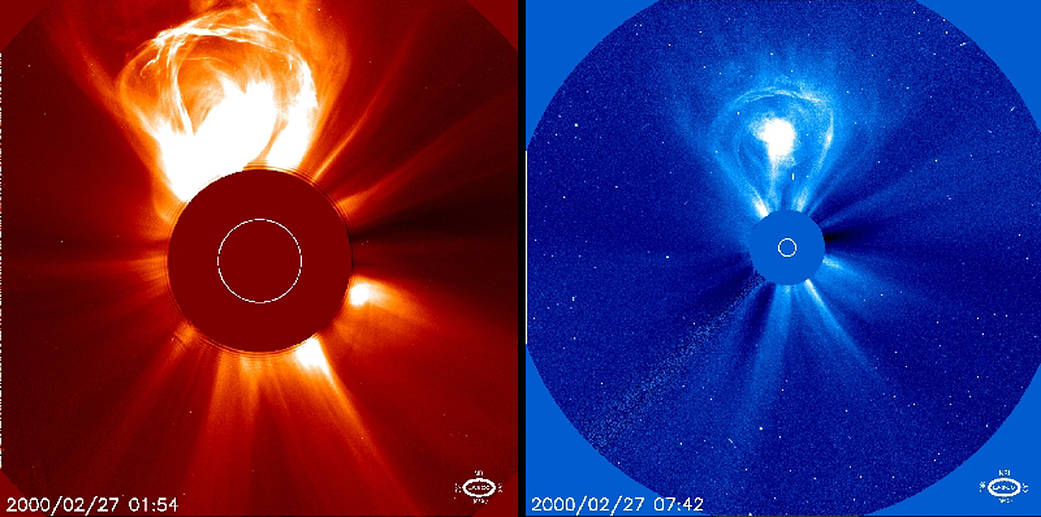
A coronal mass ejection is exactly what its name says: a huge mass of the Sun's outer atmosphere, the corona, hurled out into space. A large CME can carry billions of tons of magnetized plasma and expand to become wider than the Sun itself within hours, eventually sweeping out a region many millions of kilometres across as it crosses the solar system.
CMEs are often confused with flares, and the two frequently happen together, but they are different things. A flare is a flash of light that reaches Earth in about eight minutes. A CME is a cloud of matter that travels far more slowly, at roughly 250 to 3,000 km per second, so it usually takes one to three days to cover the 150 million km to Earth. Many CMEs begin when a filament or prominence erupts, carrying its cool plasma along inside the expanding cloud.
When a CME reaches Earth
Most CMEs head off in other directions, but when one is aimed at Earth its magnetic field can couple with our planet's magnetic field and set off a geomagnetic storm. The results can include:
- Auroras spreading far beyond the polar regions. During the strong storm of May 10–11, 2024, the northern lights were seen across much of the United States, including New Jersey.
- Power-grid problems. A storm on March 13, 1989, knocked out the Hydro-Québec grid, leaving millions without power for about nine hours.
- Satellite and GPS disruption, as the upper atmosphere heats, swells and drags on spacecraft in low orbit.
Quick facts
- CMEs are watched with coronagraphs, telescopes that create an artificial eclipse by blocking the Sun's disk so the faint corona can be seen.
- Near solar maximum the Sun can produce several CMEs a day; near minimum, about one every few days.
- The CME behind the 1859 Carrington Event reached Earth in under 18 hours, extraordinarily fast.
- A CME that appears as an expanding ring all the way around the Sun, called a "halo CME", is coming either straight toward Earth or directly away from it.
Prominence, flare or CME?
Three different things that often happen together
These three are easy to mix up because they so often occur in the same eruption, but they are different kinds of things. A prominence is a structure, a flare is a flash of energy, and a CME is a cloud of matter thrown into space.
- Prominence: a cloud of relatively cool plasma (about 10,000 K) held above the surface by magnetic fields. It can sit quietly for days or even months. Against the bright disk it looks dark and is called a filament; at the edge, against space, it glows.
- Flare: a sudden burst of light and radiation, from radio waves to X-rays, released when tangled magnetic fields snap and reconnect. It lasts minutes to hours, and its light reaches Earth in about 8 minutes. It is mostly energy; little material leaves the Sun.
- CME: billions of tons of magnetized plasma blasted out of the corona. It travels far slower than light, taking 1 to 3 days to reach Earth. That is why CMEs, not flares, cause most geomagnetic storms and auroras.
| Prominence | Flare | CME | |
|---|---|---|---|
| What it is | Cool plasma held up by magnetism | Burst of light and radiation | Ejected cloud of plasma |
| Duration | Days to months | Minutes to hours | Hours to leave the Sun, days to cross space |
| Reaches Earth? | No, unless it erupts as part of a CME | Its light arrives in about 8 minutes | Its matter arrives in 1 to 3 days |
| Main effect on Earth | None | Radio blackouts | Geomagnetic storms, auroras, power-grid trouble |
They don't always come as a set. Many flares happen with no CME, and some CMEs launch from quiet prominence eruptions with only a weak flare, or none at all. The August 31, 2012 eruption pictured in the Prominences section is a good example of a prominence becoming a CME.
How they fit together
Picture a typical active region rotating into view. In white light you see a sunspot group. Switch to a hydrogen-alpha filter and the spots are wrapped in glowing plage, with a dark filament lying along the dividing line between magnetic polarities. As the Sun turns, that filament reaches the edge and becomes a prominence. If the magnetic field becomes stressed enough, it can snap in a flare and tear the prominence loose, sending it off into space inside a coronal mass ejection. Days later, that CME may arrive at Earth and light up the sky with auroras. All six are chapters of the same magnetic story.
Image credits
- The Sun in extreme ultraviolet, 304 Å (page header) — NASA/SDO. Public Domain. Source
- Hydrogen-alpha full-disk Sun — Big Bear Solar Observatory / NJIT. Public Domain. Source
- "Sunspots on June 7 2023" — Juliebern. CC0 1.0. Source
- Giant filament, Feb. 10, 2015 — NASA/Goddard/SDO. Public Domain. Source
- X2.2 flare, June 10, 2014 — NASA/SDO/Goddard/Wiessinger. Public Domain. Source
- Filament eruption during a flare — TRACE, NASA. Public Domain. Source
- Massive filament eruption with Earth to scale, Aug. 31, 2012 — NASA/SDO/AIA. Public Domain. Source
- Coronal mass ejection, Feb. 27, 2000 — SOHO (ESA & NASA); courtesy of SOHO/LASCO consortium. Free for educational, non-commercial use with credit. Source, usage terms
- Diagram of the Sun's layers — drawn for this site.