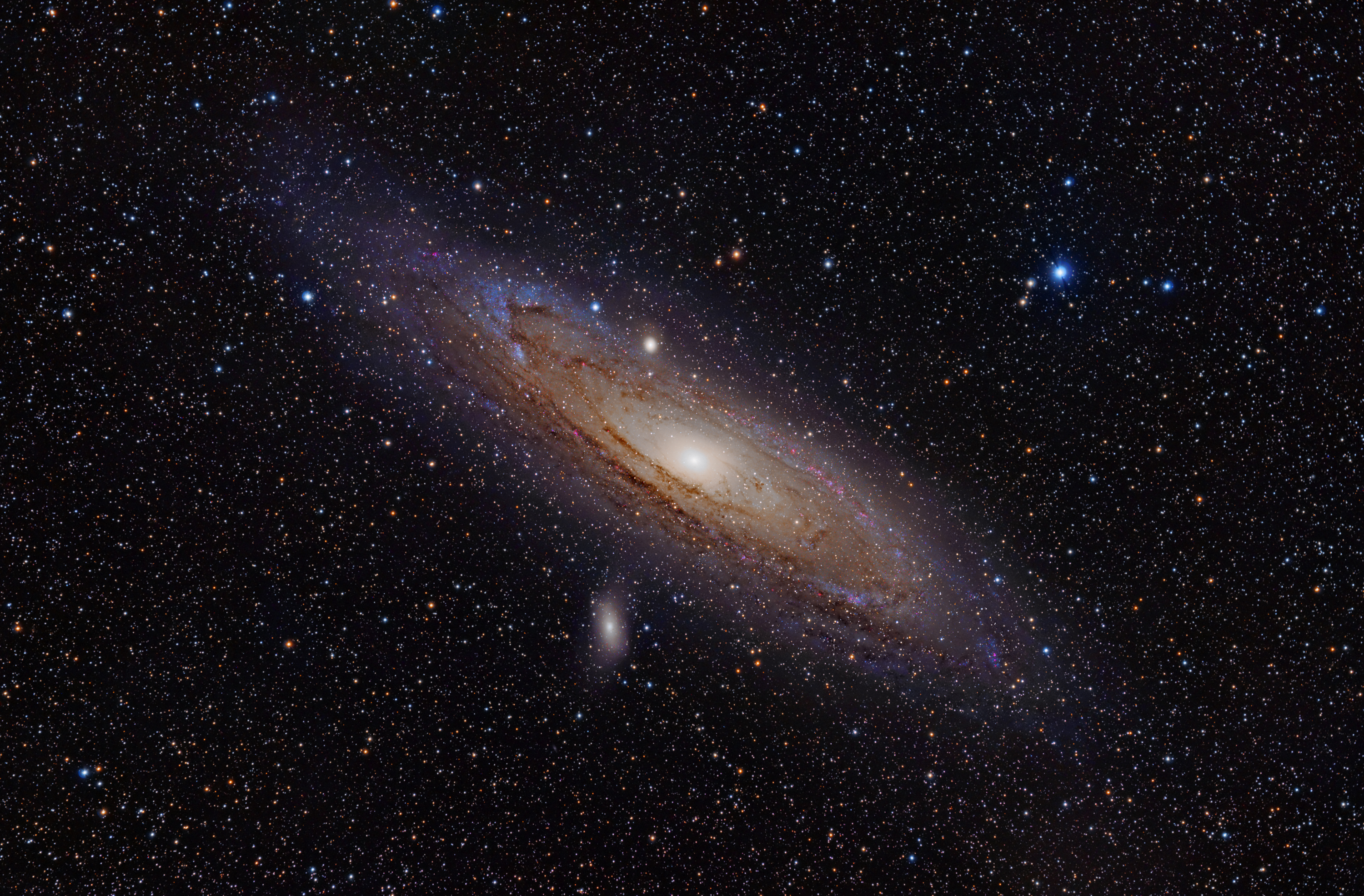

What a galaxy is
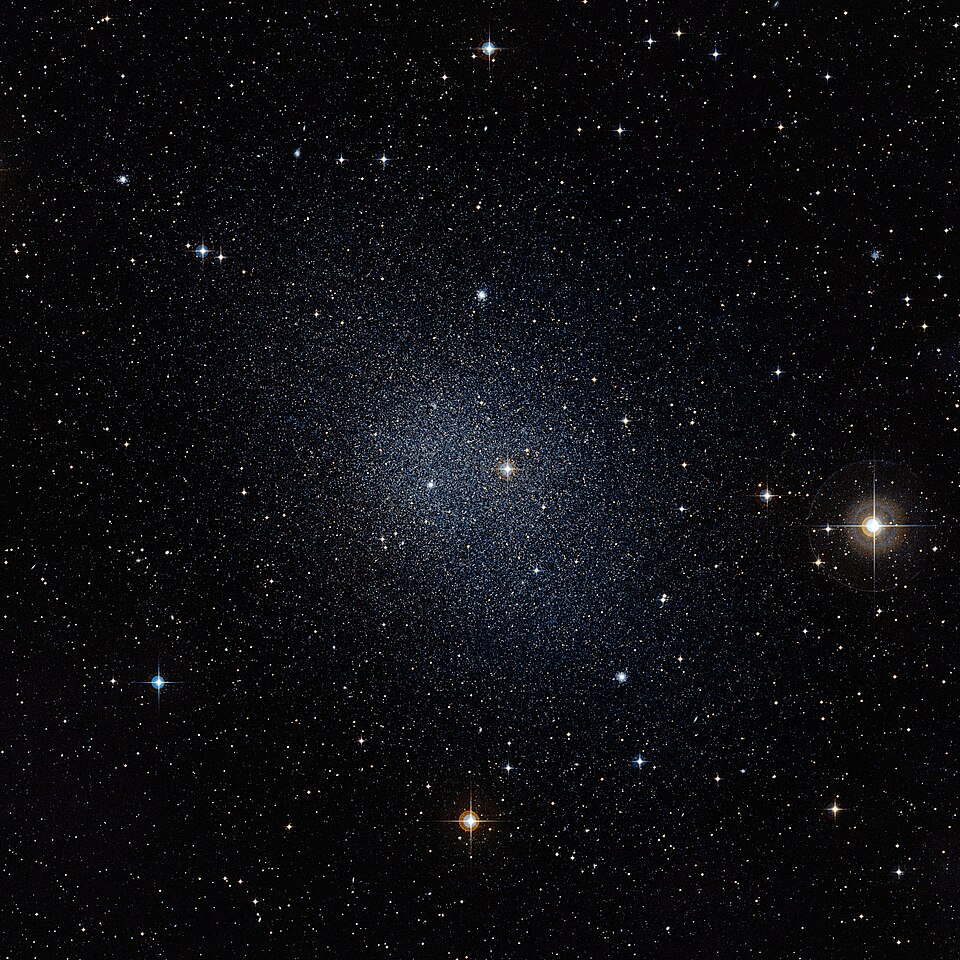
A galaxy is a gravitationally bound system of stars, gas, dust and dark matter, ranging from dwarfs of a few million stars to giants of several trillion. The Milky Way is a large one, with perhaps 200–400 billion stars in a disc 100,000 light-years across. The observable universe holds something like two trillion galaxies.
Until a century ago no one knew galaxies existed. The fuzzy "spiral nebulae" catalogued by Messier and Herschel might have been gas clouds inside the Milky Way, or "island universes" far beyond it; the Great Debate of 1920 between Harlow Shapley and Heber Curtis argued both sides. Edwin Hubble settled it in 1924 by finding Cepheid variables in Andromeda and measuring its distance at nearly a million light-years (we now know it is 2.5 million) — far beyond any star in our galaxy. Suddenly the universe was vastly larger than anyone had imagined, and full of other Milky Ways.
Most of a galaxy's mass is dark matter, arranged in a roughly spherical halo that extends several times farther than the visible stars.
- Galaxies in observable universe
- ~2 trillion
- Stars in the Milky Way
- 200–400 billion
- Milky Way disc diameter
- ~100,000 ly
- Dark matter halo
- ~85% of mass
- Distance to Andromeda
- 2.5 million ly
- Most distant confirmed galaxy
- ~13.5 billion ly (light-travel)
Kinds of galaxy
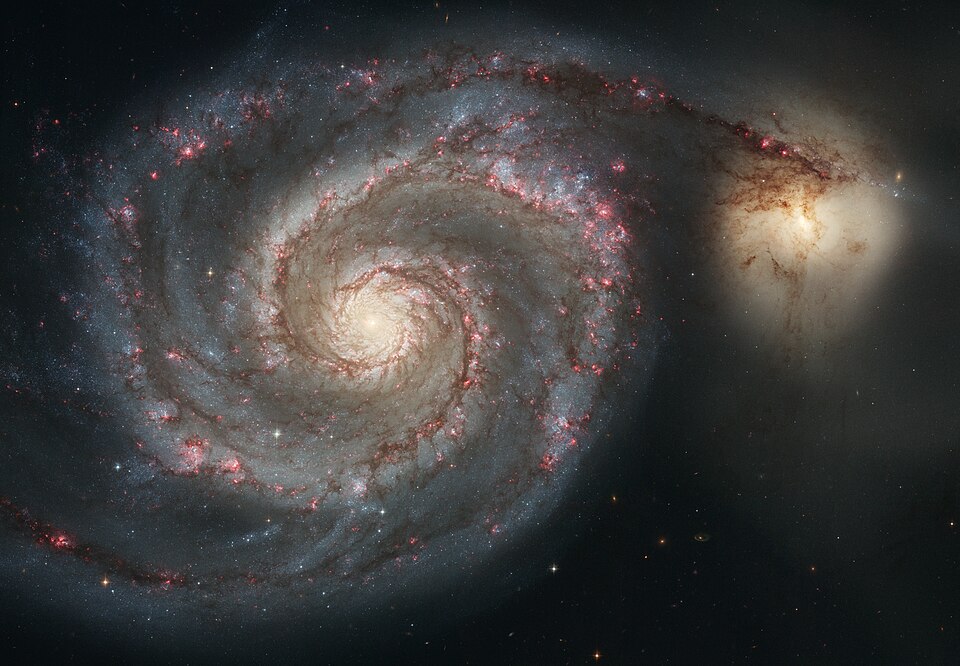
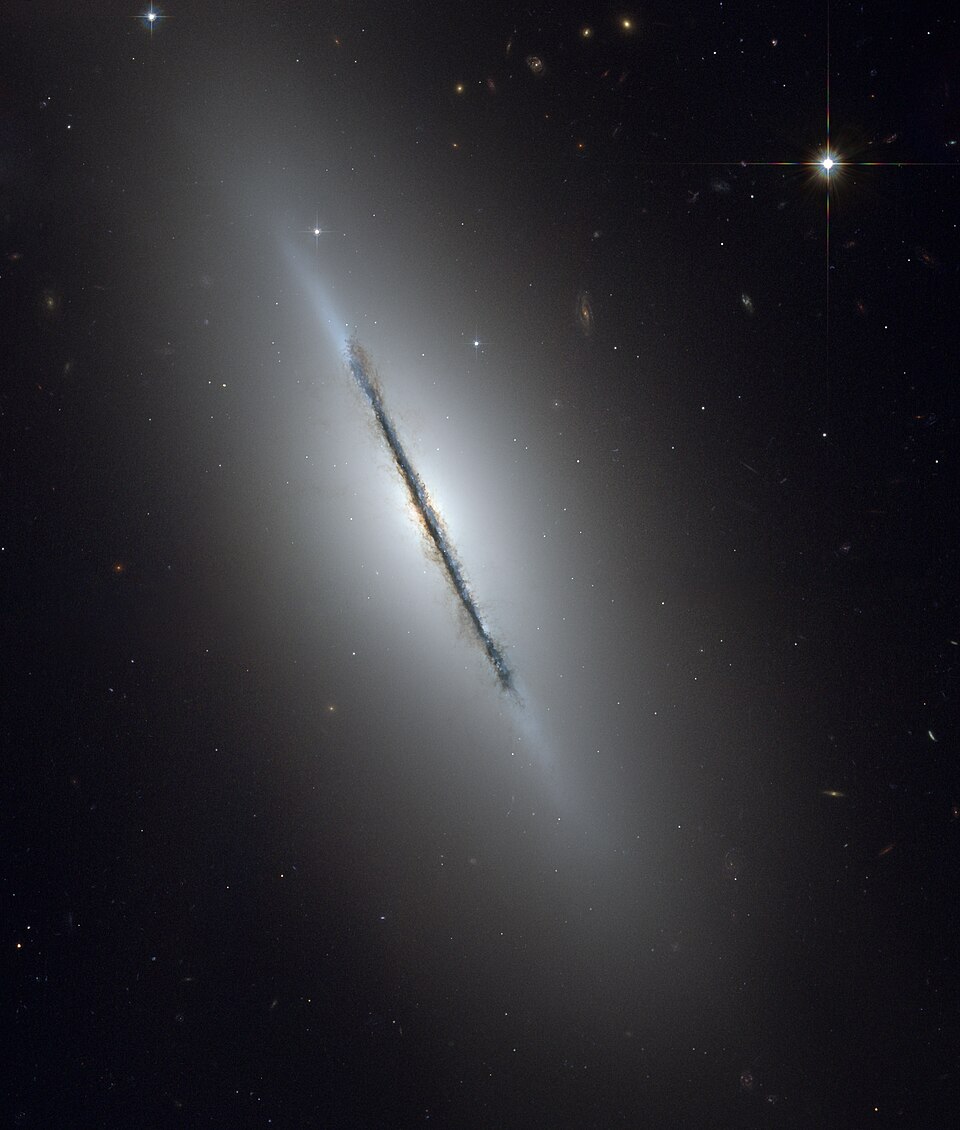
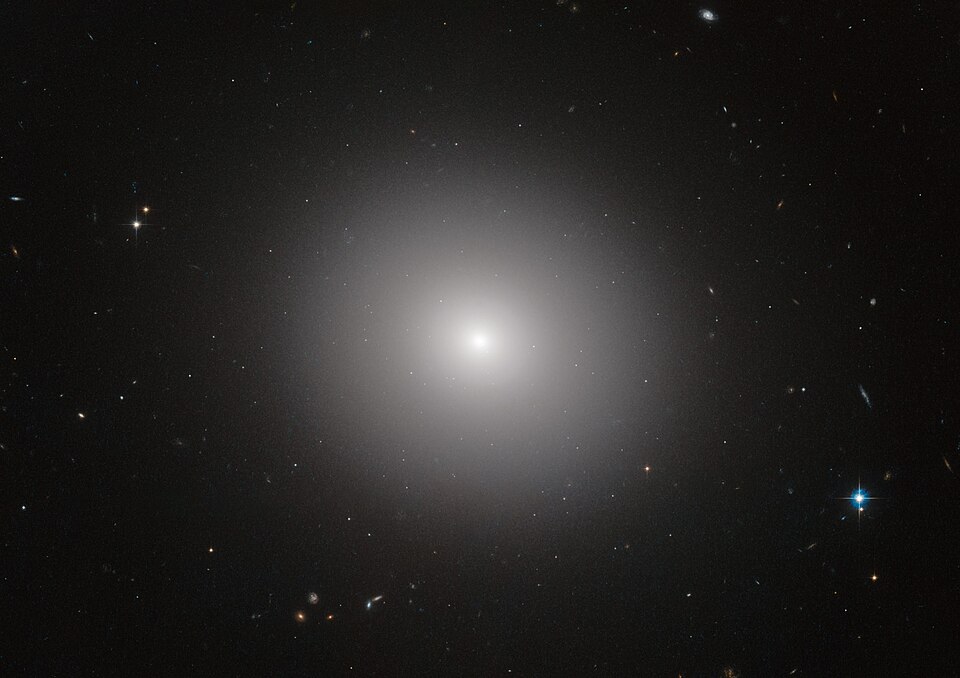
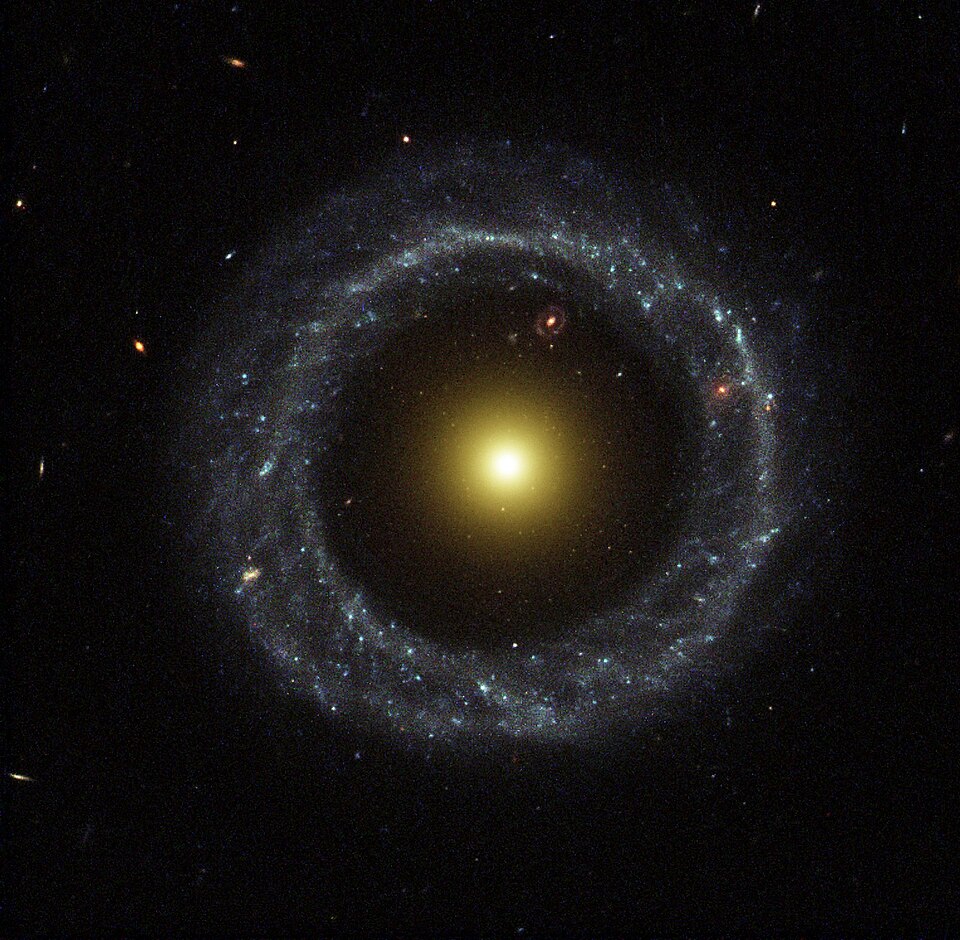
Hubble sorted galaxies by appearance into a scheme still used today, though his idea that it was an evolutionary sequence from elliptical to spiral turned out to be wrong. We now believe that mergers of spiral galaxies contribute significantly to the formation of ellipticals. Over time, the trend has been one-directional. Over the last several billion years, the share of massive “red and dead” ellipticals has steadily grown, while star-forming spirals have become comparatively rarer.





How galaxies form
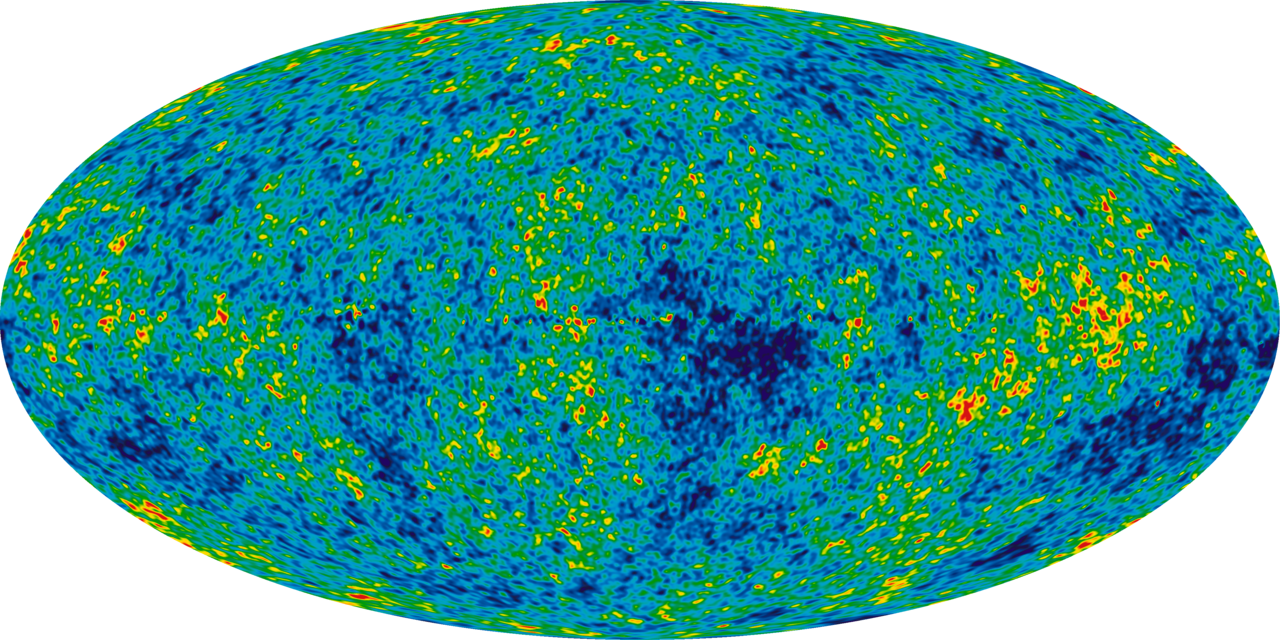
Let's begin around 380,000 years after the Big Bang, when the universe had cooled enough for atoms to form and light to travel freely. That light is the cosmic microwave background, and it shows a universe that was almost perfectly uniform — but not quite. Regions were denser than average by about one part in 100,000. Those tiny ripples were the seeds of everything.
Dark matter went first. Not feeling radiation pressure, it could begin collapsing into the overdense regions while ordinary matter was still coupled to light. Over the next few hundred million years dark matter gathered into halos, small ones first, which merged into larger ones — a hierarchical or bottom-up process. Ordinary gas then fell into the gravitational wells the dark matter had dug, cooled by radiating away energy, and sank to the centres, where it fragmented into the first stars.
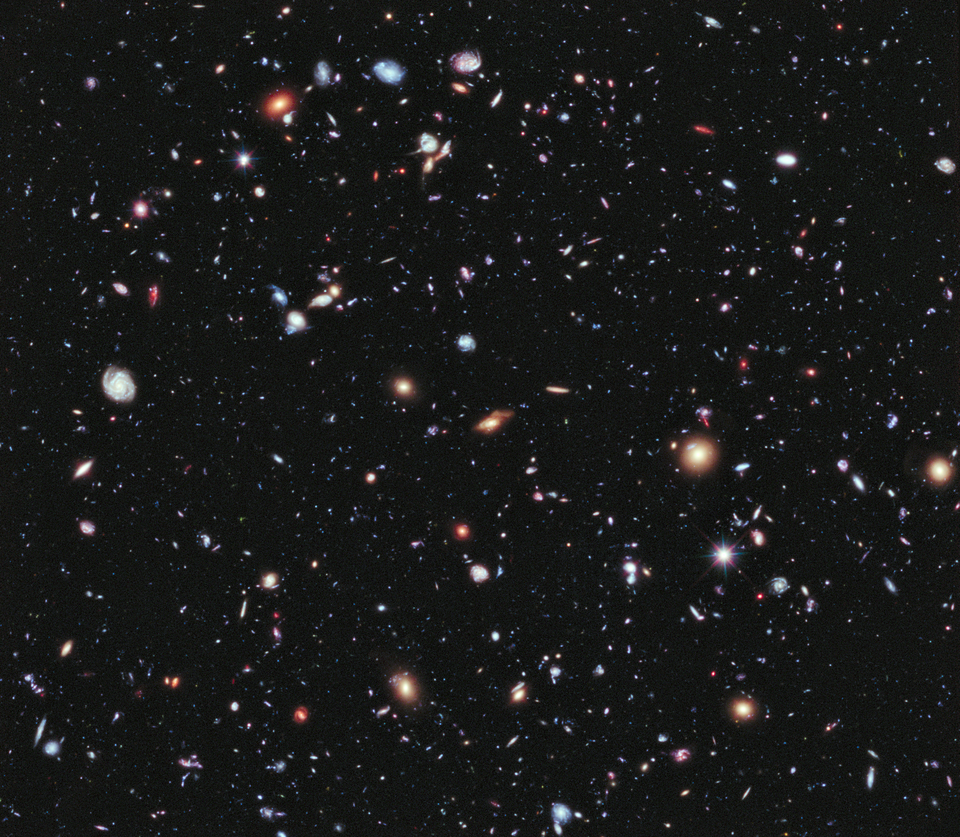
Those first stars, around 100–200 million years after the Big Bang, were probably huge, hot and short-lived, made of pure hydrogen and helium. Their ultraviolet light re-ionised the gas around them, ending the "cosmic dark ages," and their supernovae seeded the surrounding gas with the first heavy elements. The James Webb Space Telescope has now photographed galaxies as they were 300–400 million years after the Big Bang, and they are surprisingly bright and numerous — a genuine puzzle for models of how quickly stars could form.
Whether a galaxy becomes a disc or a spheroid depends largely on how it acquired its gas. Gas that flowed in smoothly along cold streams, carrying angular momentum, settled into a rotating disc and became a spiral. Halos assembled by violent, rapid mergers scrambled their stars' orbits and became ellipticals. Supermassive black holes grew in the centres alongside their galaxies, feeding on infalling gas; the energy they released as quasars and jets heated and expelled gas, throttling star formation in the largest galaxies — which is why the most massive galaxies are "red and dead" today.

How galaxies move
Within a spiral galaxy, stars orbit the centre. The Sun travels at about 230 km/s and takes roughly 225 million years to complete one circuit — a "galactic year"; it has made about twenty since it formed. The flat rotation curves described on the Stars page show that the mass responsible extends far beyond the visible disc.
Spiral arms are not fixed streams of stars. If they were, differential rotation — inner stars orbiting faster than outer ones — would wind them up tightly within a few rotations. Instead the arms are density waves: slowly rotating patterns of compression through which stars and gas pass, like cars bunching at a slow spot on a highway. Gas entering an arm is compressed and forms stars; the bright blue stars and pink nebulae that outline the arms are simply the newest and shortest-lived, which die before they drift out the other side.
Galaxies also move relative to one another. Within groups and clusters they orbit a common centre of mass at hundreds to thousands of km/s. Andromeda and the Milky Way are falling toward each other at about 110 km/s and will collide in roughly 4.5 billion years, eventually merging into a single elliptical galaxy. Our Local Group as a whole is falling toward the Virgo Cluster, and the whole region moves at about 600 km/s relative to the cosmic microwave background, pulled by a concentration of mass called the Great Attractor and, beyond it, the Shapley Supercluster.
Above all this local motion sits the expansion of the universe itself: on the largest scales, every galaxy recedes from every other, at a speed proportional to its distance. That is the subject of the section on the expanding universe.

How galaxies change
Galaxies are not static. Over billions of years they consume their gas, merge with their neighbours, and are shaped by their environment.
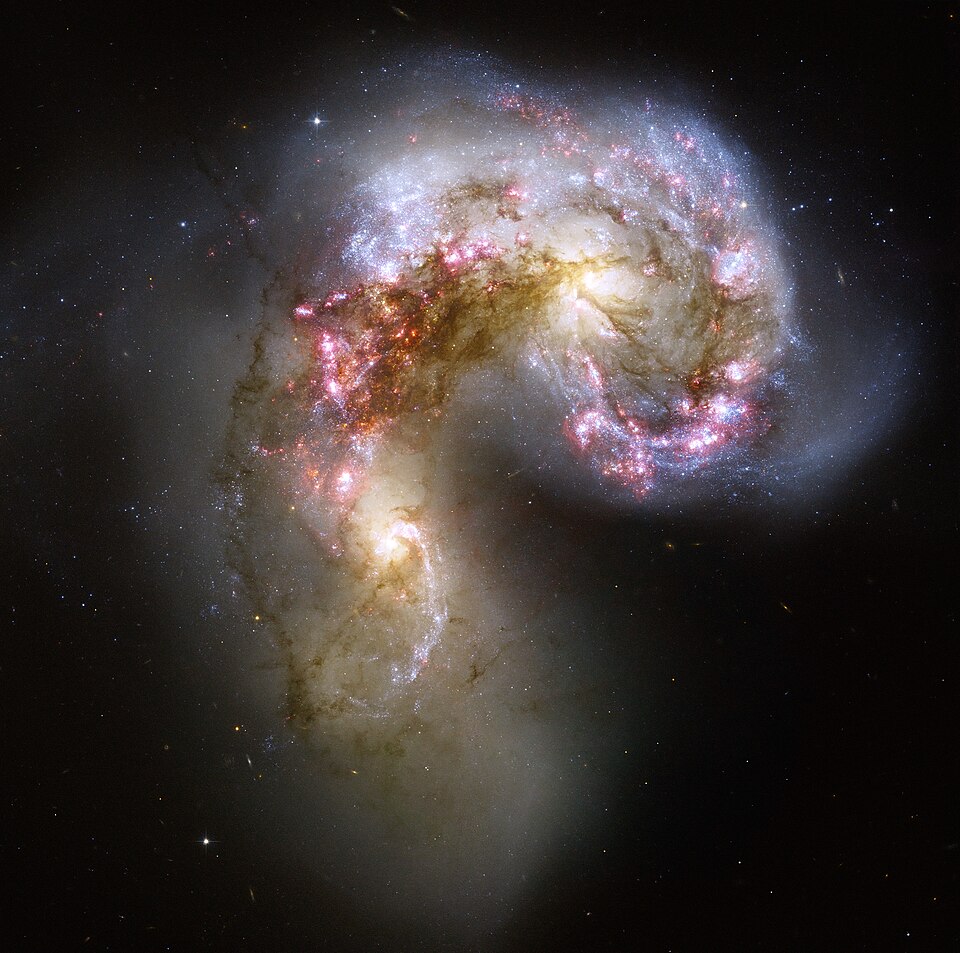
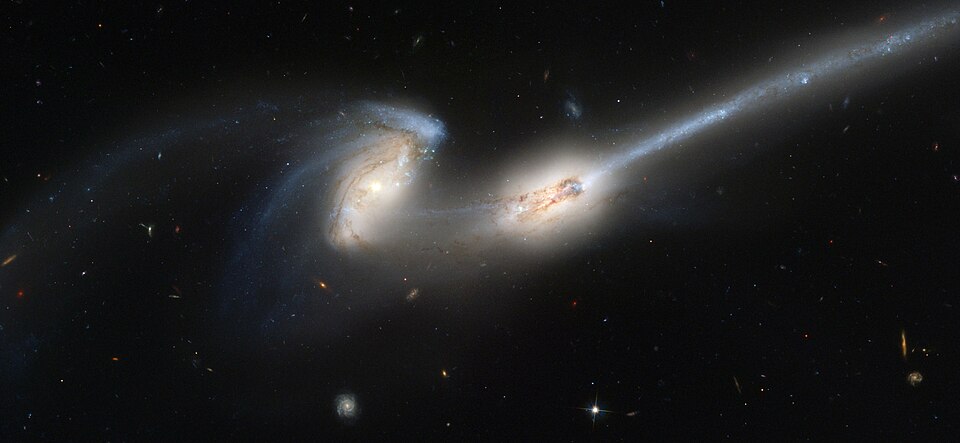
Mergers. When two galaxies of similar size collide, the individual stars almost never hit one another — they are far too widely spaced — but gravity throws them onto new orbits, and the gas clouds do collide, compressing and igniting intense starbursts. The tidal tails of the Antennae Galaxies are stars slung out in this way. After a billion years or so the two discs have been scrambled into a single spheroid: an elliptical galaxy. Large galaxies also grow by swallowing many small ones; the Milky Way is currently digesting the Sagittarius dwarf galaxy, and streams of its stars wrap around our halo.
Quenching. A galaxy forms stars only while it has cold gas. Gas can run out, be blown away by supernovae or by the galaxy's central black hole, or be stripped by the hot gas of a cluster as the galaxy falls through it. Once quenched, a galaxy reddens as its blue massive stars die, and it drifts from the "blue cloud" of star-forming galaxies to the "red sequence" of dead ones. The universe's overall star-formation rate peaked about 10 billion years ago and has been declining ever since; most of the stars that will ever exist have already been born.
Environment. Where a galaxy lives shapes what it becomes. Cluster cores are dominated by ellipticals and lenticulars, stripped and merged; spirals are found in the quieter outskirts and in loose groups. Isolated galaxies in the voids between filaments are mostly small, blue and still forming stars.
The Milky Way's own future is written in this: a merger with Andromeda, a burst of star formation, and finally a quiet red elliptical — provisionally named "Milkomeda" — settling into old age.


The Milky Way
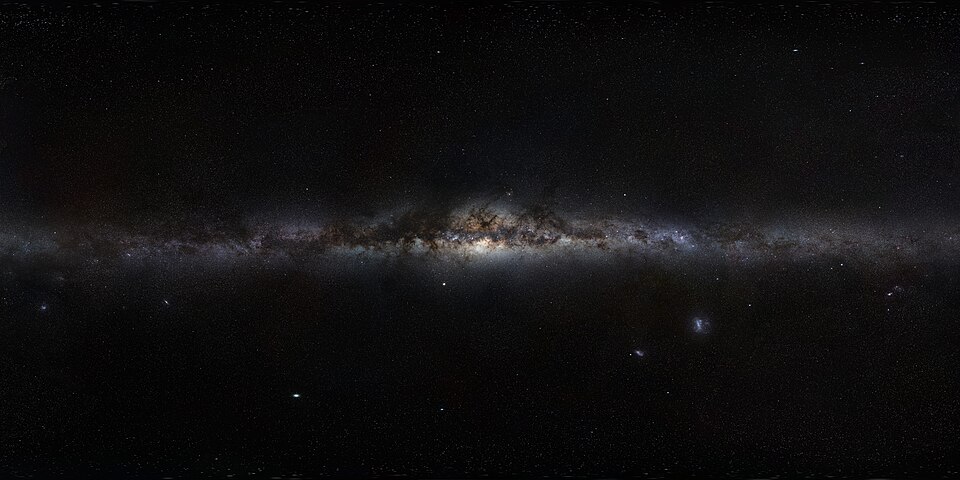
We see our galaxy from inside, as a band of light across the summer sky — the combined glow of billions of distant stars in the disc, cut by dark lanes of dust. Mapping it has been like mapping a forest from beneath the trees, and the modern picture owes much to radio and infrared surveys that penetrate the dust and to the Gaia spacecraft, which has measured precise positions and motions for nearly two billion stars.
The Milky Way is a barred spiral about 100,000 light-years across, with four major arms and a thin disc roughly 1,000 light-years thick. The Sun lies in the Orion Spur, a minor arm segment, about 26,000 light-years from the centre and slightly above the mid-plane — a good vantage point, out of the worst of the dust. At the centre is a dense bulge of old stars, a bar, and the 4-million-solar-mass black hole Sagittarius A*. Around the whole thing is a sparse halo of ancient stars and about 150 globular clusters, spherical swarms of hundreds of thousands of stars that are among the oldest objects known, some 12–13 billion years old. Many Messier objects — M13, M22, M5 — are globulars.
The Milky Way belongs to the Local Group, a loose gathering of about 80 galaxies spanning 10 million light-years, dominated by itself and Andromeda, with Triangulum (M33) a distant third and everything else a dwarf. The Large and Small Magellanic Clouds, visible from the southern hemisphere, are the largest of our satellites.

Cepheid variables and the cosmic distance ladder
A Cepheid is a yellow supergiant, 4 to 20 times the Sun's mass, passing through a phase of its post-main-sequence life in which it pulsates: the whole star swells and shrinks, brightening and dimming with clockwork regularity every 1 to 100 days. The mechanism is a valve of ionised helium in the star's outer layers. When compressed, the layer absorbs more light and heats, pushing the star outward; as the star expands the layer becomes transparent, the pressure releases, and gravity pulls the star back in. This oscillation is stable and self-sustaining while the star is in a narrow band of the H–R diagram called the instability strip.
In 1908–1912 Henrietta Swan Leavitt, studying Cepheids in the Small Magellanic Cloud at Harvard, discovered that the brighter a Cepheid, the longer its period. Since all the stars in the Cloud are at essentially the same distance, this had to be a relation between period and true luminosity — the period–luminosity relation, now called the Leavitt law. Its significance is hard to overstate. Measure a Cepheid's period, and you know how luminous it is. Compare that with how bright it appears, and you know how far away it is.
Cepheids were the tool that Edwin Hubble used in 1924 to show that the "spiral nebula" in Andromeda was an entire galaxy far outside the Milky Way, and in 1929 to show that galaxies recede from us at speeds proportional to their distance — the expanding universe. Today they remain the critical middle rung of the distance ladder: parallax calibrates nearby Cepheids, Cepheids calibrate the distances to galaxies hosting Type Ia supernovae, and those supernovae reach across the observable universe. The Hubble Space Telescope was designed with Cepheids in mind, and the current disagreement between Cepheid-based measurements of the expansion rate and those from the early universe — the "Hubble tension" — is one of the liveliest problems in cosmology.
The prototype, Delta Cephei, varies between magnitudes 3.5 and 4.4 every 5.37 days and is easy to follow with the naked eye. Polaris, the North Star, is a low-amplitude Cepheid too.
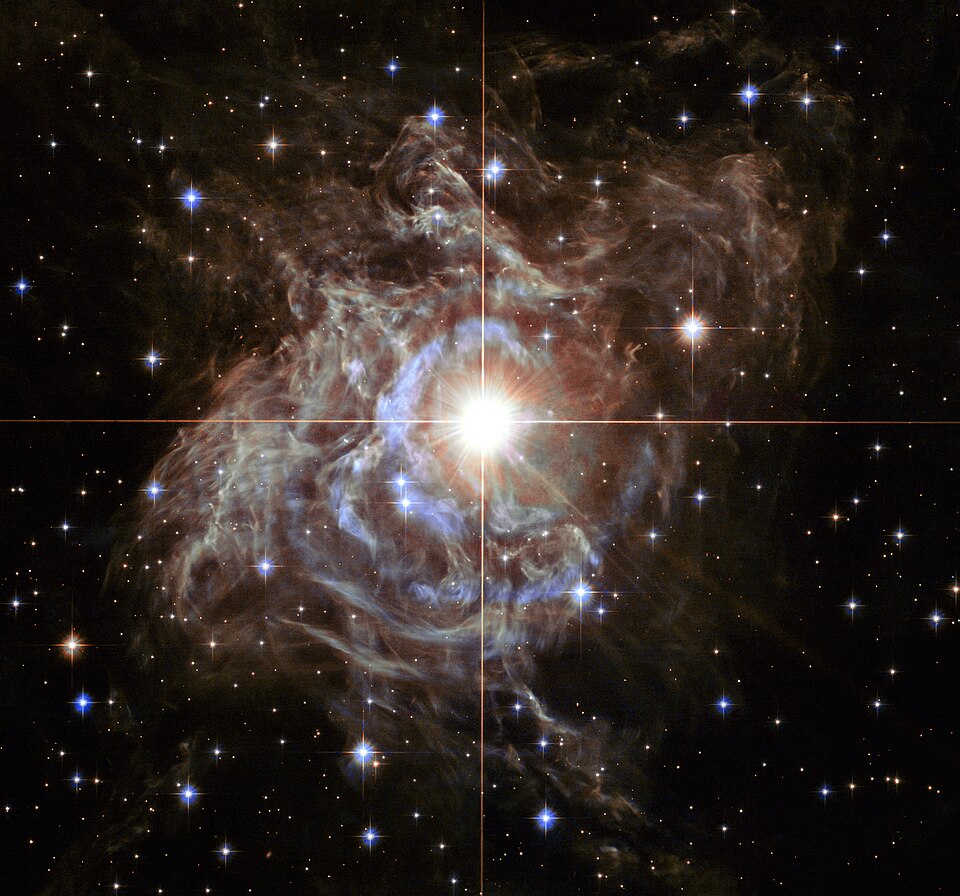

Longer period, brighter star. The light curve shows the characteristic quick rise and slow decline; luminosity follows the Leavitt law.
The expanding universe
In 1929 Hubble, using Cepheid distances and the spectra measured by Vesto Slipher, showed that galaxies' light is shifted to the red — they are receding — and that the farther a galaxy is, the faster it recedes. Georges Lemaître had reached the same conclusion two years earlier from Einstein's equations. The relation, velocity = H₀ × distance, is the Hubble–Lemaître law, and its meaning is that space itself is expanding: the galaxies are not flying through space so much as being carried apart by it, like raisins in a rising loaf.
Run the expansion backwards and everything converges 13.8 billion years ago in a hot, dense state — the Big Bang. The theory makes specific predictions that have all been confirmed: the cosmic microwave background, discovered in 1965 as a faint glow of 2.7 K filling the sky from every direction; the abundances of helium, deuterium and lithium, forged in the first three minutes; and the growth of structure from the tiny ripples in that background into the galaxies we see.
Gravity should slow the expansion. In 1998 two teams measuring Type Ia supernovae in distant galaxies found the opposite: the expansion is speeding up. Something is pushing space apart, and it has been named dark energy. Its simplest form is Einstein's cosmological constant, an energy inherent to space itself. It now makes up about 68% of the energy content of the universe, and it will dominate ever more as expansion dilutes the matter. The universe's fate, on current evidence, is to expand forever, growing colder, darker and emptier.
The current value of H₀ is disputed. Measurements built on the Cepheid distance ladder give about 73 km/s per megaparsec; those inferred from the cosmic microwave background give about 67. The gap is far larger than the stated uncertainties and may be pointing to new physics.

Large-scale structure: the cosmic web
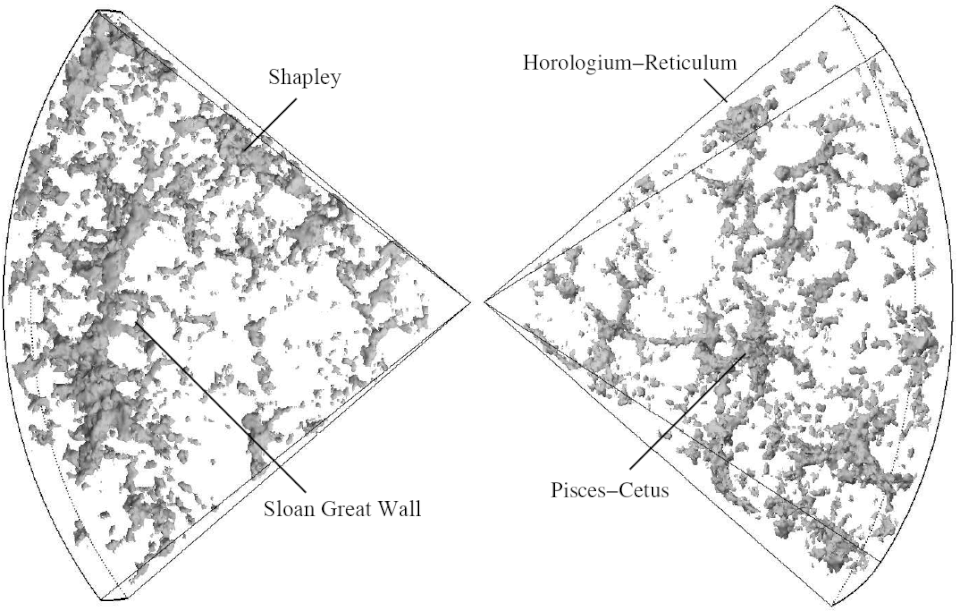
Galaxies are not scattered evenly through space. Surveys that measure the redshifts of millions of galaxies — the 2dF survey, the Sloan Digital Sky Survey, and now DESI — reveal that they are arranged in a pattern like a sponge or a foam: long filaments and flat sheets of galaxies surrounding enormous nearly empty voids, with dense clusters where the filaments meet. This is the cosmic web, and it is the largest structure in the universe.
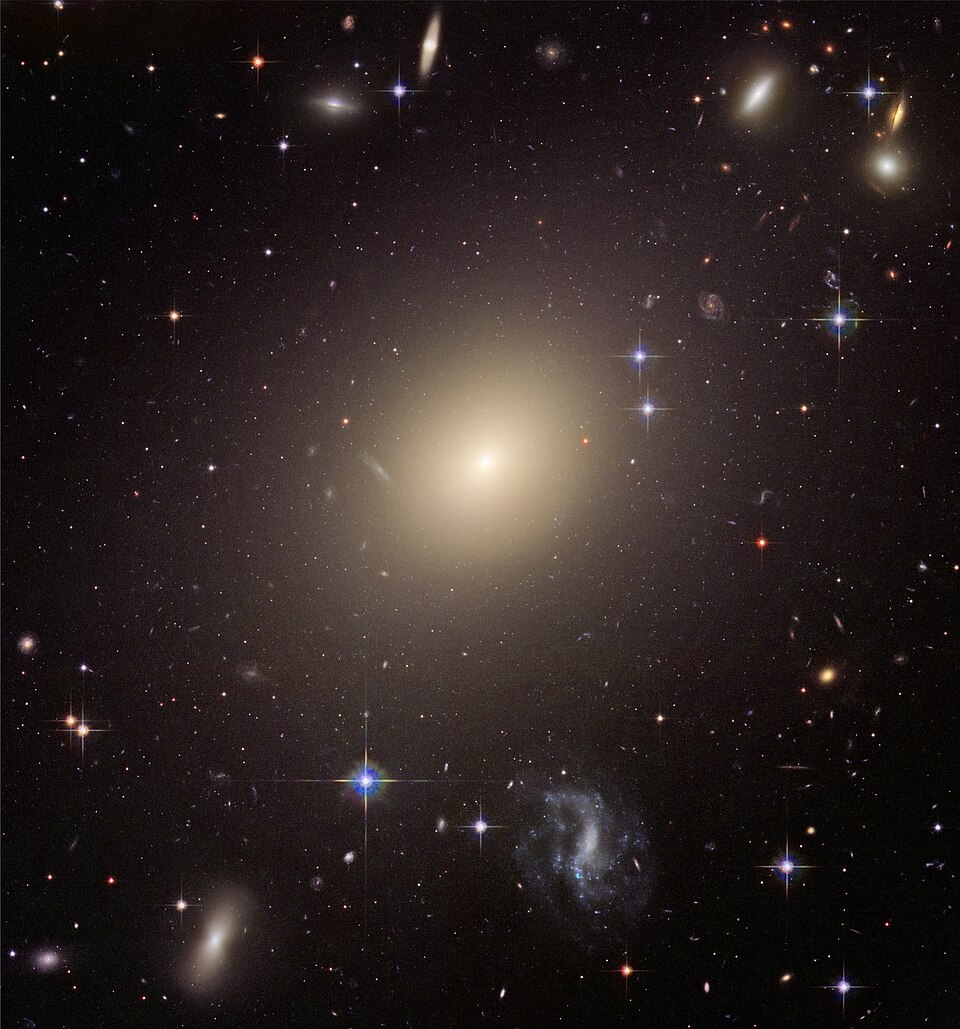
The hierarchy runs like this. Galaxies gather in groups of a few dozen (like our Local Group) and clusters of hundreds to thousands, spanning 10–30 million light-years and filled with hot X-ray-emitting gas; the Virgo Cluster, 55 million light-years away, is the nearest large one. Clusters and groups link into superclusters hundreds of millions of light-years long; the Local Group lies on the outskirts of the Virgo Supercluster, which is itself a lobe of the far larger Laniakea Supercluster identified in 2014. Between the filaments are voids 100–300 million light-years across containing almost nothing. Beyond about 300 million light-years the universe finally looks the same in every direction and every place — statistically homogeneous, as the Big Bang model requires.
The web is what gravity makes out of nearly uniform matter. Computer simulations that start from the ripples in the cosmic microwave background and let gravity act on cold dark matter for 13.8 billion years reproduce it in detail: the slight overdensities pull in matter, empty the regions around them into voids, and channel infalling material along filaments into the nodes that become clusters. Galaxies form where the dark matter is densest; the pattern of light traces the pattern of unseen mass. The remarkable thing is how few ingredients this needs — dark matter, ordinary matter, dark energy, and general relativity — to produce a universe that looks like ours.
Looking back out. The dwarf planets of the Kuiper belt, the Sun's nuclear furnace, the Cepheids that gave us the distance to Andromeda, the dark matter halos that hold galaxies together, and the filaments that string those galaxies across the sky are all governed by the same handful of laws acting on different scales of time and size. That continuity, from the pebbles that built Arrokoth to the cosmic web, is the whole point of looking outward — and of studying it.


Now bring it back to the eyepiece. The gallery holds images of many of these objects taken from a backyard telescope.
Image credits
- Andromeda Galaxy, M31 (page header) — Adam Evans. CC BY 2.0. Source
- Whirlpool Galaxy, M51 (Hubble) — NASA/ESA/S. Beckwith/Hubble Heritage. Public Domain. Source
- Lenticular galaxy NGC 5866 (Hubble) — NASA/ESA/Hubble Heritage. Public Domain. Source
- Elliptical galaxy IC 2006 (Hubble) — ESA/Hubble & NASA, J. Schmidt, J. Blakeslee. Public Domain. Source
- Antennae Galaxies, NGC 4038/4039 (Hubble) — NASA/ESA/Hubble Heritage. Public Domain. Source
- Fornax dwarf galaxy — ESO/Digitized Sky Survey 2. CC BY 4.0. Source
- Hubble eXtreme Deep Field — NASA/ESA/G. Illingworth et al. Public Domain. Source
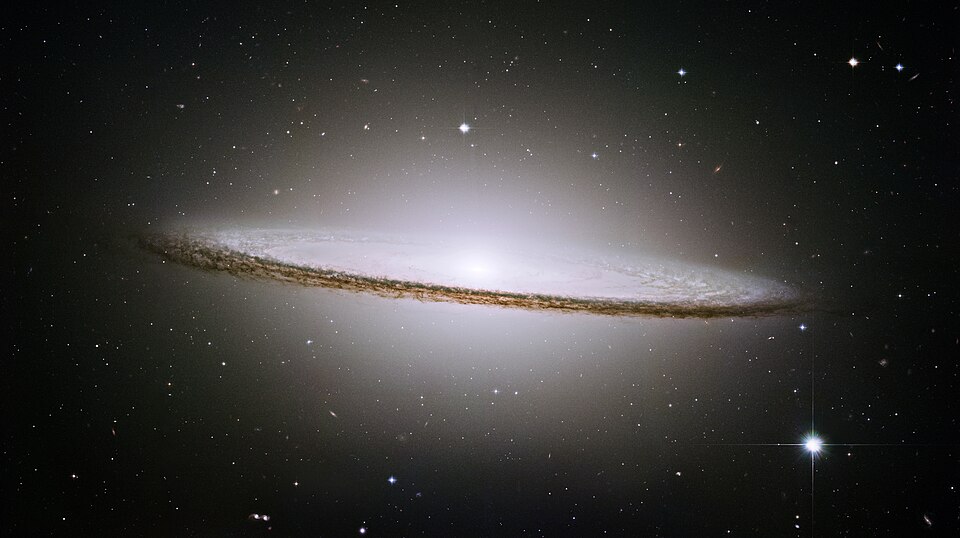
- Sombrero Galaxy, M104 (Hubble) — NASA/ESA/Hubble Heritage. Public Domain. Source
- Hoag's Object (Hubble) — NASA/Hubble Heritage. Public Domain. Source
- The Mice, NGC 4676 (Hubble) — NASA/ESA/H. Ford et al. Public Domain. Source
- Milky Way panorama — ESO/S. Brunier. CC BY 4.0. Source
- Cepheid variable RS Puppis (Hubble) — NASA/ESA/Hubble Heritage. Public Domain. Source
- Cosmic microwave background (WMAP) — NASA/WMAP Science Team. Public Domain. Source
- 2dF Galaxy Redshift Survey map — Willem Schaap. CC BY-SA 3.0. Source
- Galaxy cluster Abell S740 (Hubble) — NASA/ESA/Hubble Heritage. Public Domain. Source