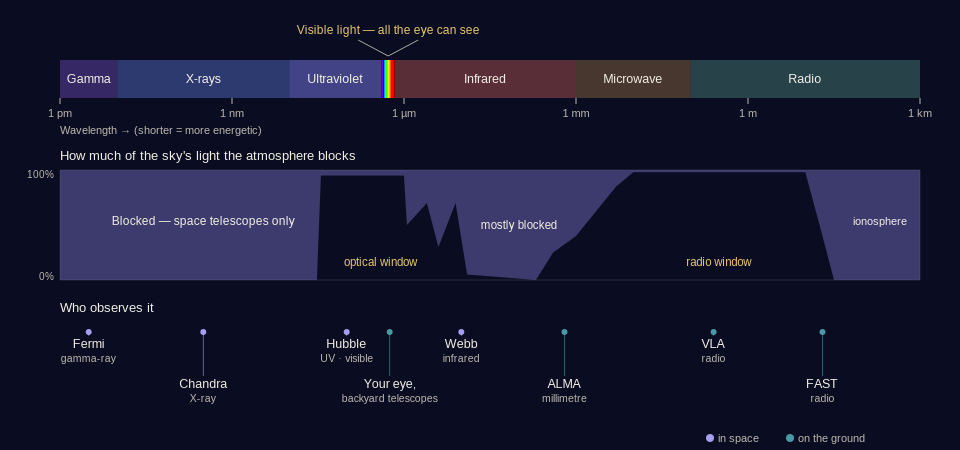
The electromagnetic spectrum
Light is a wave of electric and magnetic fields, and visible light is only a sliver of a much wider family. All of it travels at the same speed — about 300,000 km per second — but the wavelength can be anything from a trillionth of a metre to kilometres. Shorter waves carry more energy. In order of increasing wavelength, the family runs from gamma rays and X-rays through ultraviolet, the narrow band of visible light, infrared, microwaves and finally radio waves.
Each band shows a different universe. Gamma rays and X-rays come from the most violent places — gas spiralling into black holes, the shock waves of supernovae, the million-degree corona of the Sun. Ultraviolet picks out the hottest young stars. Visible light shows us stars and the glowing gas around them. Infrared sees warm dust, cool stars and planets, and peers through dust clouds that hide newborn stars; it also catches the light of the most distant galaxies, stretched to longer wavelengths by the expansion of the universe. Millimetre and radio waves trace cold gas, the 21-centimetre glow of hydrogen atoms, pulsars, and the faint afterglow of the Big Bang itself.
Our atmosphere lets only some of this through. Two "windows" reach the ground: the optical window, roughly from the near ultraviolet to the near infrared, and the much wider radio window. Water vapour absorbs most of the infrared, which is why infrared and millimetre observatories are built on high, dry mountains and deserts. Gamma rays, X-rays and most ultraviolet light never reach the surface at all — fortunately for life — so those parts of the sky can be studied only from space.
Reading starlight: spectra and spectroscopy
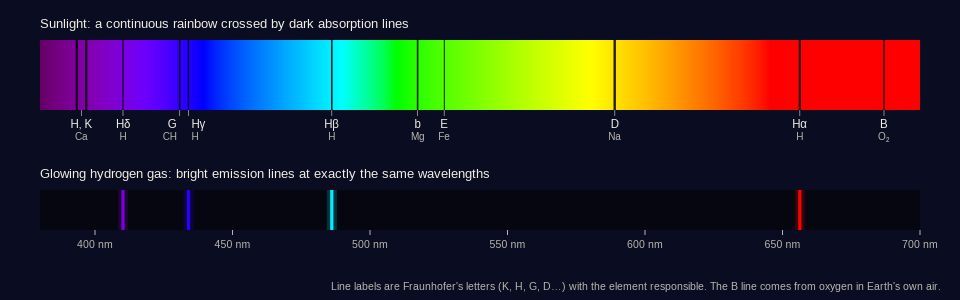
A picture shows where light comes from. Spreading the light into its colours — a spectrum — shows what made it. In 1814 Joseph von Fraunhofer noticed hundreds of fine dark lines crossing the Sun's spectrum. In 1859 Gustav Kirchhoff and Robert Bunsen worked out what they were: every chemical element, when heated, glows at its own set of precise wavelengths, and absorbs light at exactly the same wavelengths when cooler gas lies in front of a hotter source. The dark lines in sunlight are the fingerprints of hydrogen, sodium, calcium, iron and dozens of other elements in the Sun's outer layers.
That simple idea made astrophysics possible. From a star's spectrum astronomers can read:
- Composition — which elements are present, and in what amounts.
- Temperature — from the overall colour and from which lines are strong; this is the basis of the O-B-A-F-G-K-M classes on the Stars page.
- Motion — the Doppler shift moves every line slightly toward the blue for an object approaching us and toward the red for one receding. It reveals orbiting binary stars, the rotation of galaxies, planets tugging on their stars, and the expansion of the universe.
- Pressure, magnetism and more — from the width and splitting of the lines.
Nebulae show the reverse pattern. Thin glowing gas produces bright emission lines on a dark background: the deep red of hydrogen-alpha that colours the Orion Nebula, and the green-blue of doubly ionised oxygen in planetary nebulae such as the Ring.
These wavelengths are also why narrowband filters for astrophotography are named "H-alpha", "OIII" and so on: each passes just one emission line and blocks almost everything else, including most light pollution.
The spectrograph
A spectrograph captures spectra. Light from the telescope passes through a narrow slit, is spread out by a prism or, more usually, a diffraction grating — a surface ruled with thousands of fine grooves per millimetre — and is recorded by a camera. Professional spectrographs can measure a star's motion to within a metre per second, precise enough to detect the wobble caused by an orbiting planet. Some instruments record thousands of spectra at once, with optical fibres or tiny robotically positioned mirrors placed on each target; surveys built this way have mapped the motions and chemistry of millions of stars and galaxies. Amateurs take spectra too, with an inexpensive grating that screws into the eyepiece holder like a filter.
Optical telescopes
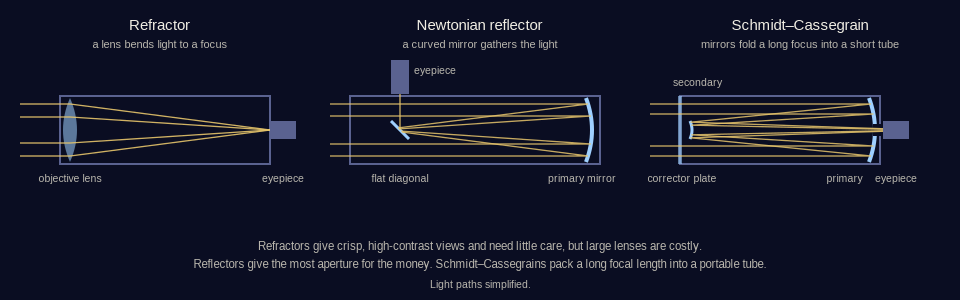
A telescope does two jobs. Its main lens or mirror gathers far more light than the eye's pupil, revealing objects too faint to see unaided; and it forms a magnified image that an eyepiece or camera can examine. The size of that main lens or mirror — the aperture — matters more than anything else. Almost every design is a variation on one of three ideas.
Refractors
Galileo's telescope of 1609 used lenses, and so do today's refractors. A simple lens bends different colours by different amounts, which fringes bright objects with colour; modern achromatic and apochromatic ("apo") refractors combine two to four lens elements of special glass to cancel it. Refractors are sealed, need almost no adjustment and give sharp, high-contrast images, making them favourites for wide-field astrophotography. Large lenses are expensive and heavy, though; the biggest ever built, at Yerkes Observatory in 1897, is 102 cm across.
Reflectors
Isaac Newton replaced the lens with a curved mirror in 1668. Mirrors reflect all colours equally and can be supported from behind, so they can be made far larger. A Newtonian reflector on a simple rocking base — the Dobsonian — offers the most aperture for the money and is the classic choice for viewing faint deep-sky objects. Every large research telescope is a reflector.
Catadioptrics
These combine a mirror with a thin correcting lens. The Schmidt–Cassegrain and Maksutov–Cassegrain fold a long light path into a short tube, giving the long focal length that suits planets and the Moon in a portable package. They are popular all-rounders on motorised "go-to" mounts.
Giant telescopes
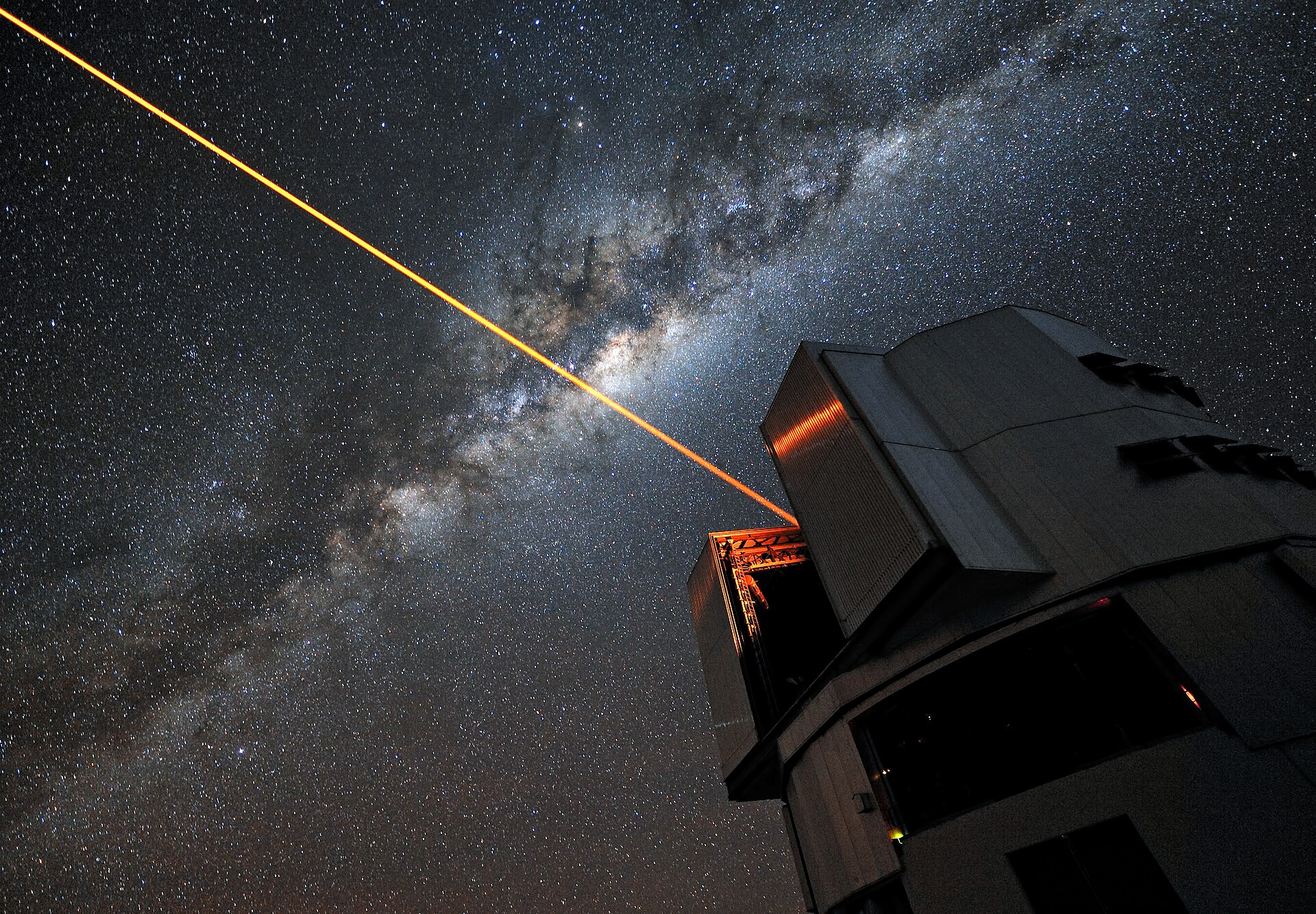
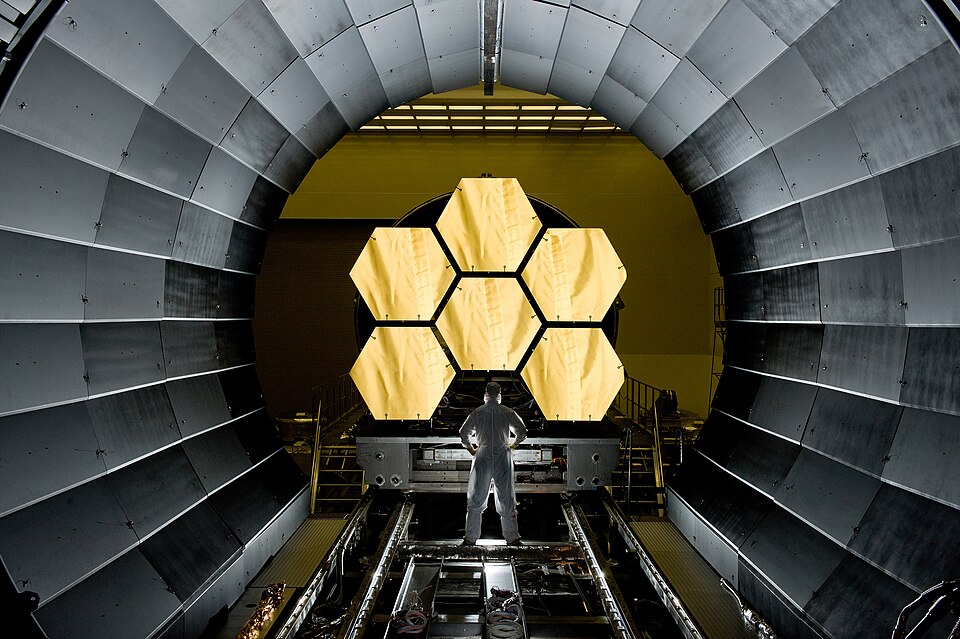
Single mirrors become impossibly heavy beyond about 8 metres, so the largest telescopes use mirrors made of many hexagonal segments held in shape by computer-controlled actuators. The twin Keck telescopes on Mauna Kea have 10-metre mirrors of 36 segments; the Extremely Large Telescope under construction in Chile will have a 39-metre mirror of 798. To beat the blurring of the atmosphere they use adaptive optics: a laser excites sodium atoms 90 km up to make an artificial "guide star", and a deformable mirror changes shape hundreds of times a second to cancel the twinkling.
Smart telescopes
A recent arrival combines a small apochromatic refractor, a camera, a motorised mount and a computer in a single unit controlled from a phone. It finds its own position by recognising star patterns, then stacks many short exposures into an image that builds up in real time. The deep-sky photographs in this site's Gallery were taken this way, with a Vaonis Vespera Classic.

Cameras and other instruments
For three centuries the detector was the human eye, which takes in light for only about a tenth of a second at a time. Photographic plates, from the 1880s, could build up exposures for hours and revealed objects no eye had ever seen. Since the 1980s electronic sensors — first CCDs, now mostly CMOS chips like those in phone cameras — have taken over. They record most of the photons that strike them rather than the 1–2% a photographic plate managed, and their output is numbers that can be measured, combined and processed.
- Imaging cameras are often monochrome, with colour images made by combining exposures through red, green and blue filters, or through narrowband filters that isolate single emission lines such as hydrogen-alpha and oxygen III. Professional cameras are cooled, sometimes with liquid nitrogen, to suppress electronic noise.
- Photometers measure brightness precisely over time. The tiny dimming as a planet crosses its star — often less than 1% — is how the Kepler and TESS missions found thousands of exoplanets.
- Spectrographs, described above, spread light into spectra.
- Polarimeters measure how light waves are aligned, revealing magnetic fields and dust.
- Coronagraphs block the light of a bright object — the Sun's disc, or a star — to reveal the faint corona, or planets and dust discs around other stars.
- Interferometers combine light from separate telescopes so they act together like a single instrument as wide as the distance between them, giving far finer detail than any one alone.
Radio telescopes
Radio astronomy began by accident. In 1932 Karl Jansky, an engineer at Bell Telephone Laboratories tracking down static that interfered with radio telephones, found a faint hiss that rose and set with the stars — radio waves from the centre of the Milky Way.
A radio telescope is usually a large dish that reflects radio waves to a receiver at its focus. Because radio wavelengths are so long, a dish must be huge to see fine detail: the resolution of a telescope depends on its width measured in wavelengths, and a 100-metre dish observing 21-centimetre waves sees detail about ten times coarser than the unaided eye. The largest single dish, China's FAST, is 500 metres across, set into a natural hollow in the karst landscape of Guizhou.
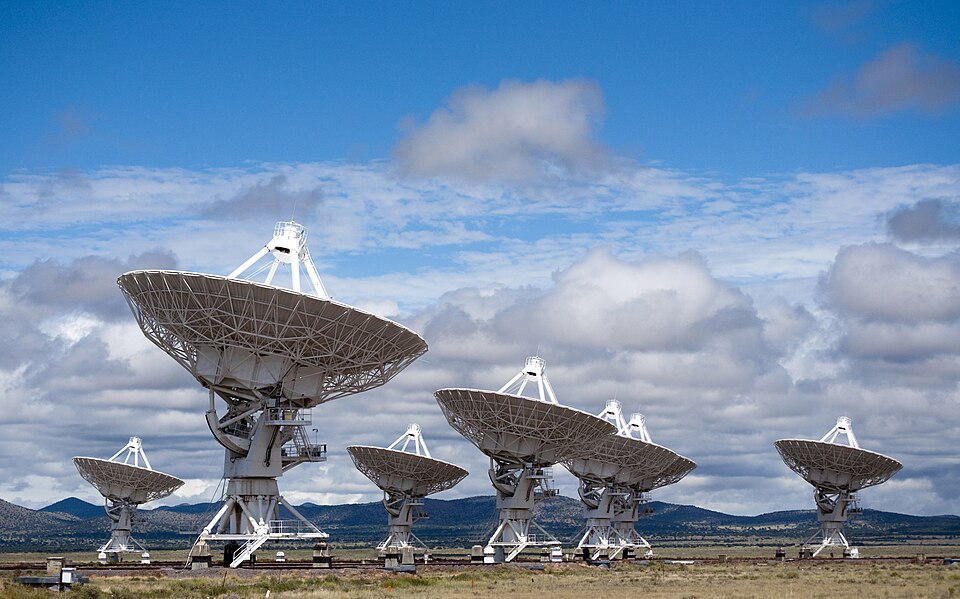
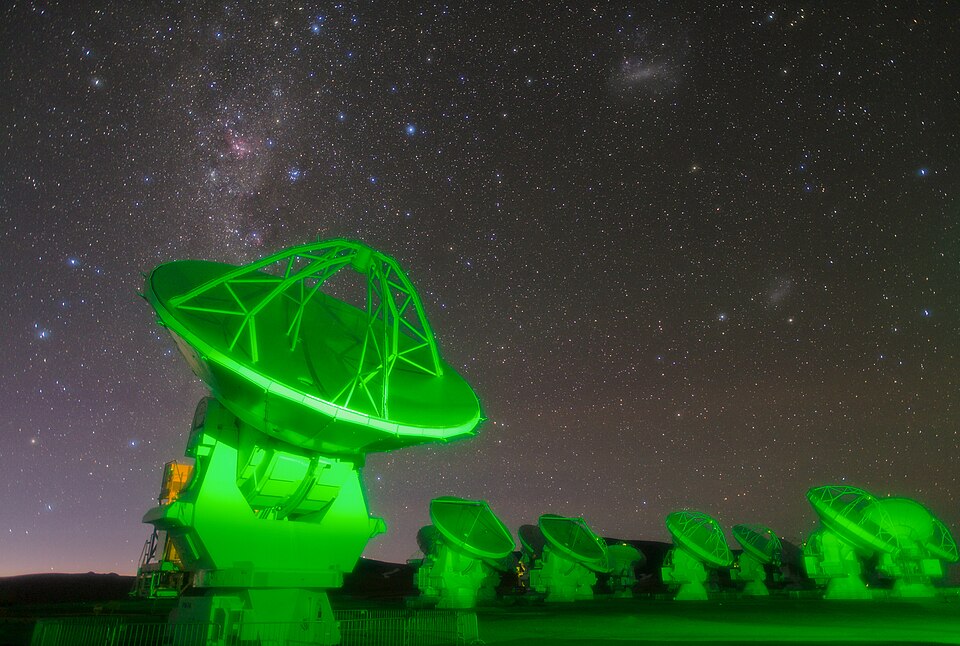
The solution is interferometry: many dishes spread over a wide area, their signals combined by computer to act like one telescope as large as the whole array. The Very Large Array in New Mexico has 27 dishes on Y-shaped tracks up to 36 km across. ALMA, on a 5,000-metre plateau in Chile's Atacama Desert, links 66 antennas to study the cold gas and dust where stars and planets form. Link dishes across continents and the "telescope" becomes the size of the Earth: in 2019 the Event Horizon Telescope used this technique to produce the first image of a black hole's shadow.
Radio telescopes discovered pulsars, quasars and the cosmic microwave background, and they map the cold hydrogen that fills galaxies using its 21-cm emission line. Because they do not need darkness, they work around the clock — though they need protection from radio interference, so many are built in remote "radio quiet" zones.


Solar telescopes
Safety first: never look at the Sun through any telescope, binoculars or camera without a certified solar filter covering the front of the instrument. Permanent eye damage can happen in a fraction of a second.
The Sun is the one star we can study in detail, and its problem is the opposite of every other target: too much light. Solar telescopes are built to reject most of it and to cope with the heat.
- White-light filters, made of special film or coated glass, fit over the front of an ordinary telescope and pass about one part in 100,000 of the light. They show sunspots, faculae and the granulation of the photosphere.
- Hydrogen-alpha telescopes pass a band of light less than 0.1 nm wide centred on the deep-red 656.3 nm line. That reveals the chromosphere: prominences arching off the edge, filaments, plage and flares. Calcium-K filters, at 393.4 nm, show the chromosphere's magnetic network in violet.
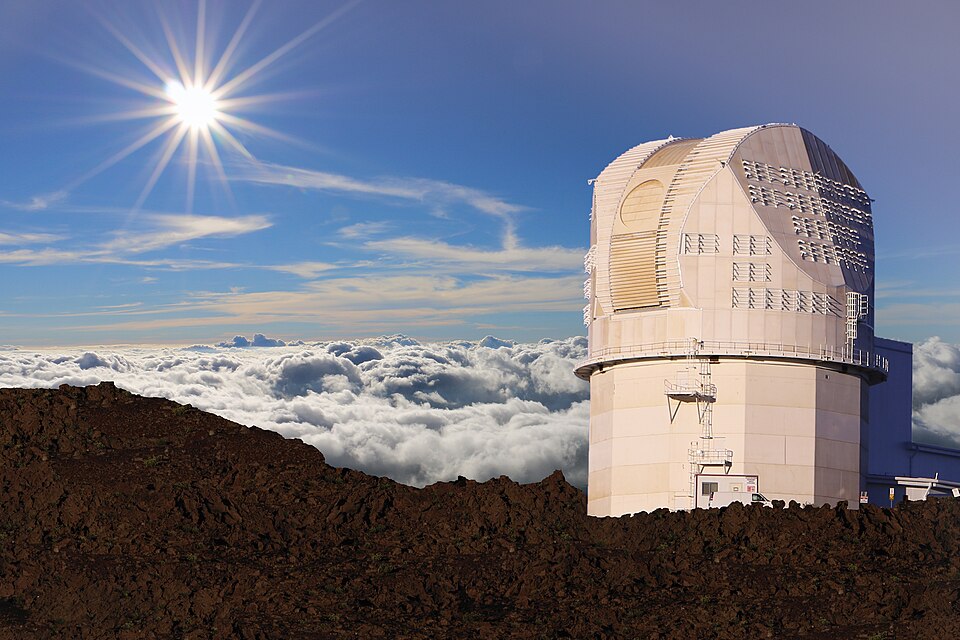
- Large research instruments such as the 4-metre Daniel K. Inouye Solar Telescope on Haleakalā, Hawaii, resolve features on the Sun as small as about 20 km. Spacecraft watch continuously from space: SOHO and the Solar Dynamics Observatory image the Sun in ultraviolet light the atmosphere blocks, and Parker Solar Probe flies through the corona itself.
See The Sun for what these telescopes show.

Telescopes in space
Above the atmosphere a telescope escapes both its absorption and its turbulence. Stars no longer twinkle, the sky is dark even in daylight, and the whole spectrum is open.
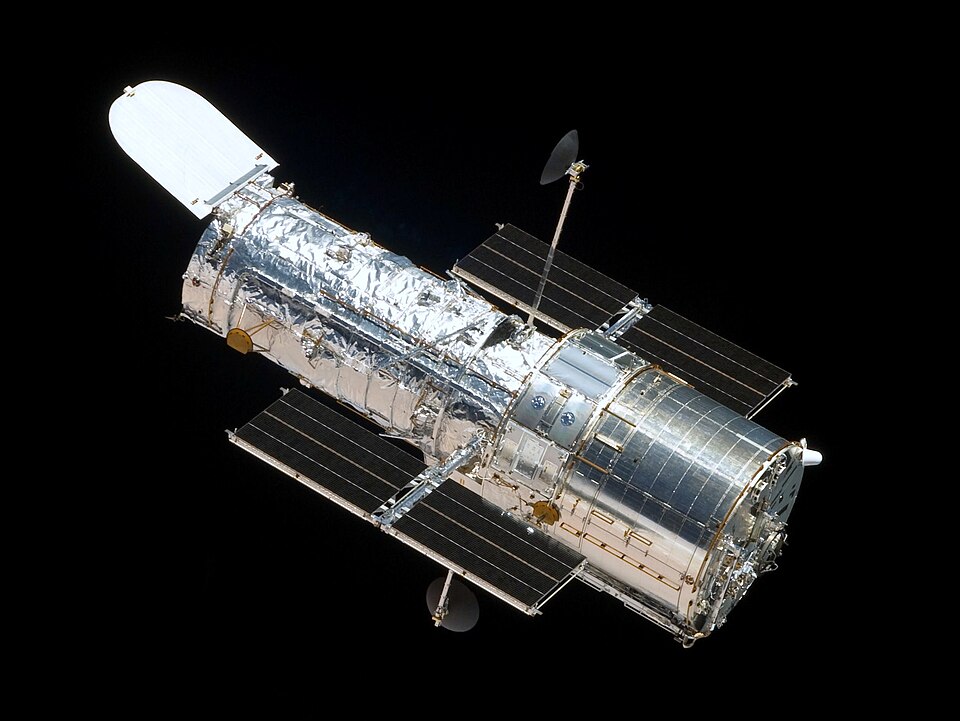
- The Hubble Space Telescope, launched in 1990 with a 2.4-metre mirror, observes in ultraviolet, visible and near-infrared light from low Earth orbit. Astronauts repaired and upgraded it on five servicing missions.
- The James Webb Space Telescope, launched in 2021, has a 6.5-metre mirror of 18 gold-coated beryllium segments and works in the infrared. It orbits 1.5 million km from Earth, shielded from the Sun by a tennis-court-sized sunshade that keeps it at about −230 °C, cold enough not to be blinded by its own heat.
- Chandra observes X-rays with nested mirrors that the rays strike at grazing angles, like stones skipping on water; ordinary mirrors would simply absorb them. Fermi detects gamma rays, which cannot be focused at all and are tracked particle by particle.
- Gaia has measured the positions, distances and motions of nearly two billion stars (see proper motion).


Beyond light
Light is no longer the only messenger.
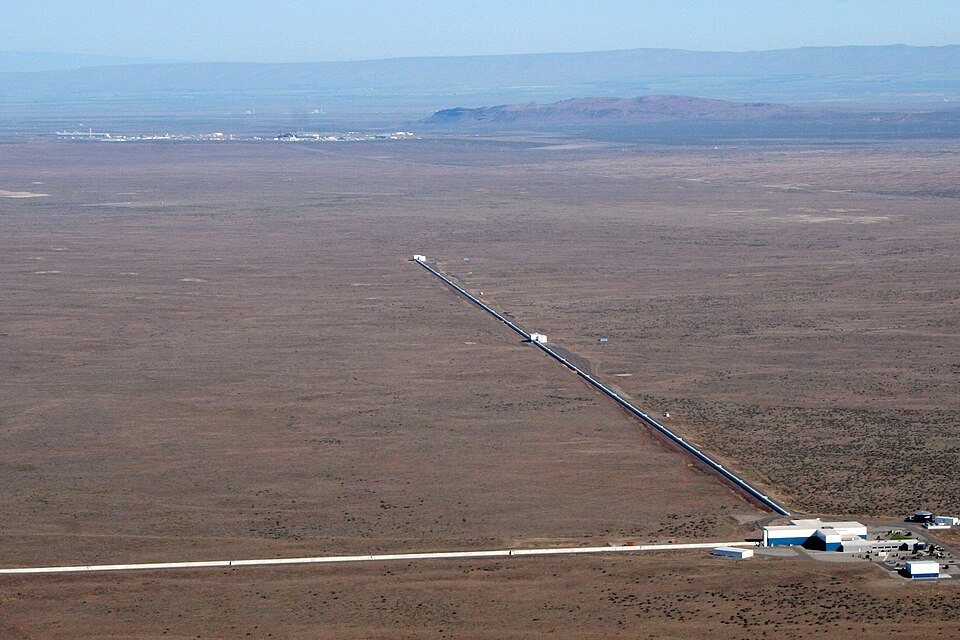
Gravitational waves are ripples in space itself, set off by colliding black holes and neutron stars. LIGO's two detectors, in Washington State and Louisiana, use lasers in L-shaped arms 4 km long to measure changes in length smaller than a thousandth of the width of a proton. They made the first detection in September 2015 — two black holes merging 1.3 billion light-years away — and in 2017 caught two neutron stars colliding, an event also seen by telescopes across the whole spectrum.
Neutrinos are ghostly particles that pass through the Earth almost unhindered. Huge detectors buried deep underground or in Antarctic ice catch a tiny fraction of them, and have seen neutrinos from the Sun's core, from Supernova 1987A and from distant galaxies.
Cosmic rays — atomic nuclei striking the atmosphere at nearly the speed of light — are recorded by arrays of detectors spread over thousands of square kilometres. And spacecraft visiting the planets, comets and asteroids collect samples and bring them home: the most direct observation of all.

Optics in practice: what the numbers mean
Telescopes are described by a handful of numbers. Each one affects what the instrument does well.
Aperture
The diameter of the main lens or mirror, and the most important number of all. Light-gathering power grows with the area, so doubling the aperture collects four times as much light. A 200 mm (8-inch) telescope collects about 800 times more light than a dark-adapted eye, whose pupil opens to about 7 mm, and shows stars roughly 7 magnitudes — over 600 times — fainter. Aperture also sets resolution.
Focal length
The distance from the lens or mirror to the point where it brings light to a focus. Long focal lengths give a large, magnified image of a small area of sky; short ones a smaller image of a wide area. A camera at the focus of a 200 mm lens and one behind a 2,000 mm telescope see the same sky, but the second shows a field ten times narrower in each direction.
Focal ratio
Focal length divided by aperture, written f/4, f/10 and so on. For photographing faint extended objects such as nebulae and galaxies, a "fast" low focal ratio builds up an image much more quickly: an f/4 system needs only about a sixth of the exposure time of an f/10 system for the same brightness per pixel. "Slow" high ratios suit high-magnification work on planets, double stars and the Moon.
Magnification
With an eyepiece, magnification is the telescope's focal length divided by the eyepiece's: a 1,200 mm telescope with a 25 mm eyepiece magnifies 48 times. Magnification is the least important number, and the one most often oversold. Above about twice the aperture in millimetres (50× per inch) the image just gets bigger and dimmer without showing more; in practice the steadiness of the air usually limits useful magnification to 250–300× however large the telescope.
Resolution
The finest detail a telescope can show, limited by the wave nature of light. A useful rule, Dawes' limit, says a telescope can just separate two equal stars about 116 ÷ aperture (mm) arcseconds apart: 2.3″ for a 50 mm telescope, 0.6″ for 200 mm. In practice atmospheric turbulence — astronomers call it seeing — smears images to between 1″ and 3″ on most nights, so large backyard telescopes rarely reach their theoretical limit.
Exit pupil
The width of the beam of light leaving the eyepiece: aperture divided by magnification. If it is wider than about 7 mm, some of the light misses the eye; if it is narrower than about 0.5 mm, the image becomes dim and floaters in the eye intrude. Faint, extended nebulae look best with a large exit pupil of 4–7 mm; planets with 0.5–1 mm.
Field of view
How much sky you see. Through an eyepiece, the true field is roughly the eyepiece's apparent field (often 50°–82°) divided by the magnification. On a camera, it is set by the sensor size and focal length. The full Moon is half a degree across; the Andromeda Galaxy spans about three degrees.
Image scale and the mount
For cameras, the image scale in arcseconds per pixel is 206 × pixel size (µm) ÷ focal length (mm). Matching it to the seeing — usually 1″–2″ per pixel — avoids wasting resolution or sensitivity. And none of it works without a steady mount. Simple altitude-azimuth mounts are fine for viewing; long-exposure photography needs a motorised mount that tracks the stars accurately as the Earth turns.
Telescope calculator
Choose an example or enter your own telescope and eyepiece.
- Focal ratio
- Magnification
- True field of view
- Exit pupil
- Useful magnification
- Resolution (Dawes)
- Light grasp vs. the eye
- Faintest stars (approx.)
The equations behind the calculator
These are the formulas the calculator uses, plus a few more that astrophotographers use for cameras. D is the aperture and F the telescope's focal length, both in millimetres; fe is the eyepiece focal length. The worked examples use an 8-inch Dobsonian (D = 203 mm, F = 1,200 mm) with a 25 mm, 52° eyepiece, and for the camera formulas the Vespera Classic (D = 50 mm, F = 200 mm, 2.9 µm pixels, 1920 × 1080 sensor).
| Quantity | Formula | Example |
|---|---|---|
| Focal ratio | N = F ÷ D | 1,200 ÷ 203 = f/5.9 |
| Magnification | M = F ÷ fe | 1,200 ÷ 25 = 48× |
| True field of view | TFOV ≈ apparent field ÷ M | 52° ÷ 48 = 1.08° |
| Exit pupil | D ÷ M (equivalently fe ÷ N) | 203 ÷ 48 = 4.2 mm |
| Highest useful magnification | ≈ 2 × D (in mm), but rarely above ~300× because of seeing | 2 × 203 = 406× |
| Lowest useful magnification | ≈ D ÷ 7 (exit pupil of 7 mm) | 203 ÷ 7 = 29× |
| Resolution (Dawes' limit) | 116 ÷ D arcseconds | 116 ÷ 203 = 0.57″ |
| Resolution (Rayleigh criterion, green light) | 138 ÷ D arcseconds | 138 ÷ 203 = 0.68″ |
| Light grasp compared with the eye | (D ÷ 7)² | (203 ÷ 7)² = 841× |
| Faintest stars visible (approximate) | 7.5 + 5 × log₁₀(D in cm) | 7.5 + 5 × log₁₀(20.3) = magnitude 14.0 |
| Camera image scale | 206.265 × pixel size (µm) ÷ F arcseconds per pixel | 206.265 × 2.9 ÷ 200 = 3.0″ per pixel |
| Camera field of view | 57.3 × sensor width (mm) ÷ F degrees | 57.3 × 5.57 ÷ 200 = 1.6° (and 0.9° high) |
| Relative exposure time for extended objects | (N₁ ÷ N₂)² | f/10 vs f/4: (10 ÷ 4)² ≈ 6 times longer |
Where the constants come from: there are 206,265 arcseconds in a radian, which becomes 206.265 when the pixel size is in micrometres and the focal length in millimetres; 57.3 is the number of degrees in a radian. Dawes' 116 was found by experiment with pairs of equal stars; Rayleigh's 138 comes from the size of the diffraction pattern, 1.22 × wavelength ÷ aperture, for 550 nm light. The limiting-magnitude formula is a rule of thumb that assumes a dark sky and an experienced observer.
Matching the telescope to the target
No single telescope is best for everything. What matters most depends on what you want to see.
| Target | What matters most | Good choices | Focal ratio | Typical magnification |
|---|---|---|---|---|
| Moon and planets | Resolution, contrast and steady air; plenty of light already | Long focal length: refractors, Maksutovs, Schmidt–Cassegrains, larger Dobsonians | Slow, f/8–f/15; f/20 or more with a Barlow lens for planetary imaging | 100–300×, as the seeing allows |
| Double stars | Resolution — aperture sets the closest pair you can split | Any well-collimated telescope; refractors excel | Any; slower ratios (f/8 and up) are more forgiving of eyepiece quality | 100–300× |
| Faint galaxies and small nebulae | Aperture above all, and a dark sky | Large Dobsonians for viewing; for imaging, a fast focal ratio and long total exposure | Viewing: any — aperture matters more. Imaging: fast, f/2–f/5 | Low to medium, 50–150× |
| Large nebulae, star clusters, the Milky Way | Wide field of view | Short focal length: binoculars, small refractors, smart telescopes; narrowband filters for emission nebulae | Fast, f/4–f/6 | Low, 15–50×, with a large exit pupil |
| The Sun | A certified solar filter — always | White-light filter on any telescope; dedicated hydrogen-alpha telescope for prominences | Any; hydrogen-alpha telescopes typically f/7–f/10 | Low to medium |
| Comets | Wide field, with enough aperture for faint ones | Binoculars, rich-field refractors and reflectors | Fast, f/4–f/6 | Low |
Two things matter as much as the telescope. The first is the sky. Light pollution washes out faint galaxies and nebulae far more than it affects the Moon, planets and bright stars. The Bortle scale rates sky darkness from 1, a pristine desert sky, to 9, an inner-city sky; most suburban sites, including the one where this site's Gallery images were taken, fall around 5 to 7. Narrowband filters and stacking many short exposures help a great deal from such skies. The second is the observer. Eyes take 20–30 minutes in the dark to adapt fully, and a single glance at a white light undoes it, which is why astronomers use red torches. And faint detail often appears only with patience: looking slightly to one side of an object, a trick called averted vision, uses the more sensitive outer parts of the retina.
Image credits
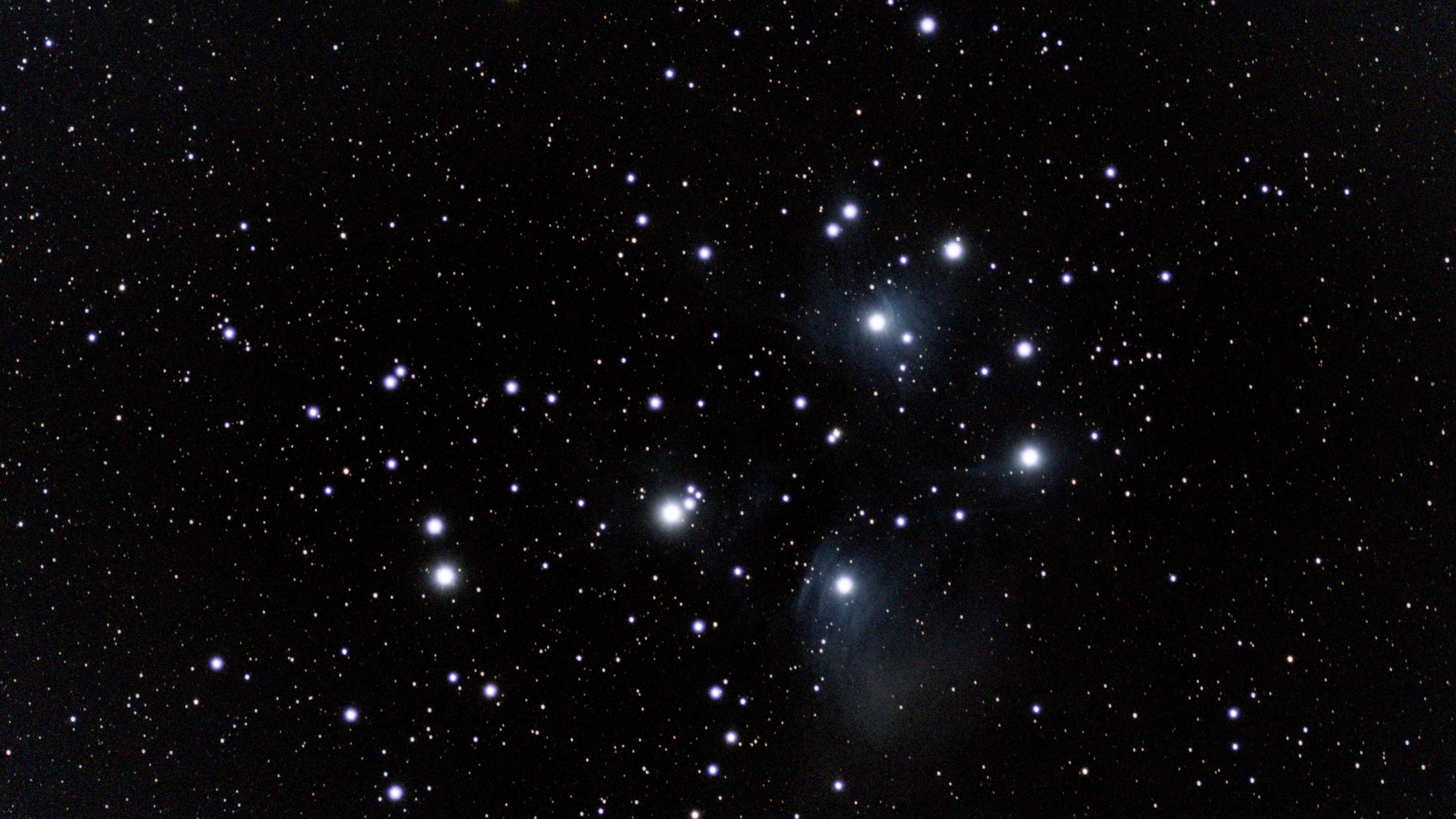
- The Pleiades, M45 (page header) — photographed by the site author from a Bortle 6 site in New Jersey with a Vaonis Vespera Classic smart telescope.
- Laser guide star at the Very Large Telescope — ESO/G. Hüdepohl. CC BY 4.0. Source
- Very Large Array, New Mexico — CGP Grey. CC BY 2.0. Source
- ALMA antennas on Chajnantor — ESO/B. Tafreshi. CC BY 4.0. Source
- Daniel K. Inouye Solar Telescope, Haleakalā — NSF/NSO/AURA. CC BY 4.0. Source
- Hubble Space Telescope (Servicing Mission 4) — NASA, STS-125 crew. Public Domain. Source
- James Webb Space Telescope primary mirror — NASA/MSFC/D. Higginbotham. Public Domain. Source
- LIGO Hanford Observatory — LIGO Laboratory. Public Domain. Source
- Diagrams — drawn for this site.