
The celestial sphere
The stars are at wildly different distances — the nearest a little over four light-years away, the faintest naked-eye stars thousands. But to the eye they all seem pinned to the inside of a great dome. Astronomers keep that illusion as a working tool: the celestial sphere, an imaginary sphere of unlimited size centred on the Earth, onto which every object is projected. Distance is set aside; what matters is direction.
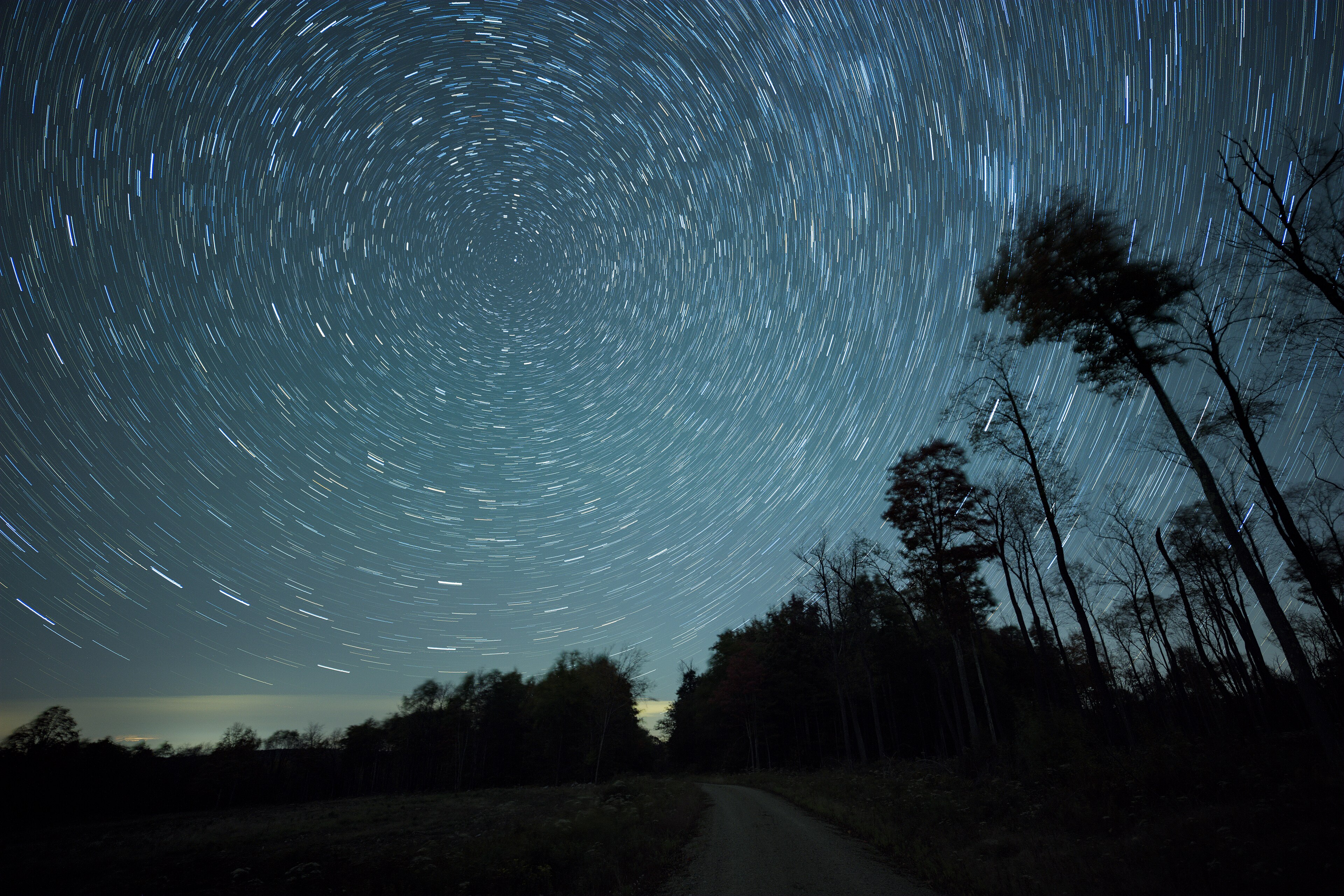
Extend the Earth's axis outward and it pierces the sphere at the north and south celestial poles. Extend the Earth's equator and it traces the celestial equator. Because the Earth spins, the whole sphere appears to turn around those poles once a day, carrying the stars from east to west.
Every coordinate system on this page works the same way as latitude and longitude on a globe: pick a reference circle, pick a starting point on it, then give two angles — one measured around the circle, one measured away from it. The systems differ only in which circle they choose.
An arcsecond is tiny — the width of a coin seen from about 4 km away. Many of the motions described below are measured in arcseconds per year or per century.
Altitude and azimuth: the sky from where you stand
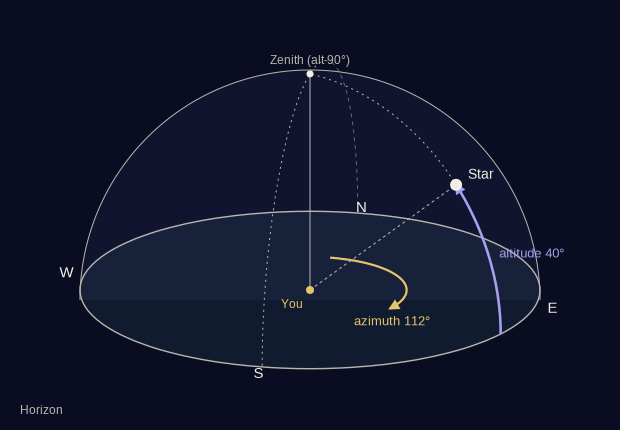
The simplest system uses your own horizon as the reference circle. Altitude is the angle of an object above the horizon, from 0° at the horizon to 90° at the zenith directly overhead. Azimuth is the compass direction, measured clockwise from north: 0° north, 90° east, 180° south, 270° west.
This is the system of everyday observing — "Jupiter is 30° up in the south-east" — and it is how most telescope mounts, including smart telescopes, physically point. The line running from due north through the zenith to due south is the meridian; an object is highest in the sky when it crosses it, which is why observers try to catch faint targets near the meridian, where they shine through the least atmosphere.
The catch is that altitude and azimuth belong to one place at one moment. As the Earth turns, every star's altitude and azimuth change continuously, and an observer in another town sees different numbers at the same instant. For a catalogue or a star chart, a coordinate system fixed to the sky itself is needed.
Right ascension and declination: addresses on the sky
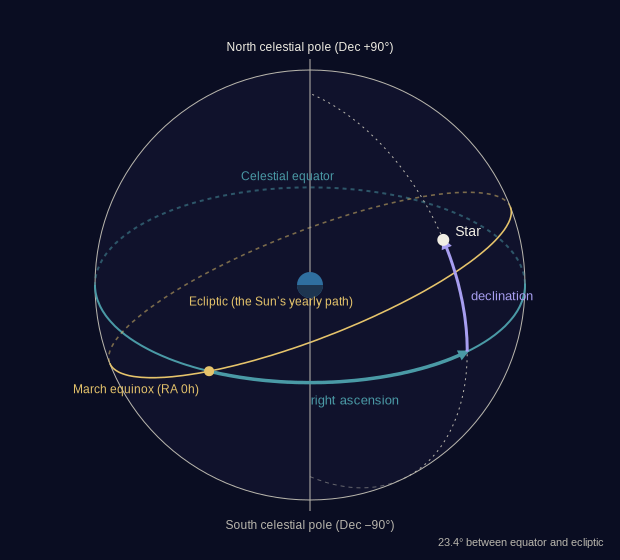
The equatorial system projects the Earth's latitude and longitude onto the sky, and it is the standard for star catalogues, charts and telescope "go-to" databases.
Declination (Dec) is celestial latitude: degrees north (+) or south (−) of the celestial equator, from +90° at the north celestial pole to −90° at the south. Polaris sits at about +89°; the Orion Nebula at about −5°.
Right ascension (RA) is celestial longitude, but it is counted in hours rather than degrees, from 0h to 24h, increasing eastward. One hour of RA equals 15°. The hours are a reminder of the sky's rotation: a star with an RA one hour greater than another crosses your meridian one hour later.
Longitude on Earth starts at Greenwich; right ascension starts at the March equinox point, sometimes called the First Point of Aries. That is where the Sun, moving along its yearly path, crosses the celestial equator heading north around 20 March. The Andromeda Galaxy, for example, sits at RA 0h 43m, Dec +41° 16′ — about three-quarters of an hour east of that point and 41 degrees north of the equator.
Because these coordinates are tied to the Earth's axis and not to any observer, they are the same for everyone, everywhere, all night long. Almost. As the rest of this page explains, the axis itself drifts, so every catalogue position has to state the date — the epoch — for which it is valid.
The revolving Earth and sidereal time
The Earth turns once relative to the stars in 23 hours 56 minutes 4 seconds — a sidereal day. Our 24-hour solar day is about four minutes longer, because while the Earth spins it also moves a little way along its orbit, and has to turn slightly further to bring the Sun back to the meridian. The result: every star rises about four minutes earlier each night, two hours earlier each month, and the evening sky cycles through the constellations over a year.
Observatories keep a second clock running on sidereal time. Local sidereal time is simply the right ascension currently on your meridian. If the sidereal clock reads 5h 35m, the Orion Nebula (RA 5h 35m) is due south and at its highest. Convert between RA/Dec and altitude/azimuth using your latitude and the sidereal time, and a go-to mount knows where to point.
Your latitude also decides which stars you see. The north celestial pole stands above your northern horizon at an altitude equal to your latitude — about 40° from New Jersey. Stars within 40° of the pole never set; they are circumpolar, wheeling around Polaris all night, as in the star trails at the top of this page. Stars within 40° of the south pole never rise at all. From the equator, every star rises and sets; from the North Pole, only the northern half of the sky is ever visible, and it never sets.
Finding Polaris. Follow the two stars at the end of the Big Dipper's bowl, Merak and Dubhe, about five times their separation. Polaris is not especially bright, but it is the only star that does not move.
Two more systems: ecliptic and galactic
Ecliptic coordinates
The planets all orbit in nearly the same plane, so their paths across our sky stay close to the ecliptic, the Sun's yearly track. For the solar system it is natural to use the ecliptic as the reference circle. Ecliptic longitude is measured eastward along it from the March equinox, in degrees; ecliptic latitude north or south of it. The Sun's ecliptic latitude is zero by definition, and its longitude advances almost one degree a day. The band of sky within a few degrees of the ecliptic is the zodiac, covered on the Constellations page.
The ecliptic is tilted to the celestial equator by the obliquity — 23.44° today. That tilt is the Earth's axial tilt, and it is the reason we have seasons.
Galactic coordinates
For studying the Milky Way, the reference circle is the galaxy's own mid-plane. Galactic longitude (l) is measured from 0° in the direction of the galactic centre, in Sagittarius at RA 17h 46m, Dec −29°. Galactic latitude (b) runs from +90° at the north galactic pole, in Coma Berenices, to −90°.
In these coordinates the Milky Way is a horizontal band along b = 0°, star-forming regions and open clusters crowd near it, and globular clusters and distant galaxies scatter far above and below it. Maps of the whole sky from missions such as Gaia and Planck are usually drawn this way. See the Milky Way section for the structure behind it.
Precession: the wobbling axis
Around 130 BC the Greek astronomer Hipparchus compared his own star positions with those recorded about 150 years earlier and found that they had all shifted by about two degrees in the same direction. He had discovered the precession of the equinoxes, the slowest and largest of the sky's motions.
The Earth is not a perfect sphere. Its spin makes it bulge at the equator, which is about 43 km wider than the distance between the poles. The Sun and Moon pull on that bulge, trying to straighten the tilted Earth up. A spinning top answers a sideways pull by wobbling instead of falling, and the Earth does the same: its axis sweeps out a cone, keeping its 23.4° tilt but changing the direction it points.
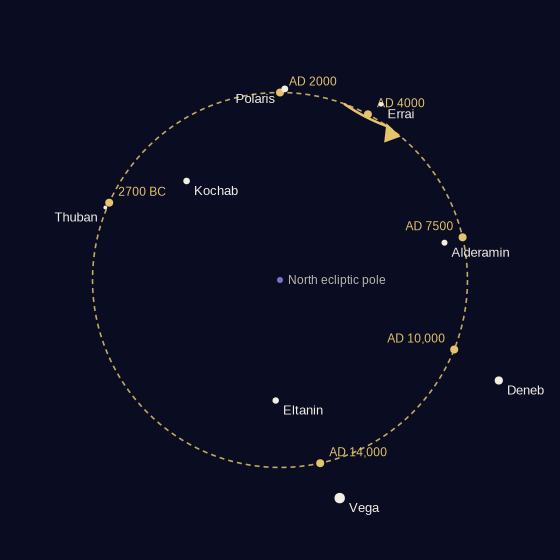
One circuit takes about 25,800 years. The celestial poles therefore trace slow circles among the stars, and the "pole star" changes over the ages:
- Thuban, in Draco, was the pole star when the Egyptian pyramids were built, around 2700 BC.
- Polaris is the pole star now, and is still getting closer. It will pass within about 0.45° of the pole around AD 2100, then begin to drift away.
- The pole will pass near Errai around AD 4000, Alderamin around AD 7500 and Deneb around AD 10,000, and will come within a few degrees of brilliant Vega around AD 14,000.
Precession also drags the equinox points westward along the ecliptic, by about 50 arcseconds a year — one degree every 72 years. Since right ascension and ecliptic longitude are both counted from the March equinox, every star's catalogued coordinates slowly change. That is why positions are quoted for a standard epoch, today usually J2000.0 (noon on 1 January 2000), and why planetarium software "precesses" them to the date of observation. A star chart printed in 1950 is already off by more than half a degree in places.
The March equinox point lay in the constellation Aries when the system was named over 2,000 years ago — hence "First Point of Aries". Precession carried it into Pisces in the first century BC, and it will cross into Aquarius around AD 2600.
Nutation: a nod on top of the wobble
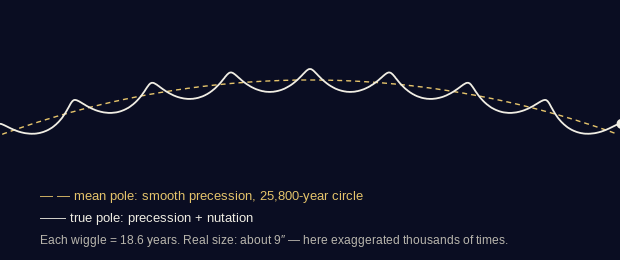
Precession would be a smooth circle if the pulls of the Sun and Moon were steady. They are not. The Moon's orbit is tilted about 5° to the ecliptic, and that tilted orbit itself slowly swivels around, completing a turn every 18.6 years. As it does, the Moon's grip on the Earth's bulge strengthens and weakens, and the axis nods back and forth as it precesses. This is nutation, from the Latin for "nodding".
The main nutation shifts the pole by up to about 9 arcseconds in the tilt direction and 17 arcseconds along the ecliptic — about a quarter of the apparent width of Jupiter. Smaller ripples follow the Sun's half-yearly and the Moon's fortnightly changes of position.
It was discovered by the English astronomer James Bradley, who noticed from 1727 onward that stars were drifting by small amounts his other corrections could not explain. He tracked them for a full 18.6-year lunar cycle before announcing the result in 1748.
Nutation is far too small to matter at the eyepiece, but professional catalogues, spacecraft navigation and the precise pointing of radio telescopes all correct for it. A position that includes precession and nutation is called a "true" position, as opposed to a "mean" one that includes precession alone.
Not the same thing: the Earth's axial tilt also varies slowly between about 22.1° and 24.5° over a 41,000-year cycle, one of the Milankovitch cycles that pace the ice ages. It is decreasing now, by about half an arcsecond a year.
Proper motion: the stars are not fixed
Precession and nutation move the coordinate grid; the stars themselves stay put relative to one another. But they are not truly fixed. Every star is orbiting the centre of the Milky Way, as the Sun is, and each has its own velocity relative to us. The sideways part of that motion, seen as a slow drift across the sky, is its proper motion.
In 1718 Edmond Halley compared modern positions of Sirius, Arcturus and Aldebaran with those recorded by Ptolemy 1,500 years earlier and found that they had shifted — Arcturus by about a degree, twice the width of the full Moon — far beyond any error in the old records. The "fixed stars" were moving.
Proper motions are tiny: most naked-eye stars shift by a small fraction of an arcsecond a year. The record holder is Barnard's Star, a faint red dwarf six light-years away in Ophiuchus, which crosses 10.4 arcseconds a year and covers the width of the full Moon in about 175 years. Arcturus, among the brightest stars, moves 2.3 arcseconds a year.
Proper motion is an angle; to turn it into a speed you need the distance. A star at 1 parsec (3.26 light-years) moving 1 arcsecond a year has a sideways speed of 4.74 km/s, and the numbers scale in proportion. Combine that with the radial velocity measured from the Doppler shift of the star's spectrum, and you have its full motion through space. Barnard's Star, for example, is approaching us at about 110 km/s and will pass within about 3.8 light-years of the Sun around AD 11,800.
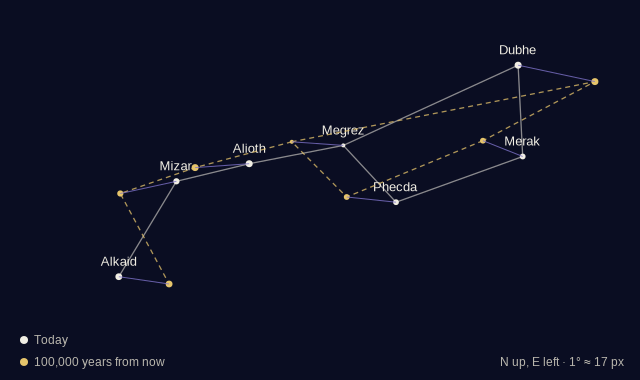
Given enough time, proper motion reshapes the constellations. Five of the seven Big Dipper stars belong to the Ursa Major Moving Group, a loose family about 80 light-years away travelling together through space. The two ends of the Dipper, Dubhe and Alkaid, are not members and are heading the other way, so the familiar shape is slowly coming apart.
The European Space Agency's Gaia spacecraft has measured proper motions for some 1.8 billion stars, for bright ones with a precision of a few hundredths of a thousandth of an arcsecond per year. With those measurements astronomers can run the Milky Way's clock backward and forward, tracing star streams torn from swallowed dwarf galaxies and families of stars born together long ago.
| Star | Proper motion | Distance |
|---|---|---|
| Barnard's Star | 10.4″ / yr | 6 ly |
| Kapteyn's Star | 8.6″ / yr | 13 ly |
| 61 Cygni | 5.3″ / yr | 11 ly |
| Alpha Centauri | 3.7″ / yr | 4.4 ly |
| Arcturus | 2.3″ / yr | 37 ly |
| Sirius | 1.3″ / yr | 8.6 ly |
| Typical bright star | < 0.1″ / yr | hundreds of ly |
Other small shifts
A few more effects move a star's apparent position, each discovered as instruments improved. Together with precession, nutation and proper motion, these are the corrections that turn a catalogue position into the exact spot where a telescope must point.
| Effect | Cause | Size | Timescale |
|---|---|---|---|
| Precession | Sun and Moon pull on the Earth's equatorial bulge | 50″ per year; 47° circle | 25,800 years |
| Nutation | The Moon's tilted orbit swivels, varying its pull | Up to ~9″ (tilt), ~17″ (longitude) | 18.6 years, plus shorter ripples |
| Aberration | The Earth's orbital speed (30 km/s) tilts incoming starlight, like rain on a moving car's windscreen; found by Bradley in 1727 | Up to 20.5″ | 1 year |
| Parallax | Viewing nearby stars from opposite sides of the Earth's orbit; first measured by Bessel for 61 Cygni in 1838 | Under 1″ — 0.77″ for Proxima Centauri | 1 year |
| Proper motion | The star's own motion through space | Up to 10.4″ per year | Accumulates steadily |
| Atmospheric refraction | Air bends light, lifting objects near the horizon | About 0.5° at the horizon; zero at the zenith | Varies with altitude and weather |
Refraction is the one you can see for yourself: when the Sun's lower edge appears to touch the horizon at sunset, the whole Sun is already geometrically below it. Parallax is the most important for astronomy — it was the first direct measurement of the distance to a star, and it is still the foundation of the cosmic distance ladder described on the Galaxies page.
Now see how the constellations sit on this grid, and how they change through the year. Continue to the constellations and the seasons.
Image credits
- Star trails around the north celestial pole, Pennsylvania (page header) — Tyler Savitski. CC BY-SA 4.0. Source
- Diagrams — drawn for this site; the precession and Big Dipper charts are computed from Hipparcos catalogue positions and proper motions.